(Note to picky readers: Please pardon the less than professional photography. I had the devil of a time with shaky-cam after dozens and dozens of attempts just to get the few good shots. I’m a crocheter, not a shootist!)
OK, so that was a trick question. There is nothing essentially wrong going on with that crochet swatch. Although most readers and comment-leavers are totally correct in assessing the yarn used in this swatch as having a final S-twist, most have also assumed that this is a bad piece of crochet. 
Not so fast there, cowgirl. Compare that previous image to this one:
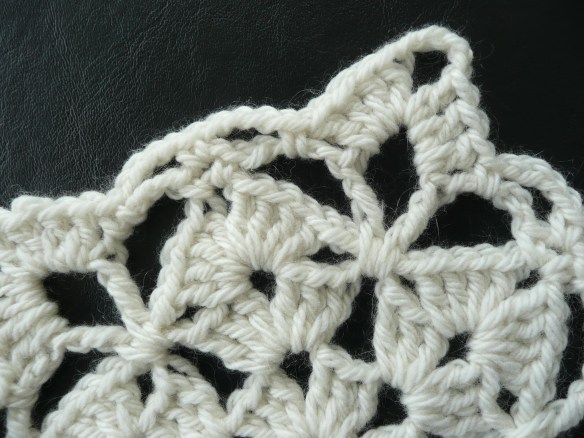 The same piece, but blocked. From how crappy the stitches look in the before image, you thought this might be cheapo yarn. Definitely not. This is a DK blend of 75% New Zealand Merino wool and 30% cashmere (Zealana Willow) that retails for around $15 a 50g skein. As a participant in a program that provides knit and crochet examples for new yarns that will be on display at TNNA in a couple of weeks (an exhibit aptly named the Great Wall of Yarn), I was given this yarn on which to work some crochet magic.
So how do I evaluate a yarn that’s new to me? First impression is important. Here’s Zealana Willow in the skein: Immediately you can see it is finished with S-twist. Upon closer inspection (peeling apart one end of a strand) I discovered that it is composed of three plies, three Z spun singles. This construction is fairly unique in my experience. The hand of the yarn in the skein is wonderfully soft, but not completely squishy. By adding cashmere to the fiber content, by doing the plies as singles, then finishing with a looser S-twist, they have created softness and airiness, avoiding any density that can happen with wool. The surface appearance is not totally matte; there is a nice reflective quality that some might call a sheen. I’m willing to wager that Willow knits up beautifully. My task is to make it sing in crochet.
How do I know this is a DK weight yarn? Just because it says “Double Knit Weight” right on the ball band does not automatically mean it works to DK gauge. Do you see the difference? This is an imported brand and does not give the CYCA category for DK weight. These little ball band symbols are the current accepted standards for classifying weights for hand yarn. Some manufacturers, brands and distributors label their yarn by weight alone (in manufacturing it would appear as yards per pound, YPP). In other words, if a yarn falls within a certain range of YPP, then it is put in that class. But yardage weight alone does not tell the whole story; we need to consider other factors such as density, diameter, texture, elasticity and eventual finish of the fiber. That makes a total difference in how the yarn will work in knit and crochet, in your hands and in your fabric.
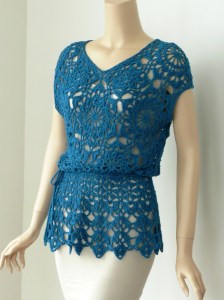
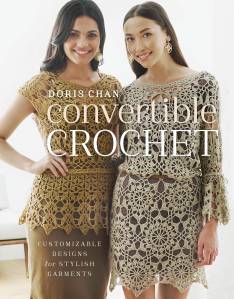
Lucky for me Zealana Willow is indeed DK, perhaps on the light side of DK, at 148 yards per 50g skein, and a knitting gauge of 22 stitches per four inches. With a design for DK wool yarn (Zodiac in Filatura di Crosa Zara) already in place in my book, Convertible Crochet, I chose to work one of those featured motifs for the swatch. My first trial, using the same hook size, H/8 (5mm), was a Copernicus Minor Pent:
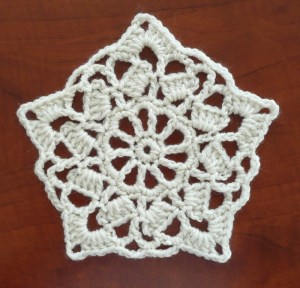 This is the full motif, finished and blocked. Before blocking I did not notice any serious issues with the S-twist, and honestly the yarn seemed happy. The motif did not quite get the same gauge as listed for the sample yarn Zara in the Zodiac pattern; it came out a tiny bit smaller and the fabric did not have the luscious drape of the original design yarn Zara, but those facts were not at all a concern for this end purpose, so this is the sample I eventually submitted. What would happen, I mused, if I pushed this yarn farther? I went up a hook size to I/9 (5.5mm) and crocheted another motif, this time a Carina Minor Pent. That’s the one I asked you readers to examine.
What happened? Good news and bad news.
Good news. By exploding the gauge with the larger hook, the motif did reach the target diameter I was seeking and nicely matched the stated gauge for the design Zodiac; the resulting drape was, to my taste, improved. In person, you’d judge drape by feeling, fondling, hanging and otherwise playing with the fabric or swatch. Since readers here can’t touch the results, I tried to figure out a way for you to see the drape. I forgot to do this with the Copernicus version so that you could get a side by side comparison, but here is the look of the drape of the Carina motif:
 See how the motif bends by itself and hangs off my finger. Crochet fabric with lesser drape would stick out more and stand by itself like a potholder.
Bad news. The combination of this more relaxed tension with swapping out the motif style from Copernicus (more closed lace, with some stitches made into stitches, including rounds of solid single crochet) to Carina (more open lace, with no stitches made into stitches, the tops of tall stitches and the chain spaces are more exposed), exacerbates the twist issue. The S-twist is more visibly and obviously being untwisted, particularly in the exposed loops of the outer motif rounds.
Now, here’s the lesson: block your crochet. This sample became respectable with blocking for two reasons: finishing the fiber, finishing the stitching. I already surmised that the wool and cashmere fibers would change with blocking. Both fibers really need blocking to bring out their best (most prized) characteristics: softness, slight bulking up (fulling) of each strand, and the hint of halo we expect from cashmere. And I know for absolute certainty that lace crochet needs blocking to smooth out the stitches, to lock the stitches into place, to attenuate stitch definition, to achieve finished shape and dimensions and to create an overall professional appearance. All this you can see when you compare the before and after shots, huh?
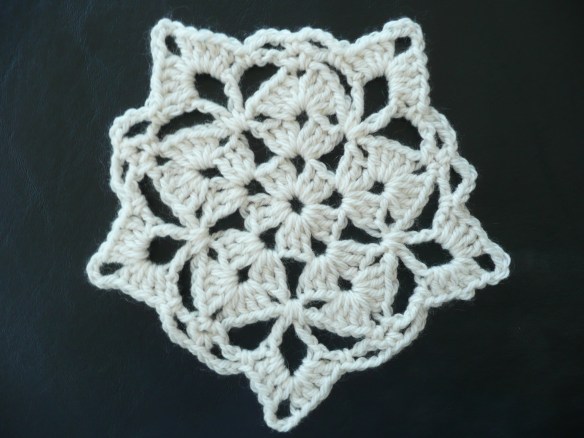
Blocking is your friend. It means pretty much the same thing as “hand wash, lay flat to dry”. I like to call it “wet and set”. I talk more about wet blocking on this page.
So I go through this kind of special agony each time I am presented with a new yarn. Often I am asked, as a professional crochet designer, what yarns I like to use. HA! Very rarely, as a professional designer, do I get the chance to actually use the yarns I like to use (I never choose the colors as published, BTW). More often I am compelled to design with yarns that suit the purposes of editors, advertisers and yarn companies for that particular magazine issue, or that specific season, as I just did with this TNNA assignment. Working each unfamiliar yarn so that it realizes its full potential in crochet, making sure the yarn is happy, but at the same time making myself and other crocheters happy… that’s what I do.
What happens when I am given the opportunity to use ANY YARN I WANT? I’ll talk about that next time.



 Doris Chan Crochet