Convertible Crochet: Zodiac Extra

In the course of crochet designing I create pieces of a certain class that never get published.  They are prototypes and practice runs, or in blunt terms, they are rejects. Some of these are never finished as full samples and acquire UFO status, see Rule #20. A few are alternate versions of published designs that for whatever reasons are not included with the pattern. And a few are personal garments that (assuming I can squeeze into them!) I wear at events where showing off your crochet is de rigueur. VKL NY January 2012 signing
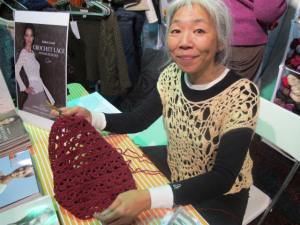
For the book Convertible Crochet I did a lot of extra crocheting just to figure out for myself how the constructions would work under varying circumstances. Like not getting gauge.  Like the neckline being too huge. Like the garment proportions not being human.  Like running out of yarn. The worst of the experiments became UFOs that you really don’t want to see or know about; make that I don’t want you to see or know about them.

But a few of the more attractive alternate versions can be enlightening for readers of Convertible Crochet and it’s these saved samples that I’d like to share with you as book extras.  Let’s look at  Zodiac as published:
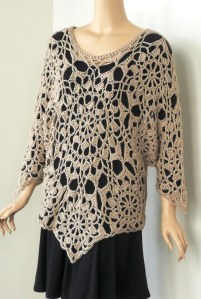
Zodiac

Zodiac

In the book, Zodiac is a relaxed fit tunic with octagons added for sleeves, crocheted in DK weight superwash wool, Filatura Di Crosa Zara.  Before this yarn was ordered, I began tinkering with an early prototype in a stash yarn, Blue Sky Alpacas Alpaca Silk.  Not only did this heavenly yarn NOT work to the target gauge, but there wasn’t enough on hand for the sleeves! Owing to the more delicate nature of this yarn, I knew I really shouldn’t rip out the completed body, so this stash remained tied up in a doomed prototype until much later, well after the book was written. Cobbling together any little scrap balls left from the main construction, I created bindings for the armholes in lieu of sleeves and I got a lovely long vest that I previewed in New York at Vogue Knitting Live, January 2012 (a year and a half before the book was published).
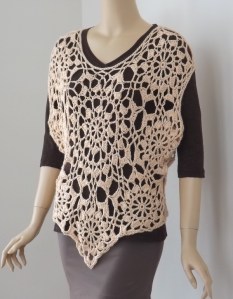
Zodiac Sleeveless

This version is crocheted as written for Zodiac, with just a few alterations. Knowing what happened here can help you deal with your own results.

The first issue is the gauge for this yarn. It is a touch finer and silkier than the design yarn, not as wooly, plump and rounded. So the motifs are just a fraction of an inch smaller than stated gauge. There is still plenty of room inside for a vest at this size, but it is slightly shorter in the body.

The major issue is that I ran out of yarn. With the four 50 g hanks on hand (about 580 yards) there wasn’t enough for two more big octagons for sleeves.  Here is the book sample laid out flat:
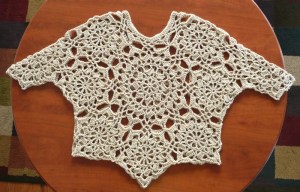
Zodiac flat

Because the tunic is designed to have a dolman sleeve shape, omitting the sleeve octs leaves huge droopy armholes.  I opted to finish the motif edges of the armhole with a binding using Foundation Single Crochet for the foundation, combined with a controlled type connecting round of chain spaces. To match at the neckline, I also worked the binding around the neck edge with Fsc (instead of the Fdc as written).

Zodiac Sleeveless flat

And here’s a tip that addresses one annoying problem with this design.  Zodiac lower sleeve is defined by the connecting of two octagon motif sides; the finished edge at the point of the sleeve is equal to the sum of two motif sides (10″) but the circumference at the connection is somewhat less (more like 8″).  Working gauges smaller than written will suddenly and inevitably result in non-human sleeve circumference.  If you find yourself in this situation where the sleeve bottoms are too tight for comfort, omitting the sleeves and binding the armholes as I did for this prototype is a brilliant way to rescue your project and have something wearable. Rule #3! VKL NY January 2012 at Knitty City BoothVKL NY January 2012 teaching

Enemy of Crochet

It’s still a mystery to me how this web stuff works.  What brings readers to this blog, what do you peruse while here and what can I do to lure you back?  No idea.  In the past week, one of my pages, Crochet Rules, has received extra attention.  I’m talking five times the usual views for a couple of days for no apparent reason.  This is puzzling but it’s welcome.  I add rules to the list every once in a while as they occur to me and I hope that readers check back to see them.

So today is one of those once in a whiles.

Crochet Rule #31: The sworn enemy of crochet, eclipsing all others for viciousness and cruelty (including coffee, hot irons and the CEO of the US division of Clover), is Velcro.

Need I say more?  🙂

Can I Crochet With This Yarn?

Well, darlin’, even though the label clearly states “hand knitting yarn”, the short and sweet but hardly perfect answer is, yes, you can crochet with anything that you can wrap around your hook.  Don’t let anyone tell you otherwise.

The designer question I would ask is, “Will this yarn be happy in crochet?”, and the answer to that is complicated.  Every yarn has to be treated as an individual and respected for its own qualities.  I’ve had the pleasure of working with dozens and dozens of ’em, from high-end luxury yarns to craft store bargain ones, silk purse and sow’s ear, the good, the bad and the totally indifferent.  I’ve enjoyed most of them, not-so-much enjoyed a few, and outright refused to work ever again with only one, maybe two. Maybe three. Back in 2010 I wrote a blog post that was going in a different direction from this one, but what I barfed up concerning my relationship with design yarn bears reprinting:

“Doris designs begin with yarn, always yarn.  I can propose, or an editor can suggest/demand, what sort of garment is needed for such and such an issue of a magazine, and we can reach agreement on an overall silhouette or impression, (for instance a fall/winter cardigan with 3/4 sleeves and collar), but that is an intellectual exercise, a step in a particular direction.  A wish.  For it is the yarn that tells me what it wants to be.  Happiness is when the editorial vision matches the desires of the yarn sent.  Agony is when the yarn refuses to cooperate and become the design it’s earmarked to be.

How does yarn speak?  How do you know when the design is right?  It’s like how you are sure you like dark better than milk chocolate.  How you feel better wearing blue and not rust.  How to tell if you are in love.  You just know.

Listen for the voice.  I pull an end from every skein and roll it between my fingers to assess the properties of thickness, density, roundness, twist and texture.  Do not rely solely on the hook/gauge suggestions or weight/yardage and fiber listings on the yarn label, or the wpi (wraps per inch) info to tell the whole story.  Your experienced fingers can gather more information about that yarn than anything you could read. This is the beginning of hearing the  yarn speak.

Each yarn has one optimum gauge for my purposes of top-down seamless lace garment construction.  A bit of tinkering and experimentation (some call this swatching, but what I develop is not your usual swatch) will soon tease out of the yarn what this gauge should be. The choice of yarn therefore is of such incredible overriding importance because the yarn totally dictates the gauge, that gauge helps determine which stitch pattern to use, that stitch pattern creates the fabric, that fabric is what makes the garment work.

I am not insisting that there is only one gauge and one way to use a particular yarn.  All I am saying is, for my very particular method of design and for each specific project, a yarn will tell me where it is happiest.  Once the piece is finished, blocked and put on the body, if you’ve been listening all along, that yarn will show you its greatness, how it behaves, moves, breathes, drapes and yes… you will hear that yarn sing.”

What was left unsaid in 2010, and what I chose not to mention at the time, is that my organic design process really chewed up certain yarns because there’s a lot of *crochet, uncrochet, recrochet, uncrochet some more*; repeat from * to * until you’re ready to scream.  Hokey Smokes, some samples were starting to look crappy before they were half-way done.  If only I had more of the technical designer in me, the type who engineers major chunks of the project first, then plugs in whatever yarn… and then can actually bundle the whole thing off to a contract crocheter who essentially tests the pattern while making the crocheted sample. Never gonna happen.  I worried about the many yarns that did not stand up well to my style of organic designing; three years ago I thought the fault was mine.

Since then I’ve come to realize that for relaxed (exploded) gauge lace crochet garments, Z-twist products are ultimately happier than S-twist ones.  As demonstrated with the mystery swatch in that previous post:S Twist DK yarn

some S-twist yarns become terribly untwisted with crocheting. This shows up as slackness in the exposed tops of stitches and the in the hanging chain spaces of my favorite lace stitch patterns, as an uneven gauge through the length of a skein of yarn, as a tendency of the yarn to grow increasingly splitty, as the appearance of sloppiness instead of the desired effect of drapey looseness. By the time I got to ordering yarns for my latest book, Convertible Crochet, it was early 2011 and I knew what I had to do.

Of the 19 yarns I cast, seven of them are Z-twisted.  That is a staggeringly huge percent compared to the ratio of Z to S yarns in the general population. In order of appearance, the Z-twist yarns are: Berroco Weekend, DMC-Cebelia Crochet Cotton, Blue Sky Alpacas Skinny Dyed Organic Cotton, Tahki Cotton Classic Lite, Prism Yarns Windward Layers, Louisa Harding Mulberry silk, and NaturallyCaron.com Spa.  I thoroughly enjoyed them all. Some of these yarns were chosen because they were destined to become skirts, in which cases a firm Z-twist contributes to long wear and stability in fabrics on which you will be sitting. I did offer two butt-covering pieces in an S-twist yarn, Elsebeth Lavold Hempathy, which worked so incredibly well as a bottom weight because of the sturdy fiber blend of hemp, cotton and modal (a type of rayon) and resulted in such beautiful drape that I put up with the untwisties.

What about the other yarns featured in the book?  How did they get happy?  Well, one of them, Southwest Trading Company Oasis, is a tubular or tape yarn, where twist is not an issue. The others, although S-twist, were perfectly fine in their roles, chosen for other properties such as luscious softness (NaturallyCaron.com Joy! and Filatura di Crosa Superior), wooly goodness (Manos del Uruguay Rittenhouse Merino, O-Wool Balance), stunning color (Misti Alpaca Tonos Pima Silk), easy care (Kraemer Tatamy), spot-on gauge (Spud & Chloe Fine and Filatura di Crosa Zara), or simply because they told me they would be fine. With a bit of TLC and judicious blocking, every piece turned out splendidly.

This begs the real question, and the point of today’s exercise: why aren’t there more Z-twist yarns on the market?  Darned if I know. 🙂

Etimo K Hook Winner

Congrats to lucky crocheter number 11, Carol Wiebe, who authored that cute poem! Carol gets a shiny new Etimo size K-10 1/2 cushion grip crochet hook, compliments of Tulip Company and myself.

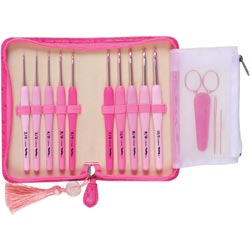
Etimo hooks are available in AC Moore craft stores, in select local yarn shops (if you don’t see them in your LYS, you could ask for special order) and may certainly be ordered online at sites such as buy.caron.com (which has the Etimo Rose hooks with pink handles,

Etimo Rosewhich are so adorable, as well as a range of other Tulip products) and joann.com.  I have not seen the size K hook offered anywhere yet, but it’s so new that I’d give everyone a chance to get them in stock.
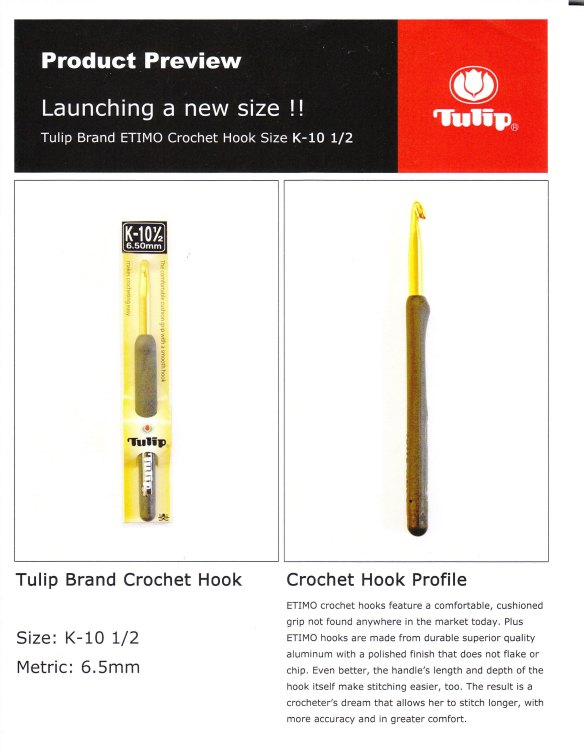
Thanks to everyone for the outpouring of Etimo love in your comments.  I hope each of you has the chance to get one in your hands soon!

New Crochet Toy: Tulip Etimo K Hook

I know, I know. Two posts ago I said I was going to talk about yarn for crochet.  I will get to that, I swear.  Today I am showing off my shiny new toy, and later at the end of this post I will be taking names to win one of your own.

Etimo KMy one and only tiny regret about the original collection of Etimo hooks that I continue to rave about and use exclusively in my crochet, both professionally and for fun, is that the sizes ran out at the J-10 (6mm) size. My friends at Tulip Company musta got tired of hearing me beg, because they went and adjusted their manufacturing in order to produce this beauty, a US size K-10 1/2 (6.5mm) crochet hook, the crowning glory in the Etimo Cushion Grip line.

Let me assure you that I am in no way paid by Tulip to endorse their crochet tools. In fact, nobody could pay me enough to work with hooks that I didn’t totally love. I discovered Etimo hooks at a TNNA (The National NeedleArts Association) trade show in 2009 through the sheer force of will of my boss, Vashti Braha. She had seen this brilliant new line of hooks earlier in the day and insisted that I HAD TO SEE THEM. She dragged me over to the Tulip exhibit as I was not in the mood for browsing new tools, I really wanted to go get some coffee. I always want to go get some coffee. Anyway, she made me play with the sample hooks and yarn that were thoughtfully provided. From the moment I held one in my hand I was, pardon the expression, hooked.

There is no other cushion grip crochet hook like it, and in my opinion none other as fine. I could go on and on about how the hook is supremely comfortable and fits the hand, how it is perfectly balanced in weight and proportion, the exacting quality of the manufacturing. Nothing else I’ve tested even comes close. Now that there’s the K size to fill out the set, I am a totally happy hooker. I had to custom order my first Etimo set straight from the company in Hiroshima, Japan. Since 2009, Tulip Company has secured US distributors for their products, including incredibly smooth bamboo knitting needles, bead and thread crochet hooks, specialty needles and awesome interchangeable hook and needle sets. Today you can find Etimos right on the shelf at your local AC Moore craft store!

Why, you ask, does the Etimo K make me so giddy?  Isn’t a hook that big only used with chunky or bulky weight thick yarn (CYCA category 5)? AH-HA!  Not in my ‘verse.  I routinely match the K with medium and heavy worsted weight yarns (CYCA category 4) in order to lighten up the fabric. Vashti says the K is the key to creating the melting drape of her special sort of slip stitch designs (get Vashti’s free pattern here). For my crochet demonstrations at TNNA in Columbus, Ohio next week I’ll be presenting a unique stitch I call the K-Cluster, worked into a burly scarf with a ribbing-like texture, using the Etimo K and Filatura di Crosa Zara 8, a true worsted weight yarn in wonderfully soft superwash merino wool. Here’s a preview of the scarf pattern I’ll be giving to visitors to the demo:

K-Cluster Scarf

So, who wants one?  To celebrate the launch, I am offering one lucky crocheter a free Etimo K-10 1/2 (6.5mm) hook, compliments of Tulip Company and myself. If you’ve never tested an Etimo hook, then here’s a chance to get one in your hands.  If you’re already a hardcore fan, then this is the hook to complete your collection. Just leave a comment/reply to this post before midnight Eastern Time, Sunday night, 16 June, and I’ll be back with a winner on Monday. Remember, sucking up to me does not increase your chances of winning! 🙂 But you are invited to tell me about your own experiences with Etimo crochet hooks, if you like. Best of luck to all!