>Hitting a Smaller Target: Conclusion

>Perhaps you thought I’d never get to the pay-off promised for this series of posts.  You’d be correct.  I totally intended to spill all I could offer about small sizing.  But the more I tried to put the answers into a set of blog posts, the more I came to accept that it’s not gonna happen in this blog-o-sphere.

What has happened since I started down that road a couple of months ago is that I’ve had a brain blast.  I decided to create small size designs and publish them as individual patterns.  Since there is no proven market for girl/tween/teen sized crocheted garment patterns, generally big girl sizes 6 through 16, I have been unable to find a traditional publishing venue eager enough to help me go there.  So I am planning to self-publish the lot.

I know.  I KNOW!  I have said here that I am a crocheter, not a publisher.  Never say never.  Put the blame squarely on my friend and now my boss, Vashti Braha.  Vashti has just rolled out the welcome mat for her new website, www.DesigningVashti.com, the ultimate crochet destination, pattern boutique and crochet information treasure trove.  Using her uncanny powers of persuasion and threatening me with bodily harm if I didn’t cave in, Vashti talked me into testing the self-publishing waters by inviting me to contribute designs for her beautiful site.  She offered me a comfy cyber-home for my new pattern line, DJC Designs, no deadlines, no hassles, and complete creative freedom.  But she needed a couple of patterns in time for the shopping cart going live this week. YIKES!

What to do… what to do… WHAT TO DO?

I did not want to rush into the girl designs just yet.  But I did have two pet projects that would take to download land really well.  Both designs are more like sets of patterns, encompassing multiple samples and requiring a crap ton of pages to spit out.  Think of these as fat patterns.  Bloated patterns.  Patterns with booklet tendencies.

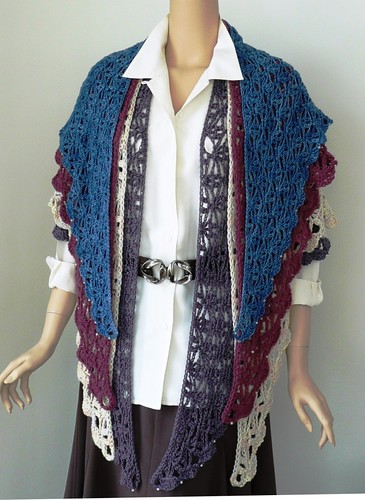
The first DJC Designs pattern now available is DJC: Triangular Shawl and Variations.

Sample in Tahki Torino with beading
DJC: Triangular Shawl and Variations

Thanks to the designers’ options with Interweave, I retained rights for this little beaded wrap, originally published in the premier special issue of Interweave Crochet, 2004.  Now featuring new stitch diagrams, six fresh shawl samples in various yarns, instructions and suggestions for many gauges and sizes, this deluxe version of the Triangular Shawl will become your go-to pattern for gorgeous, stash-busting stuff for yourself and for gift-giving.

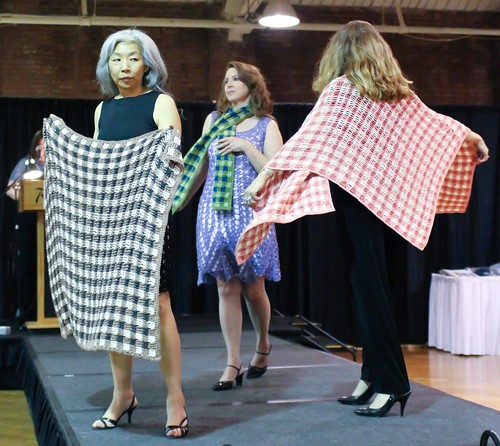
Next up will be DJC: PlayPlaid, a collection of four projects in a clever 3-color plaid stitch.  This is the pattern that includes the pieces I showed in the CGOA 2010 Chain Link Fashion Show last month in Manchester, NH.

Photo credit Alex Iannelli, used by permission

And, if I stop blogging and start seriously crocheting, in the coming season you will see the debut of DJC Designs, Too!, a series of designs including tops, cardigans, skirts, dresses and whatever comes into my head, in girl sizes 6 to 16.  Keep checking www.DesigningVashti.com for the latest DJC Designs patterns, or subscribe to the DesigningVashti newsletter for the heads-up.

>Hitting a smaller target: Part 2

>It helps consumers of my patterns to know that I totally suck at imaginary counting.  What I mean is I am incapable of coming up with absolutely correct counts where the stitches are extrapolated for pattern sizing, not actually in my hands as tangible crochet.  Obviously, I work really hard {really really really hard} at crunching the correct numbers for all sizes, but in reality, the only set of numbers in my patterns that I can guarantee to be perfect and consistent are the stitch counts for the garment sample I have myself crocheted. Any other string of numbers will simply swim in front of my eyes, a downside to advancing age. I can clearly see what stitches have to happen, where, when and how often.  But don’t ask me to count those suckers.

So you could conclude that I am a visual person, a tactile learner, a hands-on designer.  I describe my design approach as organic.  I cannot make crochet design without making crochet.  I’ve heard that there are designers who work differently, for whom the entire process is virtual.  They make a sketch of the design, plug the variables of stitch pattern and gauge into their own particular standard pattern template, then pass the mess along to a contract stitcher who crochets the sample and often fixes the pattern writing to conform to the real object.  This could be an efficient way to crank out a limitless body of work in seemingly no time.  Not for me.

With my paltry few years professional designing experience and the hundreds of designs I’ve done, I still don’t know if a design works until I do it.  Likewise, I honestly won’t know if the sizing extrapolations I’ve calculated will actually work for real unless and until I have crocheted that particular pattern to those exact finished measurements myself.  And as I just spilled a couple of paragraphs ago, I wouldn’t be able to give absolutely reliable stitch counts for any of those imaginary pieces.

As quickly and as efficiently as I crochet, and depending on the project and the number of loose ends (!), it still takes me from three to ten days to nail down a crochet design (complete the sample to the point where I know it works).   Deadlines are usually pressing.  I routinely have less than two weeks to devote to any one design.  Most editors and/or yarn companies provide enough materials to complete the sample, with not much to spare. So, there is never enough time or materials to physically crochet multiple samples of a design.  Nor do the design fees offer enough compensation for the extra work.  Even for designs with publisher guarantees that they have been pattern tested, not every size of every garment has been crocheted.  When my patterns take written form, all those extra sizes and all those stitch counts are, and will remain forever imaginary.

That’s where you come in.  I rely on feedback from crocheters who have worked from my patterns and crocheted the other-than-model sizes.  You guys are brilliant at tracking me down, showing and telling me what works. Spotting you wearing  your finished projects at events is one of the reasons I look forward to events. Your on line comments and critiques on the construction and fit help me do the next one better.  The group at Ravelry.com dedicated to my designs, Doris Chan: Everyday Crochet,  is my chief contact with fans.  Each time a Raveler posts to the forum, asks a question, begs for pattern support, points out a pattern error {usually a stupid stitch count!}, shows pictures of finished projects, cheers on other crocheters, commiserates with others over ripped rows and wonky gauge…  every word teaches me something.  Hundreds of somethings.

So what am I hearing right now from my legion of crochet whisperers?  Aside from the background hubbub of excitement upon discovering crochet empowerment, I am hearing a tiny plea that could be growing into a more significant groundswell of discontent concerning, of all things, not plus sizing but smaller sizing. You may wonder how this issue even exists, since according to the first lesson in Part 1 I learned that I have to crochet design samples that look good on skinny models, but there is a limit to how low you go.
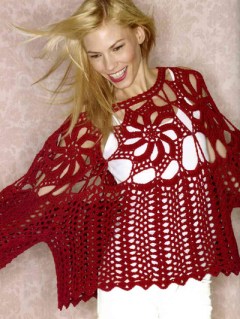
Claudia modeling Rosalinda

I was invited to {more like I jumped up and down and held my breath until they allowed me to attend} the photography shoot for my book Crochet Lace Innovations.  The design samples I provided were carefully and deliberately sized to fit fairly skinny humans.  But nothing prepared me for the range of body shapes that we encountered among the three gorgeous models, Claudia, Chanel and Eva.

Chanel modeling River Song
Eva modeling Jadzia

You’d think one fashion model might be interchangeable with another fashion model.  HA!

Claudia was lithe and coltish at a size 2.

Chanel, the curviest of the three {she gets the hubba-hubba award}, was a graceful, perfectly proportioned size 4.

Little Eva, who was certainly not underage, but appeared so young and underdeveloped, like a blossoming12-year-old, was a solid size 0.  Even the stylist, Kristen Petliski, couldn’t have planned for the different clothing sizes that were needed to coordinate with the crochet.   Some samples and clothes had Chanel spilling over a little {the hubba-hubba factor!}, but were playful and flowing on Claudia; some stuff was just too loose on Eva. That’s probably why you never see the back of the Jadzia jacket in photography.  Eva’s shorts are clipped in the back!

No one at the shoot touched any of the crochet samples; I wouldn’t allow it, and none suggested it.  We played musical crochet until the right model was matched with each outfit.  So what you see in those images is the real shape of each crocheted piece.

But here’s the thing.  Nothing in the book was supposed to fit a size 2 or 0.  Hardly anything I design goes there. As much as we exalt those fashion model figures, in real life few consumers need patterning that small. For mass market publishing, I have found no call for sizing smaller than 4 and no comment when I don’t provide it. My recent design output illustrates that I have learned all too well the second and third lessons from Part 1.  I have to produce patterns containing as few words as possible, and those patterns must offer plus sizing.  There is the trade-off and why the entire process is doomed to lead to disappointment among small sized crocheters.  If we go bigger, we make the choice to drop the smaller in order to keep the patterns to manageable length.

More next time.  Oh, and if you’re wondering how I got to be so stubborn and cute (!), check out my piece in this issue of Crafter News, the newsletter from my publisher, Potter Craft.
>What’s in a Design Name?

>

Plenty.  During the Getting Loopy podcast of 5 April, Mary Beth Temple voiced the question that will be on readers’ minds as they peruse the list of design titles in my new book, Crochet Lace Innovations.  So, what the heck are all those unpronounceable names about?

My editors at Potter Craft suggested that all my book designs have interesting names.  So I found some REALLY brilliant ones this time that seemed to complement the crochet.  Other than a few personal choices that don’t have backstories, but just sounded evocative or nice to me, the group includes feminine names that read like a game of Trivial Pursuit.  Some are merely obscure, a few are esoteric, one or two are downright unfathomable.  Likely, if you are a fan of sci-fi or fantasy film, television series, or literature, you’ll get at least a few.  If not, then just view them as little Doris idiosyncrasies and don’t worry about it.

Among the femme names are:

  • flaming-haired “perfect being” from the film “The Fifth Element”
  • sultry Companion in residence on board Serenity in the series “Firefly”
  • blue Delvian priestess in the series “Farscape”
  • science officer and host to the Trill symbiont Dax in the series “Star Trek: Deep Space Nine”
  • mythical heroine imagined by Starbuck in a production number from the Jones/Schmidt musical play, “110 in the Shade”
  • introverted, geeky (and doomed) computer specialist of “Torchwood”
  • simple-minded scullery slave who is literally swept away by a winged vamipiric prince in the Tanith Lee short story “Bite-Me-Not Or, Fleur de Feu” (I did say esoteric, didn’t I?)
  • one of the pet names given to the main character by her father in the Newberry Medal winning book by Madeleine L’Engle, “A Wrinkle in Time”
  • stunningly beautiful woman who is separated from her lover by the curse of an evil bishop in the film “Ladyhawke”
  • archeologist whose relationship to a future Doctor is left to much speculation (“spoilers”) in the episodes “Silence in the Library” and “Forest of the Dead”, Doctor Who Series Four
  • heroine and embodiment of the “Golden Path” in “God Emperor of Dune”, the fourth novel of Frank Herbert’s Dune series
  • gun-slinger and mercenary who joins the morally ambiguous crew in the fourth and final season of the Terry Nation (creator of Daleks!) series “Blakes 7”
  • headstrong and sensual Weyrwoman whose mind is broken after her dragon, gold Prideth, dies during a mating flight in the Dragonriders of Pern series by Anne McCaffrey

One name is a not-girl.

  • if you were born before 1955, then it’s the duck from a charming children’s book;  if you were born after 1980 then it’s Mulan’s boy-alter-ego

And two from pop music:

  • crazy Latin dancing solo down in Herald Square
  • she whirled as the music played in Rosa’s cantina out in the West Texas town of El Paso

So, for a truly warped game of Jeopardy, before actually seeing the table of contents, can you surmise these design names?  No fair googling.

>New to Crochet?

>Hokey Smokes!  March is flying by and still I have not joined in the celebration of National Crochet Month.  You’d think I could come up with something extraordinary to contribute.  As a professional designer and author I spend most of my time in my own crochet alternate reality.  There are days and weeks on end where I hardly talk to anyone but other crocheters who deign to come out of their own crochet alternate realities.  I have to be reminded that not everybody speaks the language.

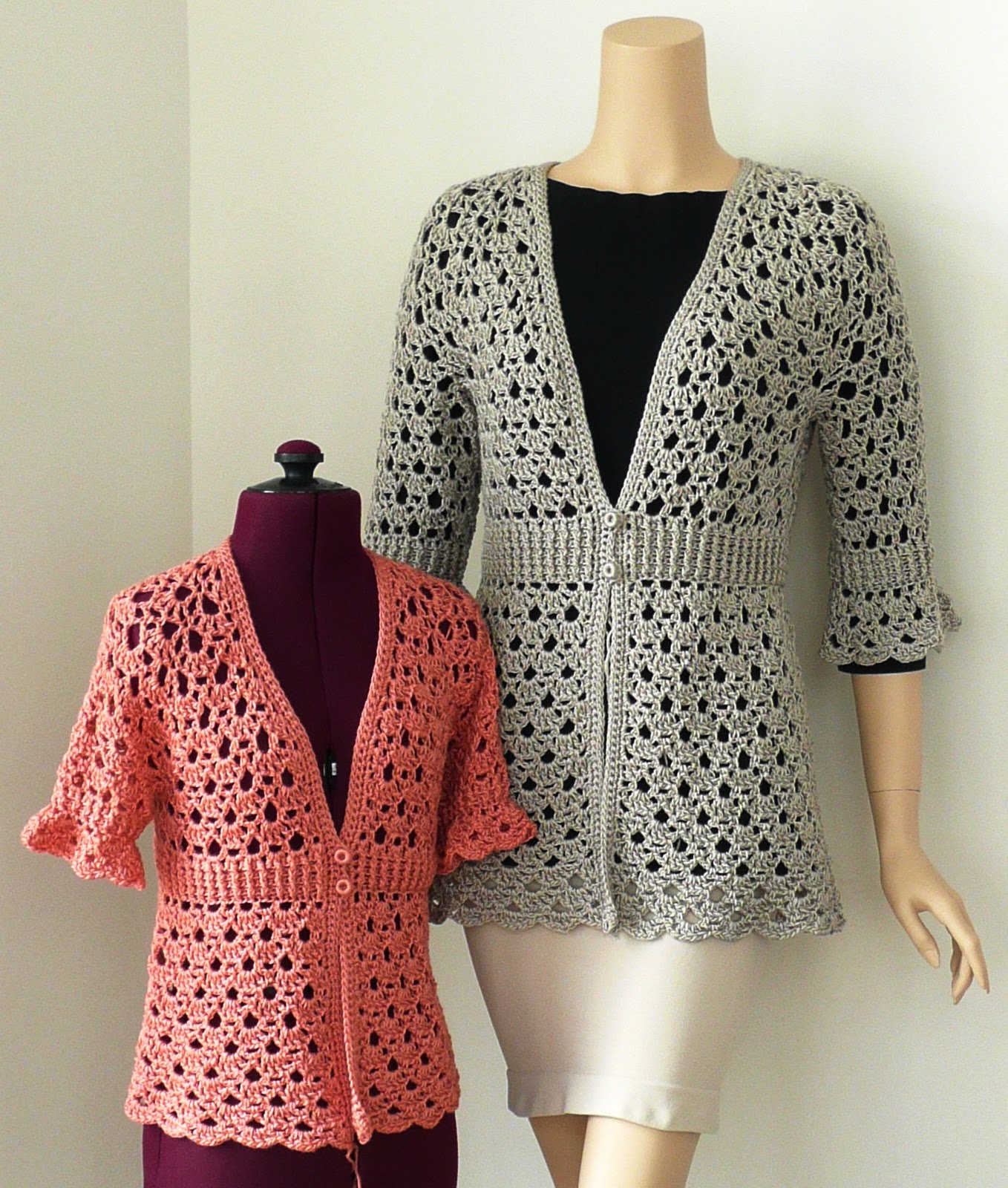
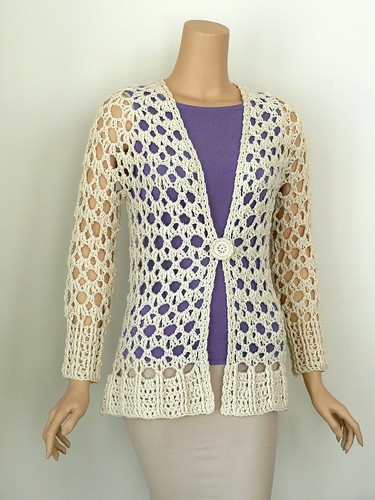
Chloe and Clarity Cardigans, Interweave Crochet, Spring 2010

So today I am sticking my head out of my timeless tunnel and offering a few words to newbie crocheters. Meanwhile, for any avid crocheters who have ventured this far into the post, I will put up some images of designs I have out this season, sprinkled like fairy dust throughout this long tirade. Hey,  I do hope that you are coming to the craft as a result of reading or hearing about NatCroMo, and that the hype has sucked you in, because a lot of people have done a whole lot of work this month just to get to you. Perhaps you are a knitter or other fiber artist and you’re now looking to add crochet to your skill set.  Or maybe you’ve never before held a skein of yarn in your hands, but you’re attracted to this thing we do.  I have three words to say.  Crochet ain’t easy.

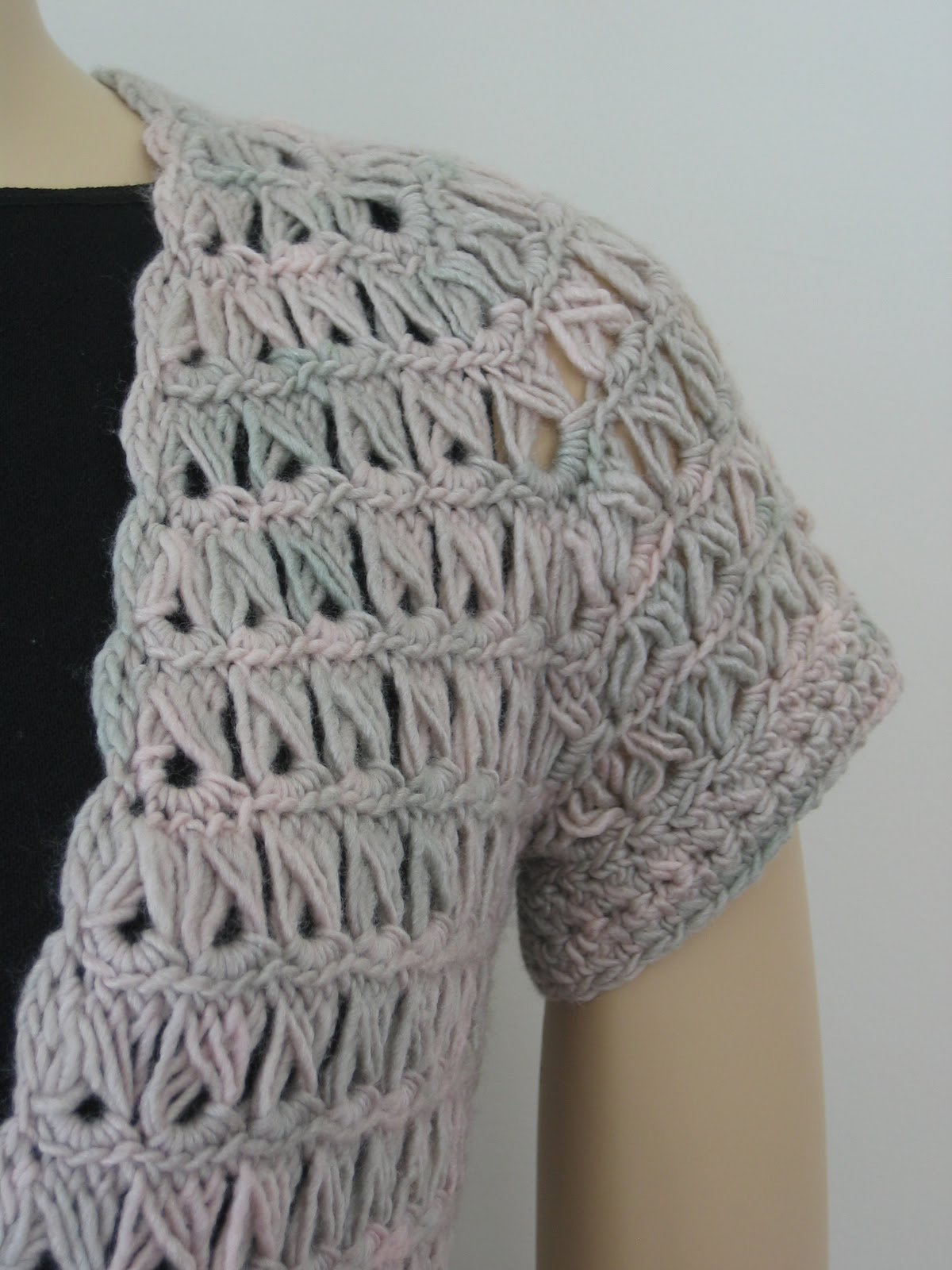
Tokyo Vest, Tahki City Crochet
Man, we all hate moments when we are made to feel unbalanced, stupid and foolish.  It’s like fussing with the back of your hair or trimming your bangs while looking in a mirror.  Don’t you always go the wrong way?  Doesn’t it make you feel dumb?  Or it’s like tying a bow tie on yourself.  It’s supposed to be exactly like tying your shoelaces.  But damned if the fact that you’re looking at it from the other direction makes it so much harder. Hey, my guy still can’t do it for himself.
Graceful Lacy Cardigan, Crochet Today, March/April

Our human pride begs us not to go there.  Avoid those situations that can only lead to awkwardness.  Life is too short to spend any of it undermining your ego.   So how can I convince you that my beloved craft is worth it?  There is no question that learning to crochet is often frustrating, with agonizing hours spent fumbling around and pitiful little to show for it.  At first you have to think about the movements of every fracking muscle in your hands and wrists as you struggle with using the hook and maintaining tension in the yarn.  And there’s the hitch.  Thinking.  What has to happen is that you must remove the cognitive process from the equation and fly on purely physical auto-pilot.

It’s like driving. I can get in my car and arrive at the supermarket and not remember driving there.  This is not about being careless, preoccupied, distracted or asleep at the wheel.  I am certain that it was uneventful, even pleasant, and that I have driven quite well and lawfully, but the trip was on total auto-pilot.  I am so used to my vehicle and the route to the destination, so accustomed to performing the actions of steering, braking, accelerating and adjusting for traffic and conditions, that I don’t actually think about any of it.  I just do it.

Marseilles Jacket, NaturallyCaron.com

Not having taught crochet a great deal, and with limited experience teaching absolute beginners, and not the slightest memory of actually learning to crochet as a girl (it might have been by osmosis!), I can still feel your pain.  I am the world’s worst student. That rascal Dee Stanziano, in her class Pushme-Pullyu, forced me to examine my so-called skills from a different perspective.  She made us crochet backwards, first with our other hand (for me that’s the left) and then with our regular hand.  It made me feel as though I didn’t know how to crochet.   At the time I am sure I cursed Dee and the devilishness of it all.  But it turns out the embarrassing experience in that class gave me a greater appreciation for what it must be like for a newbie.

The hands are eloquent when the brain is mute. The moment your body “gets it” and your brain stops thinking about each tiny motion and nuance, and you let go of the beginners’ mantra going round and round in your head (I particularly like “hook up, hook down, pull through”, but each teacher will dispense her own), that’s the epiphany.  The goal and the ultimate reward is getting to that point where your hands “know” what to do, smoothly and automatically.

Kylara, Crochet Lace Innovations, April 2010

So what will it take?  Another brand of teacher might admonish you to practice, practice, practice.  Wax on, wax off. That makes it sound so boring.  The word practice has such negative connotations.  Visions of working back and forth and back and forth with the same stitch though a gazillion yards of yarn.  Sort of like {shudder} swatching.   I prefer to say play.  Take up your hook and yarn and play, play, play.  The more you play the closer you’ll get to nirvana.

Melisande, Crochet Lace Innovations, April 2010

And then you can start feeling cocky.  Don’t worry about what you think you know or what skill level you’re at.  Pick a project that appeals to you.  One that has you drooling.  Try it.  Wing it.  Fly.  So what if you mess up.  So what if it’s not perfect.  So what if you have to learn stuff as you go.  There are all kinds of ways to find help, online tutorials, pattern support from designers and other crochters.  I hear all the time from fans on my forum at Ravelry, Doris Chan: Everyday Crochet (where I lurk), that sometimes the first time through one of my patterns is the learning curve.  They work and rip, work and rip some more and beat themselves up all the while. But, watch out!  The second one be brilliant.

As for how long will it take, it depends.  I have taught knitters to crochet in 15 minutes.  On the other hand it might be better for a student to approach crochet without any particular yarn experience or bias.  No habits to unlearn.  But here’s my belief.  If you can tie your shoelaces, you can crochet.  And when crocheting feels as natural as tying those laces, then you’ll understand what all the fuss is about. Do you trust me?

>Cotton Classic Lite

>For decades the cornerstone of the Tahki Yarn collection has been the Cotton Classic family; first Cotton Classic, the long-time DK weight favorite, and later Cotton Classic II, the worsted weight big sister.  For as many decades I have been waiting for the little sister to be born.  Congratulations, it’s a sport weight!

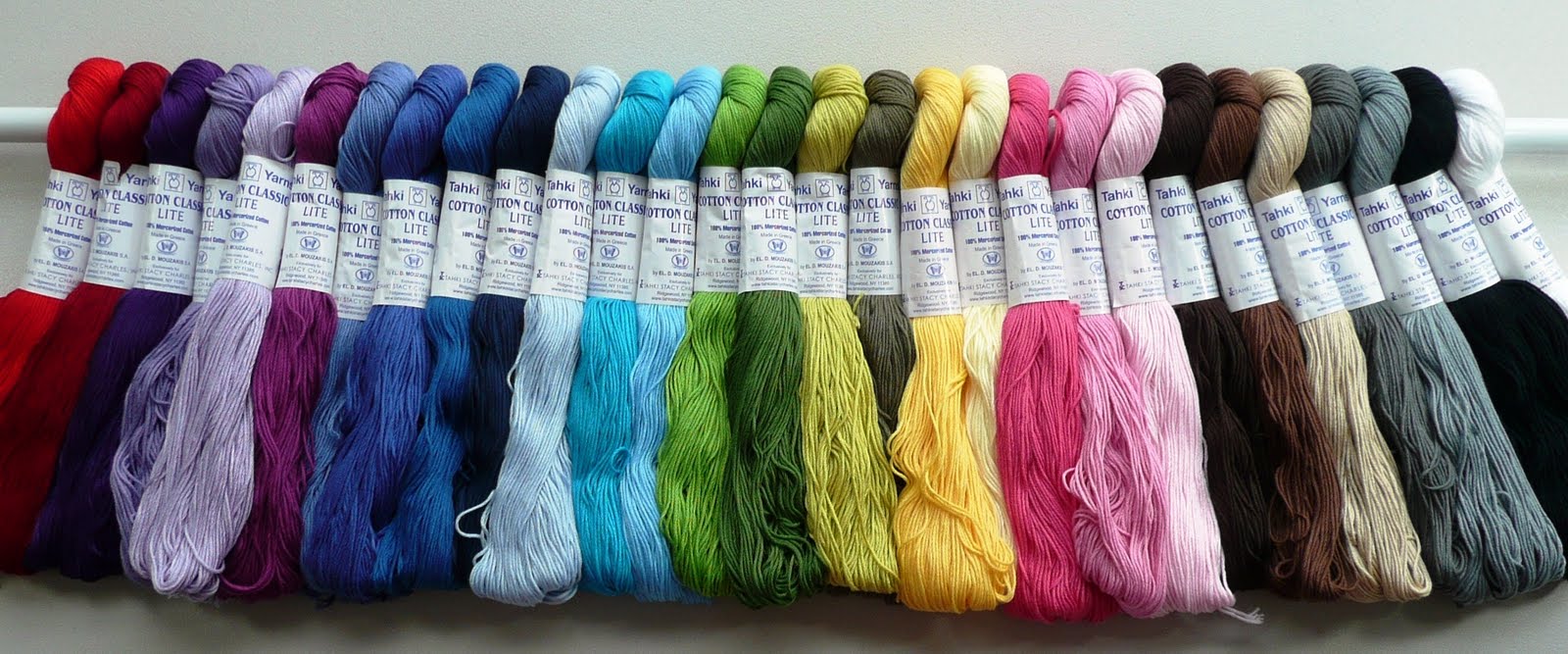
New this season, Tahki Cotton Classic Lite is everything I could want in a cotton yarn; it is a versatile, crochet-friendly sport weight, comes in a huge palette of brilliant mercerized cotton colors, features a sturdy Z-twist cable construction, with a non-pilling, non-shedding, smooth drape, is sensibly priced and easy care.

I think I’m missing a shade or two, but you get the picture.  Many cool colors are available.  Here’s a look at the label, so I don’t have to type out the specs:

Look for a plethora of crochet designs featuring Cotton Classic Lite coming out for spring and summer 2010, including a new crochet book from Tahki titled City Crochet.  This top, Paris Tunic, is one of the designs I contributed.

Cotton Classic Lite substitutes beautifully for a number of other yarns, and works for most sport weight applications.  For example, I would swap it as a classier step up from Patons Grace or Red Heart Lustersheen, I’d use it as a non-wool alternative to medium sport weight sock yarns, or as a more affordable sub for super high-end fibers like Tilli Tomas silk Plie.