It’s not my fault and neither is it yours if a yarn substitution isn’t working. I’d love to tell you that it’s easy to just plug your favorite yarn into a design and get good results. I’d sort of be lying if I did.
Let’s say you’ve discovered a crochet design that you want to make but you don’t like/have never heard of/can’t find/wouldn’t pay that much for in this lifetime, or whatever, the yarn suggested in the pattern. So you examine the yarn requirements and consider the possible substitutions. You have on hand enough yardage of a similar product in a color you’d actually wear, so you go for it. Three things can and often happen: you can’t achieve the stated crochet gauge; you don’t like the looseness or tightness of the resulting fabric or drape; you end up with not enough yarn to complete the project. This would totally piss me off and I would be cursing the designer, the publisher, the yarn manufacturer, my dog and myself {not necessarily in that order} for the complete botched job. I say it again. It’s not my fault and neither is it yours.
Experience has shown me that no two skeins of yarn are exactly alike. I’m not talking about skeins of completely different yarns that list the similar information on the labels. I mean I’ve had skeins of the same yarn that differ, albeit subtly, in weight or thickness, twist and texture from one color to another color, even from skein to skein of the same color same dye lot. Hell, there has been yarn that worked to varying gauge within the same fracking skein. (This happens occasionally when you crochet with softly S-twist yarn that inexorably untwists and loses coherence as you go. However I’ve had yarn that wasn’t intended to be thick and thin, but gave me thick and thin areas just the same!)
How is a crocheter supposed to navigate these waters? The only way to know for sure is through experience; lots of trial and error and cursing.
You’d think there should be some standardization in how yarns are classified and categorized and that such critical information be printed on the yarn labels of every skein offered for sale to aid the unwary public. Well, in a limited way there is. The system developed and published by the Craft Yarn Council of America (CYCA) is in this downloadable booklet, Standards and Guidelines For Crochet and Knitting. Not to say that the CYCA efforts are unappreciated, but if you study the page Standard Yarn Weight System you’ll find that the system is general and still leaves you guessing.
Standard Yarn Weight System
Categories of yarn, gauge ranges, and recommended needle and hook sizes
|
Yarn Weight Symbol
& Category Names
|
 |
 |
 |
 |
 |
 |
 |
|
Type of
Yarns in
Category
|
Fingering
10-count
crochet
thread |
Sock,
Fingering,
Baby |
Sport,
Baby |
DK,
Light
Worsted |
Worsted,
Afghan,
Aran |
Chunky,
Craft,
Rug |
Bulky,
Roving |
|
Knit Gauge
Range* in
Stockinette
Stitch to 4 inches
|
33–40**
sts |
27–32
sts |
23–26
sts |
21–24
st |
16–20
sts |
12–15
sts |
6–11
sts |
|
Recommended
Needle in
Metric Size
Range
|
1.5–2.25
mm |
2.25—
3.25
mm |
3.25—
3.75
mm |
3.75—
4.5
mm |
4.5—
5.5
mm |
5.5—
8
mm |
8 mm
and
larger |
|
Recommended
Needle U.S.
Size Range
|
000–1 |
1 to 3 |
3 to 5 |
5 to 7 |
7 to 9 |
9 to 11 |
11
and
larger |
|
Crochet Gauge*
Ranges in
Single Crochet
to 4 inch
|
32–42
double
crochets** |
21–32
sts |
16–20
sts |
12–17
sts |
11–14
sts |
8–11
sts |
5–9
sts |
|
Recommended
Hook in Metric
Size Range
|
Steel***
1.6–1.4
mm |
2.25—
3.5
mm |
3.5—
4.5
mm |
4.5—
5.5
mm |
5.5—
6.5
mm |
6.5—
9
mm |
9
mm and
larger |
|
Recommended
Hook U.S.
Size Range
|
Steel***
6, 7, 8
Regular
hook B–1 |
B–1
to
E–4 |
E–4
to
7 |
7
to
I–9 |
I–9
to
K–10 1⁄2 |
K–10 1⁄2 to
M–13 |
M–13
and
larger |
| * GUIDELINES ONLY: The above reflect the most commonly used gauges and needle or hook sizes for specific yarn categories.** Lace weight yarns are usually knitted or crocheted on larger needles and hooks to create lacy, openwork patterns. Accordingly, a gauge range is difficult to determine. Always follow the gauge stated in your pattern.*** Steel crochet hooks are sized differently from regular hooks—the higher the number, the smaller the hook, which is the reverse of regular hook sizing |
The CYCA system is not universally recognized nor are the stated standards and little ball band symbols used much outside the US. They know that. And it figures. It is after all the Craft Yarn Council of America. Imported yarns are often labeled by their US distributors for our market, but that is no guarantee that the CYCA category will be offered or even considered. Hey, even US manufacturers aren’t putting those symbols on all yarn labels yet. Is that any example for the world? Really.
This chart tells you what you can expect from each category in terms of suggested tool sizes and stitch gauges. For the most part, for knitting and for normal crochet techniques, these suggestions are OK and enormously useful. But this chart does not spell out what guidelines are used to categorize the yarns in the first place. You’d hope that the thickness or diameter of the strand (occasionally measured in wpi or wraps per inch) would be considered along with the density or airiness of the fiber (apparent in the number of yards per ounce). You can judge this for yourself in many ways, the simplest is by running a strand through your fingers. Some yarns are between categories or posses qualities that put them in more than one category. It is then up to the manufacturer or the distributor to assign a weight based on their own customary method. And that method is often unfathomable.
You say tomato, they say to-mah-to. Even if the yarn description uses familiar terminology, there’s no guarantee that we’re speaking the same language. For example, I have been stalking 100% silk yarns on a UK site, Colourmart. 
A caveat is printed alongside this DK silk offering: “note that we call this a dk based on its yardage but the denser nature of silk yarn means our dk silks feel more like a fingering weight or similar..”. The gorgeous Z-twist silk yarn I eventually purchased is put up in a 150 gram cone with 540 yards, which divides out to 180 yards per 50 gram skein (50 grams equals 1 3/4 ounces and is a universally common put-up for skeins of yarn). This places my silk way finer than DK (CYCA Category 3 Light), possibly finer than sport (CYCA Category 2 Fine). It coulda been a disaster, but because of their warning, I was prepared for that yarn to work to an even finer fingering weight gauge that better corresponds to CYCA category 1. Buyer beware!
Don’t let the CYCA Category names fool you. The titles Medium, Light, Fine, SuperFine are not meant to be absolute descriptions, they are relative terms. A Category 4 Medium yarn can actually feel lighter than a Category 3 Light one.
All things considered, it is very fortunate if your yarn has a really good label like this example, but you must still beware. See newly added Crochet Rules #29 and #30.

Even if your label tells the truth and the yarn appears to be a perfect match for your purpose, your substitution outcome can still go horribly wrong due to factors beyond weight category and suggested tools and gauge.
- Fiber content makes a huge impact. Sticky fibers, definitely mohair as well as some wools, cashmere and alpaca, can adapt to a range of gauges and applications because that stickiness helps the surface hold the stitches, either tighter or looser, so there’s a better chance you can match stated gauges. A classic example is when laceweight mohair is worked using oversized tools to get extremely open, cobweb gossamer fabric.
- Slick, slippery fibers, such as rayon, or dense fibers, such as mercerized cotton, might not offer as much latitude.Taken to extremes, the stitches could be too stiff at smaller gauges (potholders) or begin to fall apart, unable to hold larger gauges.
- The spin or twist of the yarn also makes a difference in how a yarn behaves, which I’ve come to expect given my experiments with twist.
- The most annoying issue is that the yarn color can make a difference in the gauge. Intuitively you’d think that a darker shade of a yarn would have more processing and dye. If there’s any difference at all, it should be the darker yarn that feels weightier in your hands and on your hook than a pale or natural shade of the same yarn. Hokey Smokes! The opposite is often the case.
Back to the conundrum. How does a crocheter confidently substitute yarn in a project, particularly in cases where critical label information is lacking or just plain wrong?
You can begin by first judging a yarn by the yardage per skein, hank or ball. This is only a crude initial look and cannot tell the whole story. The yardage can vary wildly from product to product, but for traditional type yarn these are some of the averages you can expect:
- worsted weight Category 4 Medium yarns contain around 80-90 yards per 50g;
- DK weight Category 3 Light yarns contain around 110-120 yards per 50g;
- sport yarns Category 2 Fine contain around 140-150 yards per 50g;
- fingering yarns Category 1 SuperFine contain around 200-250 yards per 50g.
Again, it all depends on the heaviness or density of the fiber and type of construction and twist. For example, compare these two yarns that I’ve had the pleasure of using for recent design.
Blue Sky Alpacas Techno is put up with 120 yards per 50g hank:

It has a more yardage per hank than this Tahki Cotton Classic, which is 108 yards per 50g hank:

The Techno is a whipped up baby alpaca blown into a mesh tube of silk, making it very light and airy. It is a Category 4 Medium yarn that works to worsted gauge, bordering on chunky! The Cotton Classic is a firmly Z-twisted mercerized cotton that is dense. It is a Category 3 Light yarn and works to DK gauge.
Here’s the next tell, and you can try it too. Much of the yarn available to us is manufactured, labeled, marketed, intended and destined for hand knitting. The industry is accustomed to catering to knitters. Nearly every skein of commercial yarn I have ever held (this does not include certain boutique, specialty or artisan products for which there are few rules!) gives a suggested knitting gauge on the label. So in cases where the weight class or crochet gauge is not clear, canny crocheters can use the ubiquitous knitting gauge as a guideline.
Compare the suggested knitting gauge of your yarn to the CYCA standards above. I know, I know. Every listing in the standard is given as a range, so it’s not exact. For example, the Techno above gives a knitting gauge of 3 to 5 stitches per inch using a US Size 9-10.5 knitting needle. The needle diameter alone (same mm size as crochet hooks I/9 through K/10.5) puts Techno squarely in the thicker worsted, even chunky range. Cotton Classic is labeled 5 stitches per inch on a US Size 6 needle; it is on the heavier side of DK.
I find myself writing the next words more than I’d care to. There is no magic bullet. After these initial judgements of yarn weight class and knitting gauge, the next step, and the only way to truly know if the yarn will work, is to just do it. Experience, trial, error, cursing. 🙂
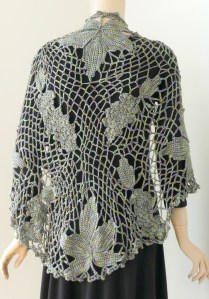
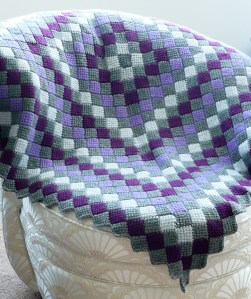
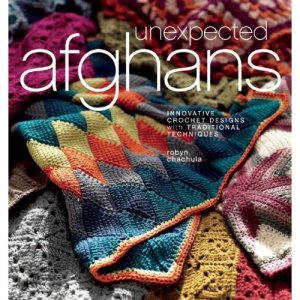 Robyn’s idea was to get each of us to design an afghan in our own unique style. For me this meant seamless lace, the Exploded Pineapple Afghan:








 Doris Chan Crochet