Crochet Yarn Conundrum

It’s not my fault and neither is it yours if a yarn substitution isn’t working.  I’d love to tell you that it’s easy to just plug your favorite yarn into a design and get good results.  I’d sort of be lying if I did.

Let’s say you’ve discovered a crochet design that you want to make but you don’t like/have never heard of/can’t find/wouldn’t pay that much for in this lifetime, or whatever, the yarn suggested in the pattern. So you examine the yarn requirements and consider the possible substitutions.  You have on hand enough yardage of a similar product in a color you’d actually wear, so you go for it. Three things can and often happen: you can’t achieve the stated crochet gauge; you don’t like the looseness or tightness of the resulting fabric or drape; you end up with not enough yarn to complete the project. This would totally piss me off and I would be cursing the designer, the publisher, the yarn manufacturer, my dog and myself {not necessarily in that order} for the complete botched job. I say it again.  It’s not my fault and neither is it yours.

Experience has shown me that no two skeins of yarn are exactly alike. I’m not talking about skeins of completely different yarns that list the similar information on the labels. I mean I’ve had skeins of the same yarn that differ, albeit subtly, in weight or thickness, twist and texture from one color to another color, even from skein to skein of the same color same dye lot.  Hell, there has been yarn that worked to varying gauge within the same fracking skein. (This happens occasionally when you crochet with softly S-twist yarn that inexorably untwists and loses coherence as you go.  However I’ve had yarn that wasn’t intended to be thick and thin, but gave me thick and thin areas just the same!)

How is a crocheter supposed to navigate these waters? The only way to know for sure is through experience; lots of trial and error and cursing.

You’d think there should be some standardization in how yarns are classified and categorized and that such critical information be printed on the yarn labels of every skein offered for sale to aid the unwary public. Well, in a limited way there is.  The system developed and published by the Craft Yarn Council of America (CYCA) is in this downloadable booklet, Standards and Guidelines For Crochet and Knitting. Not to say that the CYCA efforts are unappreciated, but if you study the page Standard Yarn Weight System you’ll find that the system is general and still leaves you guessing.

Standard Yarn Weight System

Categories of yarn, gauge ranges, and recommended needle and hook sizes

Yarn Weight Symbol
& Category Names
lace super fine fine light medium bulky super bulky
Type of
Yarns in
Category
Fingering
10-count
crochet
thread
Sock,
Fingering,
Baby
Sport,
Baby
DK,
Light
Worsted
Worsted,
Afghan,
Aran
Chunky,
Craft,
Rug
Bulky,
Roving
Knit Gauge
Range* in
Stockinette
Stitch to 4 inches
33–40**
sts
27–32
sts
23–26
sts
21–24
st
16–20
sts
12–15
sts
6–11
sts
Recommended
Needle in
Metric Size
Range
1.5–2.25
mm
2.25—
3.25
mm
3.25—
3.75
mm
3.75—
4.5
mm
4.5—
5.5
mm
5.5—
8
mm
8 mm
and
larger
Recommended
Needle U.S.
Size Range
000–1 1 to 3 3 to 5 5 to 7 7 to 9 9 to 11 11
and
larger
Crochet Gauge*
Ranges in
Single Crochet
to 4 inch
32–42
double
crochets**
21–32
sts
16–20
sts
12–17
sts
11–14
sts
8–11
sts
5–9
sts
Recommended
Hook in Metric
Size Range
Steel***
1.6–1.4
mm
2.25—
3.5
mm
3.5—
4.5
mm
4.5—
5.5
mm
5.5—
6.5
mm
6.5—
9
mm
9
mm and
larger
Recommended
Hook U.S.
Size Range
Steel***
6, 7, 8
Regular
hook B–1
B–1
to
E–4
E–4
to
7
7
to
I–9
I–9
to
K–10 1⁄2
K–10 1⁄2 to
M–13
M–13
and
larger
* GUIDELINES ONLY: The above reflect the most commonly used gauges and needle or hook sizes for specific yarn categories.** Lace weight yarns are usually knitted or crocheted on larger needles and hooks to create lacy, openwork patterns. Accordingly, a gauge range is difficult to determine. Always follow the gauge stated in your pattern.*** Steel crochet hooks are sized differently from regular hooks—the higher the number, the smaller the hook, which is the reverse of regular hook sizing

The CYCA system is not universally recognized nor are the stated standards and little ball band symbols used much outside the US.  They know that.  And it figures. It is after all the Craft Yarn Council of America.  Imported yarns are often labeled by their US distributors for our market, but that is no guarantee that the CYCA category will be offered or even considered. Hey, even US manufacturers aren’t putting those symbols on all yarn labels yet.  Is that any example for the world?  Really.

This chart tells you what you can expect from each category in terms of suggested tool sizes and stitch gauges.  For the most part, for knitting and for normal crochet techniques, these suggestions are OK and enormously useful.  But this chart does not spell out what guidelines are used to categorize the yarns in the first place.  You’d hope that the thickness or diameter of the strand (occasionally measured in wpi or wraps per inch) would be considered along with the density or airiness of the fiber (apparent in the number of yards per ounce). You can judge this for yourself in many ways, the simplest is by running a strand through your fingers. Some yarns are between categories or posses qualities that put them in more than one category.  It is then up to the manufacturer or the distributor to assign a weight based on their own customary method.  And that method is often unfathomable.

You say tomato, they say to-mah-to. Even if the yarn description uses familiar terminology, there’s no guarantee that we’re speaking the same language. For example, I have been stalking 100% silk yarns on a UK site, Colourmart

A caveat is printed alongside this DK silk offering: “note that we call this a dk based on its yardage but the denser nature of silk yarn means our dk silks feel more like a fingering weight or similar..”.  The gorgeous Z-twist silk yarn I eventually purchased is put up in a 150 gram cone with 540 yards, which divides out to 180 yards per 50 gram skein (50 grams equals 1 3/4 ounces and is a universally common put-up for skeins of yarn).  This places my silk way finer than DK (CYCA Category 3 Light), possibly finer than sport (CYCA Category 2 Fine). It coulda been a disaster, but because of their warning, I was prepared for that yarn to work to an even finer fingering weight gauge that better corresponds to CYCA category 1. Buyer beware!

Don’t let the CYCA Category names fool you.  The titles Medium, Light, Fine, SuperFine are not meant to be absolute descriptions, they are relative terms. A Category 4 Medium yarn can actually feel lighter than a Category 3 Light one.

All things considered, it is very fortunate if your yarn has a really good label like this example, but you must still beware.  See newly added Crochet Rules #29 and #30.

Even if your label tells the truth and the yarn appears to be a perfect match for your purpose, your substitution outcome can still go horribly wrong due to factors beyond weight category and suggested tools and gauge.

  • Fiber content makes a huge impact. Sticky fibers, definitely mohair as well as some wools, cashmere and alpaca, can adapt to a range of gauges and applications because that stickiness helps the surface hold the stitches, either tighter or looser, so there’s a better chance you can match stated gauges. A classic example is when laceweight mohair is worked using oversized tools to get extremely open, cobweb gossamer fabric.
  • Slick, slippery fibers, such as rayon, or dense fibers, such as mercerized cotton, might not offer as much latitude.Taken to extremes, the stitches could be too stiff at smaller gauges (potholders) or begin to fall apart, unable to hold larger gauges.
  • The spin or twist of the yarn also makes a difference in how a yarn behaves, which I’ve come to expect given my experiments with twist.
  • The most annoying issue is that the yarn color can make a difference in the gauge. Intuitively you’d think that a darker shade of a yarn would have more processing and dye.  If there’s any difference at all, it should be the darker yarn that feels weightier in your hands and on your hook than a pale or natural shade of the same yarn. Hokey Smokes!  The opposite is often the case.

Back to the conundrum.  How does a crocheter confidently substitute yarn in a project, particularly in cases where critical label information is lacking or just plain wrong?

You can begin by first judging a yarn by the yardage per skein, hank or ball. This is only a crude initial look and cannot tell the whole story.  The yardage can vary wildly from product to product, but for traditional type yarn these are some of the averages you can expect:

  • worsted weight Category 4 Medium yarns contain around 80-90 yards per 50g;
  • DK weight Category 3 Light yarns contain around 110-120 yards per 50g;
  • sport yarns Category 2 Fine contain around 140-150 yards per 50g;
  • fingering yarns Category 1 SuperFine contain around 200-250 yards per 50g.

Again, it all depends on the heaviness or density of the fiber and type of construction and twist. For example, compare these two yarns that I’ve had the pleasure of using for recent design.

Blue Sky Alpacas Techno is put up with 120 yards per 50g hank:

It has a more yardage per hank than this Tahki Cotton Classic, which is 108 yards per 50g hank:

The Techno is a whipped up baby alpaca blown into a mesh tube of silk, making it very light and airy.  It is a Category 4 Medium yarn that works to worsted gauge, bordering on chunky! The Cotton Classic is a firmly Z-twisted mercerized cotton that is dense.  It is a Category 3 Light yarn and works to DK gauge.

Here’s the next tell, and you can try it too.  Much of the yarn available to us is manufactured, labeled, marketed, intended and destined for hand knitting. The industry is accustomed to catering to knitters.  Nearly every skein of commercial yarn I have ever held (this does not include certain boutique, specialty or artisan products for which there are few rules!) gives a suggested knitting gauge on the label. So in cases where the weight class or crochet gauge is not clear, canny crocheters can use the ubiquitous knitting gauge as a guideline.

Compare the suggested knitting gauge of your yarn to the CYCA standards above. I know, I know. Every listing in the standard is given as a range, so it’s not exact. For example, the Techno above gives a knitting gauge of 3 to 5 stitches per inch using a US Size 9-10.5 knitting needle.  The needle diameter alone (same mm size as crochet hooks I/9 through K/10.5) puts Techno squarely in the thicker worsted, even chunky range. Cotton Classic is labeled 5 stitches per inch on a US Size 6 needle; it is on the heavier side of DK.

I find myself writing the next words more than I’d care to. There is no magic bullet. After these initial judgements of yarn weight class and knitting gauge, the next step, and the only way to truly know if the yarn will work, is to just do it. Experience, trial, error, cursing. 🙂
I’m a Valley {crochet} Girl!

Knowing for myself that I am loathe to leave the comfort of my home for any reason, I browse and shop for yarns on line these days.  I love WEBS at www.yarn.com.  I discovered a fully realized, fully functioning yarn store offering a staggering diversity of products and volume discounts… and I never have to get out of my chair.

But I was most impressed by the first  printed WEBS catalog I received last year.  In it, owner Kathy Elkins wrote so sincerely about being a crocheter herself and wanting to include crochet in what might otherwise be a knit-centric publication.  Her crochet-friendly attitude, the support for crochet design and designers and her willingness to be so in-your-face about it was refreshing.  So when it came time for me to raise funds for the CGOA 2011 Crochet Design Competition, I contacted Kathy.  Happily she immediately and wholeheartedly agreed to support us and WEBS is the proud sponsor of the prizes for the design category Accessories.

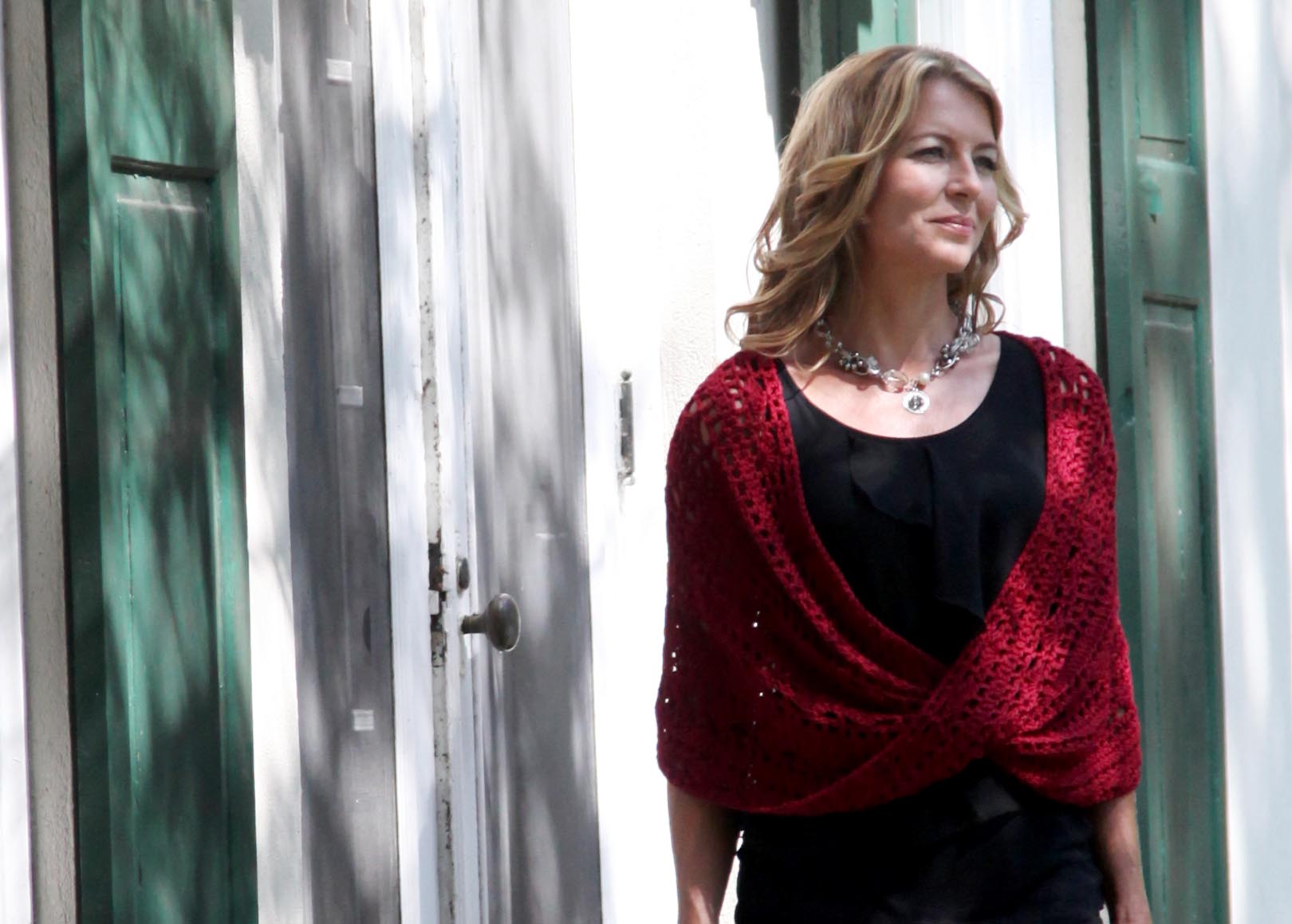
So when Kathy hinted at… asked… uh, insisted… that I do some crochet designing for her private label Valley Yarns, I dove right in.  Valley Cowl is the result.  Crocheted with Deerfield, a soft luxe DK blend of baby alpaca and silk, in a lacy stitch pattern in true mobius fashion (continuous figure 8’s), Valley Cowl looks amazing.

I recently talked with Kathy and husband Steve on the WEBS podcast, Ready, Set, Knit (episode #228 23 July)  and at the very end of the interview Kathy mentioned that the Valley Cowl would be the next featured crochet-a-long.  So check the WEBS blog on Saturday afternoon for all the details.

Kirsten Hipsky, Design Coordinator for WEBS, has asked for more details about the Foundation Double Crochet used to begin the cowl.  It’s not an impossible technique, just difficult to describe in words.  So when you join the CAL, which I hope you will, and you become petrified, which I hope you won’t, see this page or get a downloadable pdf version here.

DJC Foundation Double Crochet Tutorial

Foundation and Crochet: Let’s try this again.

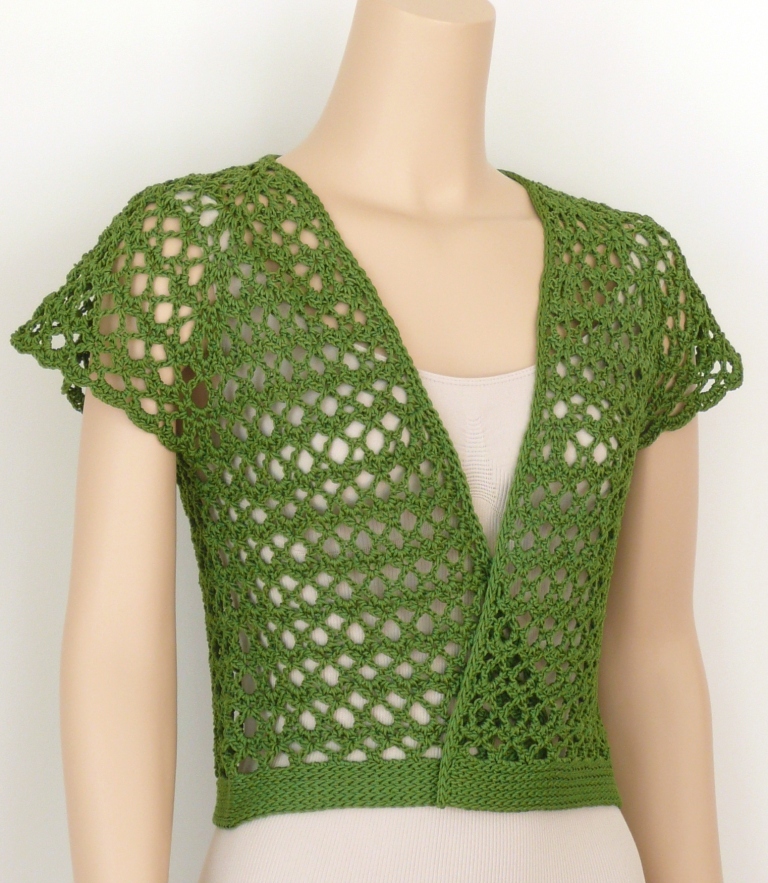
And still there is confusion.   In the July 2011 issue of Crochet! magazine, my design Leaves of Summer vest is linked to a tutorial for the Foundation Single Crochet… which would have been awesome if the technique so clearly illustrated was actually the way I prefer to do it.

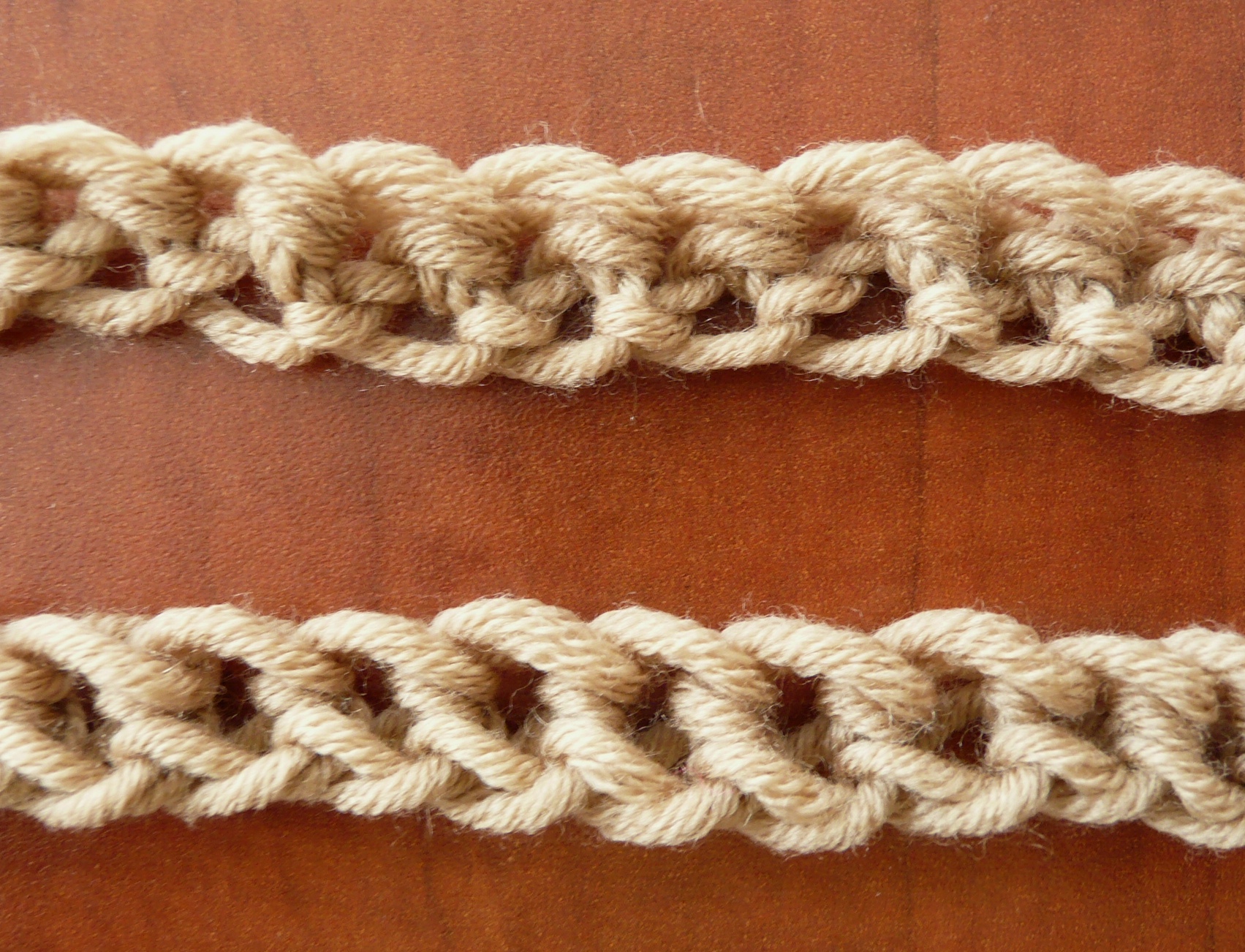
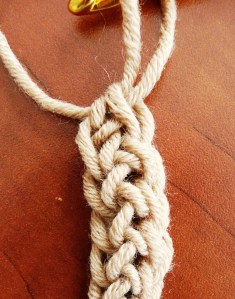
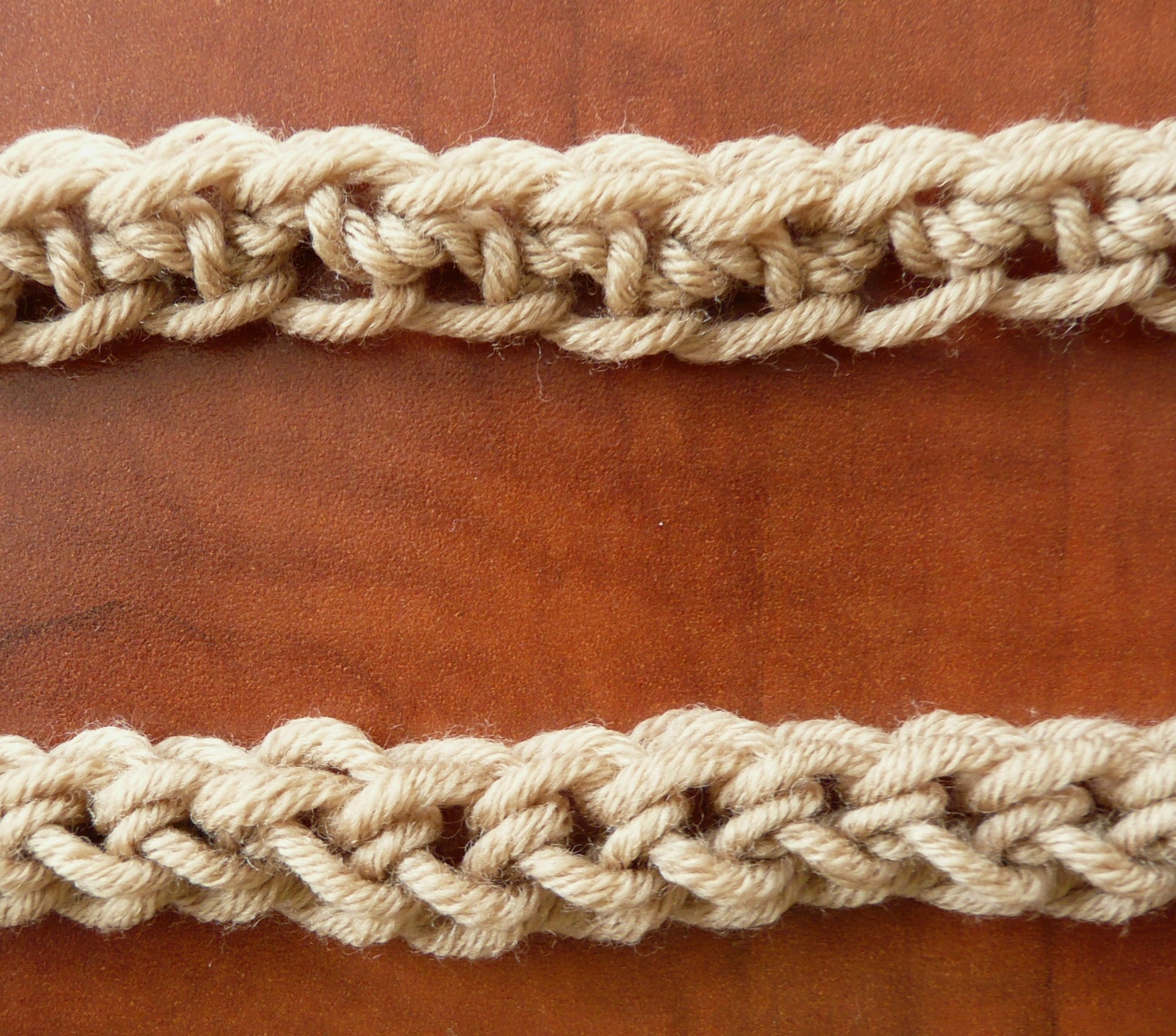
Please look at these two foundations.  On top is the Fsc version that is described in the Crochet! magazine tutorial.  On the bottom is the Fsc version I have recently posted about here.  This is the view from the RS (the side you’re looking at while you crochet it).

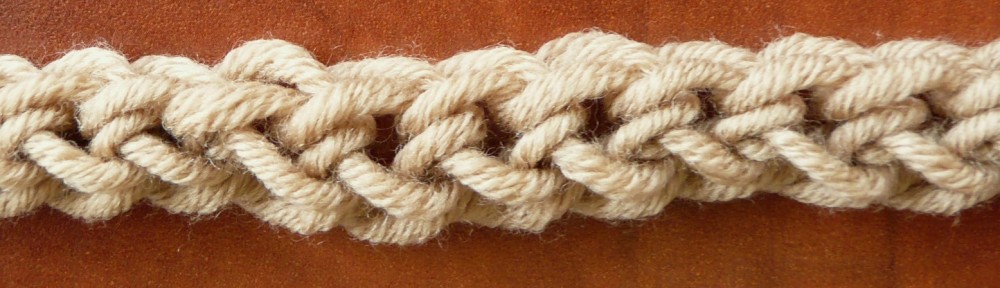
This is the view from the WS (the back side of the single crochet).

The difference is all about the chain part of the foundation.  Each single crochet stitch has a chain at its base.  In the Crochet! version the chain has one strand running across the foundation row.  In my preferred version the chain has two strands.

It may seem a small thing, rather trivial to you now, but trust me, it makes a world of difference in how the foundation behaves when you continue to work more crochet on both the sc and chain edges.

My friend (and boss) Vashti Braha has just done a gang of research about this foundation and posted her own photo tutorial on the DesigningVashti Crochet Companion blog, which goes a long way toward getting this confusion sorted out.

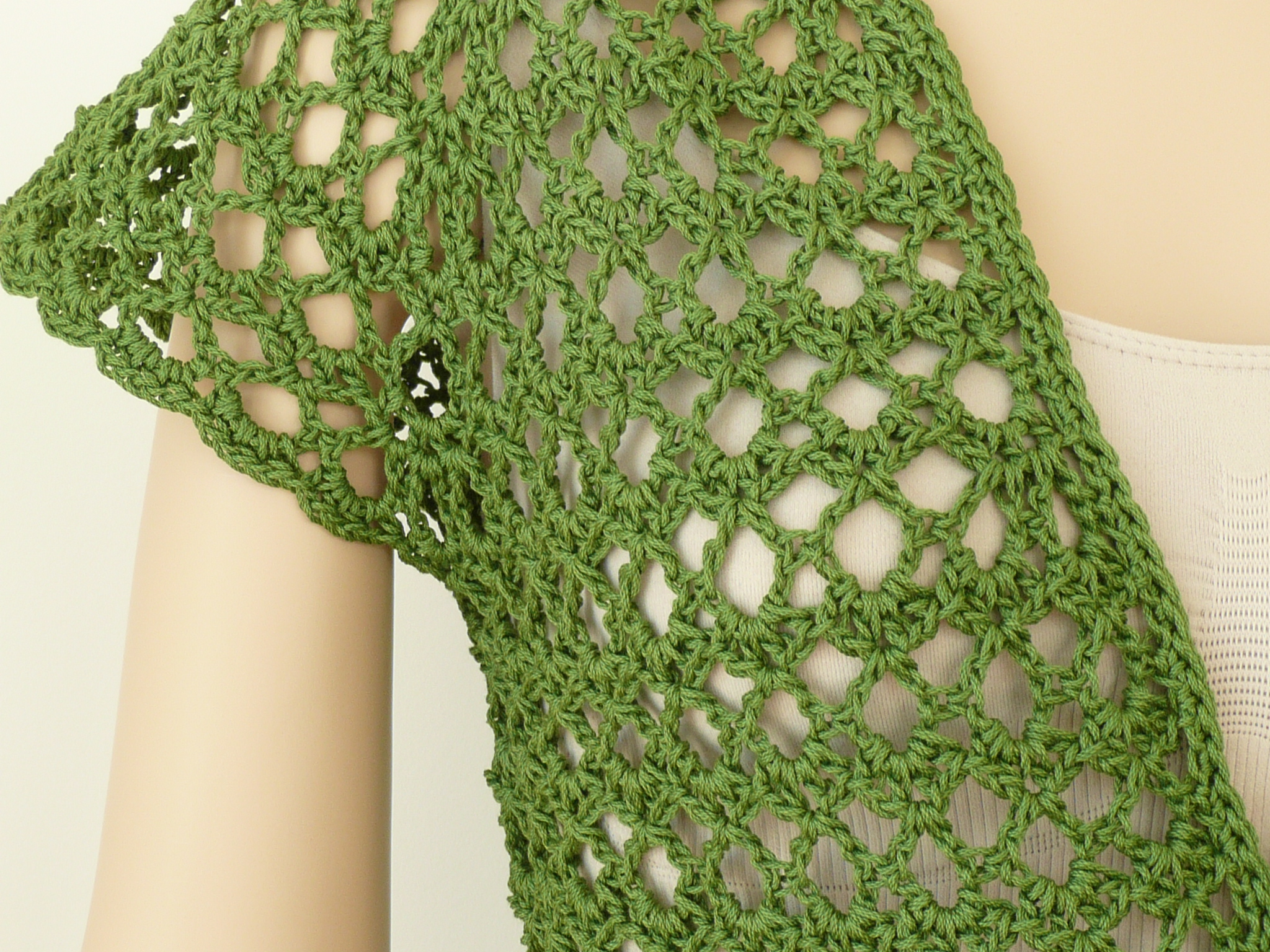
Leaves of Summer is a pretty little vest that is made from the neck down seamlessly.  The instructions begin with a strip of Fsc that forms the back neck; work begins across the single crochet edge of the foundation.  The chain edge of the foundation will be finished later with a simple row of sc edging.  Fortunately, which Fsc variant you use this time is not totally critical, however if your Fsc isn’t like mine please understand that you may not achieve the result as intended.

Blocking Crochet: Just Do It

Yes.  Block.  Yes.  Even if your project looks good to you right off the hook it will look even better blocked, with keener stitch definition, more even edges and proportions, and an overall professional finish. Most of my designs feature seamless, one piece construction and are blocked after they’re done. For projects that are created in separate sections (back, fronts, sleeves) it would be wise to block each piece to measurements before assembly. Yes, that includes motif afghans.

I get a lot of complaints from fans and readers about blocking. Not to perpetuate the perception of crochet and knitting as US vs. Them, but apparently, knitters just do it. In every single knitting pattern I have ever read, particularly for designs requiring the sewing of seams, the Finishing section routinely begins with the words “Block pieces to measurements”. Why, oh why is that same instruction in a crochet pattern greeted with so much fear and loathing?

It’s not because we are slackers unconcerned that our work look its best. The more I interact with crocheters the more I suspect that our attitude about blocking derives from our personal experience with crochet. By far the largest segment of the crochet population comes from a place of craft yarn and from making not-garments.

I was hardly surprised by the recently published results of the 2010 U.S. Attitude & Usage Study by the Craft & Hobby Association (CHA) wherein crocheting shows up as third (with 17.4 million doers) among the Top Ten Crafts by Household Participation (knitting is ninth with 13 million). Crochet ranks seventh (with over a billion dollars) in the Top Ten Craft Segments by Sales.  Knitting does not even appear on that  list.

You really can’t compare these statistics with what we were told in the survey from The National NeedleArts Association (TNNA, a summary of The State of Specialty NeedleArts 2010 is available to the public) because the two studies are, like, apples and oranges… or Boyes and Bates.  I did it anyway.  Picking apart the differences in survey methodology, the statistical significance of the sample sizes (the actual number of crochet respondents in each of the studies), and myriad ways these statistics may be interpreted, I feel the numbers back up something we already knew.  Crocheters spend an uncontested, undeniably big fat whopping gang of money on craft yarn  and not as much money (at least not as much as our knitting sisters) on yarn shop yarn.

Between the lines of these surveys lives the traditional and stereotypic inference that crochet is all about afghans and home goods; knitting is about sweaters and socks.  In my experience the difference is very real.  I have never met a knitter who has not knitted at least one wearable for self.  Can’t say the same about crocheters.

So it is no surprise that millions of crocheters coming from a place of craft yarns and craft projects have never blocked any of their work. Most craft crochet doesn’t truly  need it. I readily concede that there are fibers, project categories and constructions that you don’t want to block, and that we make some things that wouldn’t be any better if blocked so why bother: obviously,  jewelry and beaded/embellished masterpieces; anything crocheted in little bitty pieces or destined to be stuffed (toys, amigurimi, dolls, scrumbles); anything crocheted very firmly and solidly (“hard” crochet meant to stand up on its own); anything for everyday household use (potholders, coasters, tissue covers, dishcloths);  most bags, belts and other accessories like hair doo dads.  No block, no worries.

HOWEVER, day by day more crocheters are coming to my lace garment designs after years (decades for some) of non-garment crochet.  I am overjoyed every time I meet a long-time craft crocheter who has caught the excitement, newly determined to make something wonderful to wear, taking the first steps toward the Dark Side. Once you start down the Dark Path, forever will it dominate your destiny, consume you it will.  🙂

To you I offer these words of encouragement.  I do not berate you for not knowing what you don’t know through experience.  But from this day forth you will block.  Yes you will.  Really.

Blocking is in part for the benefit of the yarn, to bring out the qualities of the fiber that are not apparent in the hank, or to attenuate the qualities already there. In other words there’s more than meets the eye/hand, particularly with many animal fibers like wool and mohair and to some extent alpaca and cashmere which are expected to soften and full (plump up or halo out). You would never have seen this happen with acrylic where blocking makes no discernible change in the fiber.

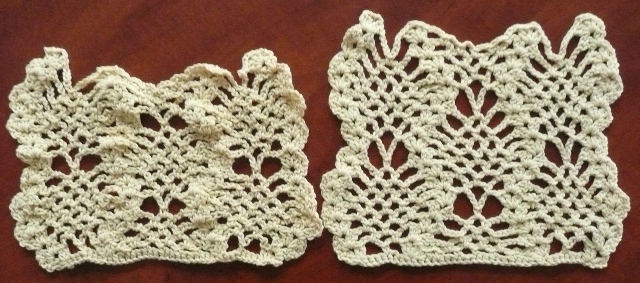
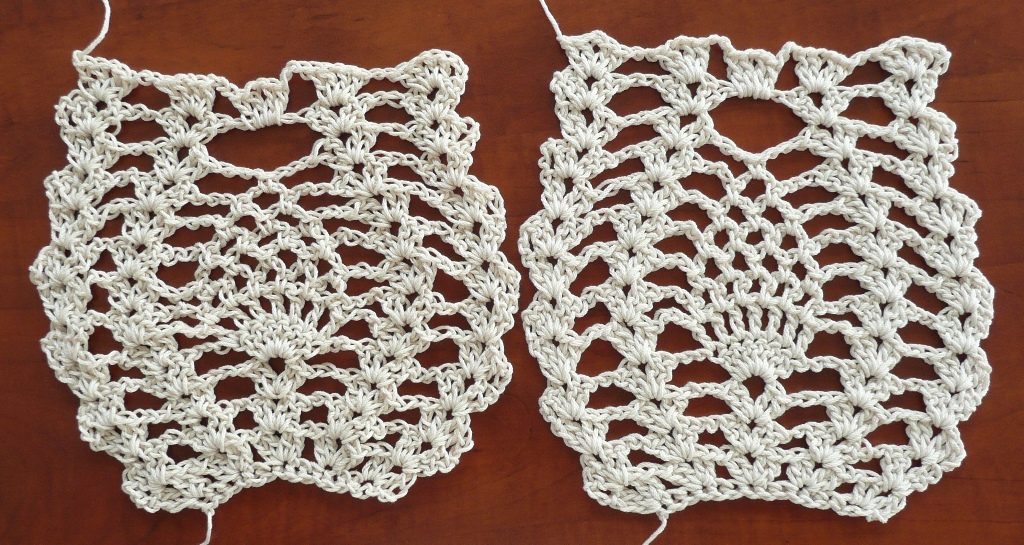
But it’s not just about the  yarn.  The major goodness of blocking is about the crochet stitches and the fabric.  If the yarn is kinky or twisty out of the skein, if the stitch pattern has bunchy bits, holely places, shaping (like ripples, increases or decreases, short rows), blocking helps to lock the stitches in place and smooth out the hinky bits. I did these swatches for an article I wrote a while back.  They’ve been stored… kinda balled up and stuffed in a box all this time… but you can still see what happens.

Do I have to tell you which is which?

To make that swatch come out so horrible I had to force myself to crochet without messing with it at all.  You can’t help but smooth, straighten, pull and stretch the work as you go; we all do it.  It’s part of being able to correctly read your crochet stitches and see what the heck you’re doing. So in that instance the work was artificially made to look really lousy off the hook on purpose.

What about if you finger block as you go and it looks decent off the hook?

Still dont have to say which is which.

Then it becomes an issue of fit and fabric. Blocking helps you achieve full measured garment dimensions and helps create the fabric that you’d most want to wear.  Most lace will gain in both width and length after blocking, but not always in the same proportions or in any calculable way, so you really have to do it to know the end result.  Most crocheted fabric will open up and have improved drape after blocking, be better able to bend, curve and mold around the body.  What you get is a better looking and better fitting garment.

Hey, I block afghans, too.  Especially lace stitch ones.  Even ones that are made in craft yarn granny squares. It never hurts and it always gives your work a smooth, even appearance that spells “hand-made” instead of “home-made”.  Know what I’m saying?

So if I’ve cajoled you into just doing it, check this separate page for an expanded excerpt from one of my DJC Designs patterns that addresses the technique.  Trust me, it be OK.

Foundation and Crochet

Foundation Single Crochet, that is.  In the years since I began using the Fsc as an integral part of my designs, I’ve worried about why many who try the Fsc are having so much trouble with it. I might be part of the problem.  Here I hope to be part of the solution.

I do not claim to have invented this technique.  The chainless foundation has been in use forever as one of the wonderful things you could pull out of your crochet bag of tricks if you knew about it.  But I had never seen the Fsc specifically written into a pattern, even when the design would have been greatly improved by its inclusion. There was an incredible amount of editorial resistance in 2004 when I first dropped the Fsc bomb in my own design patterns.  Resistance proved futile. 🙂 Resistance also equals V/I, depending on what sort of post you think you’re reading.

At the time there was no standard published name for the technique. In the vacuum I gave it my own title (no, I did not name it after myself), Base Ch/Sc, because it makes a base chain and a row of sc in one pass.  I did not want to use the word foundation in the name because to me a foundation row is the first pass of the actual stitch pattern which sets up the repeats upon which the fabric will grow.  After a bit of scrambling among the members of industry’s elite corp of technical editors, one generally accepted title prevailed.  This method of the chainless beginning of a piece of crochet is now known as Foundation Single Crochet.

The Fsc is one of many chainless foundations, elegant solutions to the problems inherent in the traditional chain start.  I’ve written extensively about the beauties of foundation stitches, but haven’t addressed the major angst it has engendered among newbies to crochet and to the technique.

One of the important aspects that I never thought to mention because it seems so obvious while you are crocheting it is that it comes out upside down. It has the feeling of making a long, skinny strip that is one stitch wide, and for those who are familiar with Tunisian crochet technique, it resembles the way the edge stitch is worked as you begin a return pass in TSS.
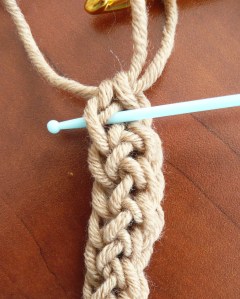
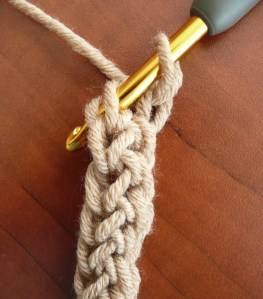
The sc as you make them will not present themselves as a horizontal row going from the hook back to the start of the row the way normal rows look.  This foundation will hang  down from the hook, with the “chain” edge running on the forward side (in the direction of your work, to the left if you are a righty, to the right if you are lefty) and sort of on the top. The “sc” edge is running behind the hook (back from the direction of your work, to the right if you are a righty, to the left if you are lefty) and sort of on the bottom of the strip.

Keep your eyes on the “chain” step of the Fsc.  I tell people to physically grab the chain after you make it; pinch it and keep it relaxed and open so you can 1) find it for the following Fsc, and 2) work into it without struggle.

Here is where some confusion has been generated. The “chain” edge of the foundation is on top and to the left.   Working into the “chain” of the previous stitch under two strands means that you insert the hook so that two strands stay on top and to the left.  You need those two strands to run across the “chain” edge of the Fsc to form the sturdiest, most elastic foundation.

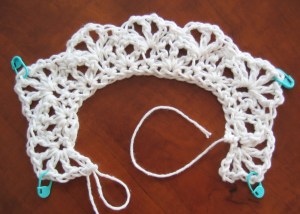
So, in case you’ve been looking for an overwrought, obsessive account of how to do this useful technique, I’ve excerpted some stuff from my DJC Designs pattern, Birthday Girl skirt.  It is written specifically for the beginning of a top down skirt, however the information can be generalized for working other types of projects in rounds (like top down sweaters) or worked flat without connecting into a ring.
Fsc (foundation single crochet): This creates a beginning row of single crochet, each with its own chain at the bottom, for a sturdy, elastic foundation.

Start with a slip knot, ch 2, insert hook in 2nd ch from hook, YO and draw up a loop, YO and draw through one loop on hook (the “chain”), YO and draw through 2 loops on hook (the “sc”).  The following stitch is worked under the forward 2 loops of the stem of the previous stitch (into the “chain”).  *Insert hook into the face of the “chain” and under the nub at the back of the “chain” (under two strands), YO and draw up a loop, YO and draw through one loop (the “chain”), YO and draw through 2 loops (the “sc”).  Repeat from * for the length of foundation.

— To work with Fsc as a ring, let the foundation hang vertically from the hook, with the sc edge running down from the last loop on hook (on the right if you are right-handed) and the ch edge running down the left.  Making sure the foundation is not twisted, take the lower end (beginning end with the tail) and curve it up to meet the hook, with the sc edge on top, sl st in the beginning sc to form a ring.  With the sc edge of the ring now on top, do not turn, start with first round of stitches.

— This foundation has height.  You have connected the stitches at the sc edge, but the ch edge is not yet connected.  Eventually, whenever you get to it, at least before you go back and put the waistband on the skirt, thread the beginning tail onto a yarn needle and loop it through the last ch of the foundation to close the gap, weave in the end.

There is one other caveat I can offer that might relieve some aggravation.  In many of my top-down top designs, the foundation will not remain flat or straight.  Don’t be upset when it becomes curved after laying on the following rows of stitch pattern.  It is suppposed to curve.  By squeezing more stitch pattern onto fewer foundation stitches you are giving a jump start to the increase shaping of the yoke and are on the road to creating the shoulder bumps that fit so nicely.

Curvy not flat.