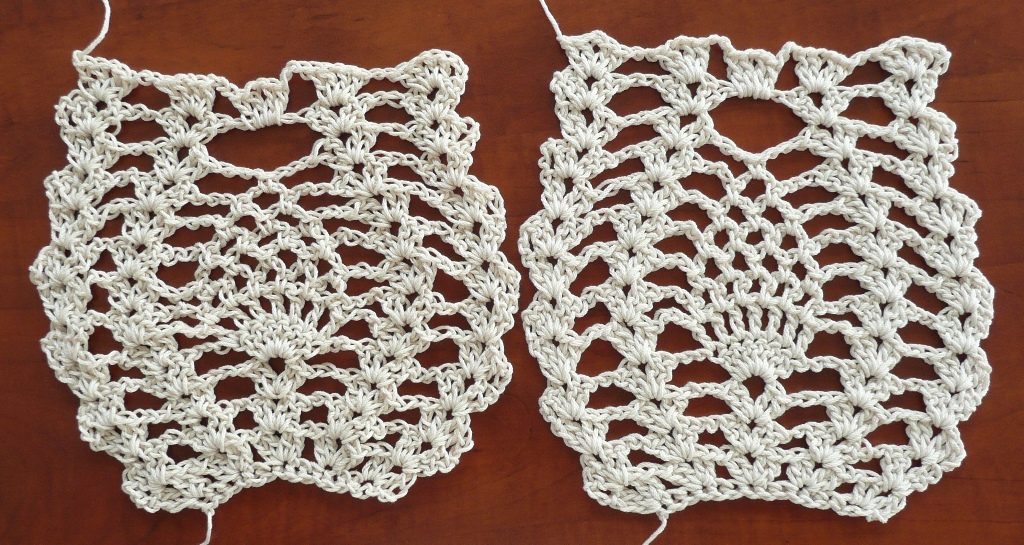
DJC2: Tank Girl Arrives

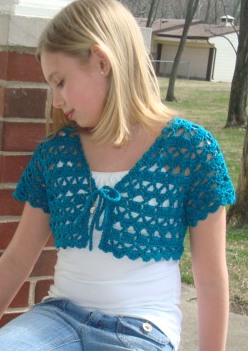
She’s cute …  she’s fast and easy…  and she’s fully loaded.  Tank Girl is the newest pattern in my independent line, DJC, Too!, a collection of garment designs sized and proportioned for girls, tweens and teens.  As the source of previously posted agony, Tank Girl survived her difficult birth and is now available exclusively at DesigningVashti.com.

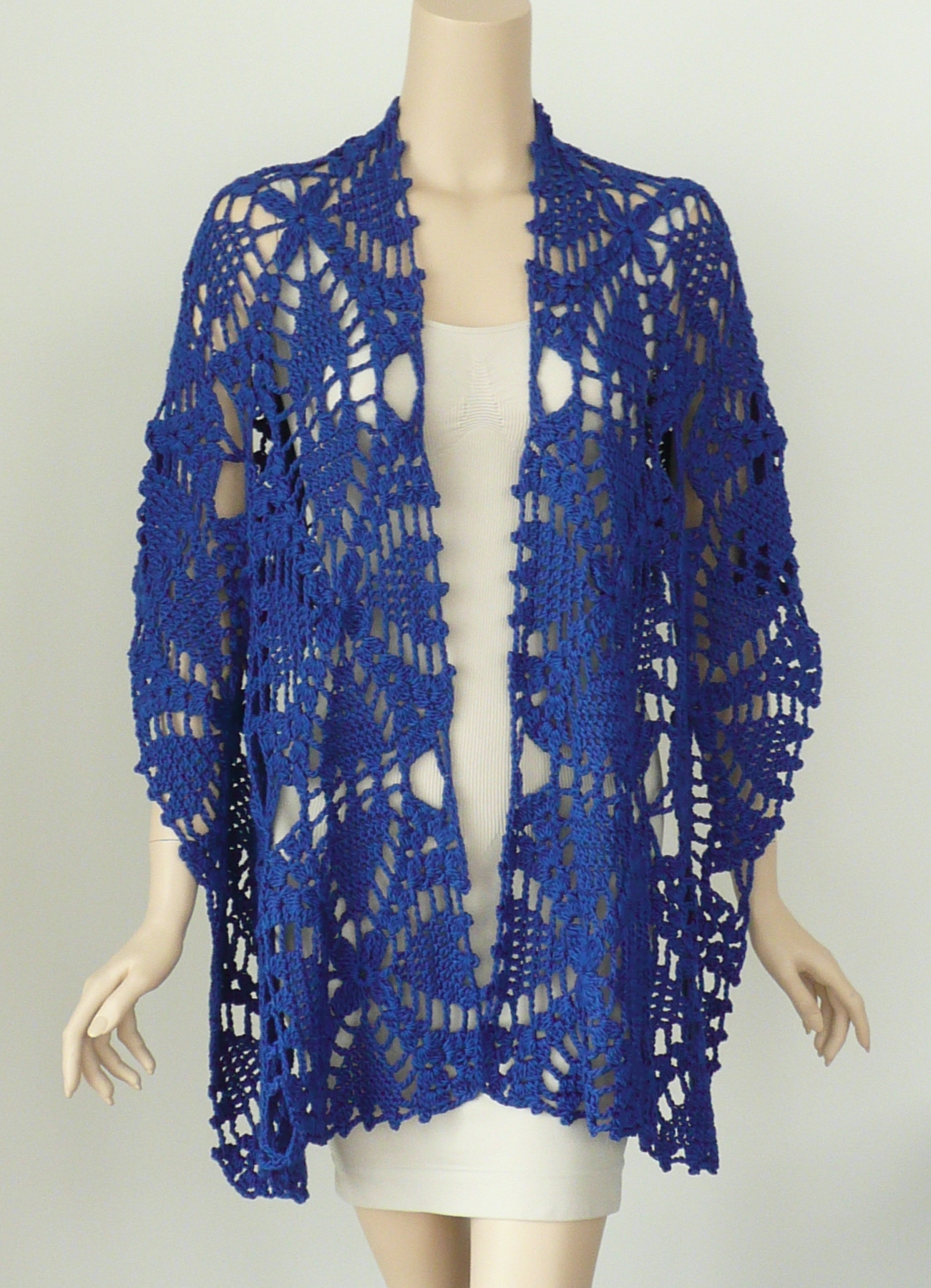
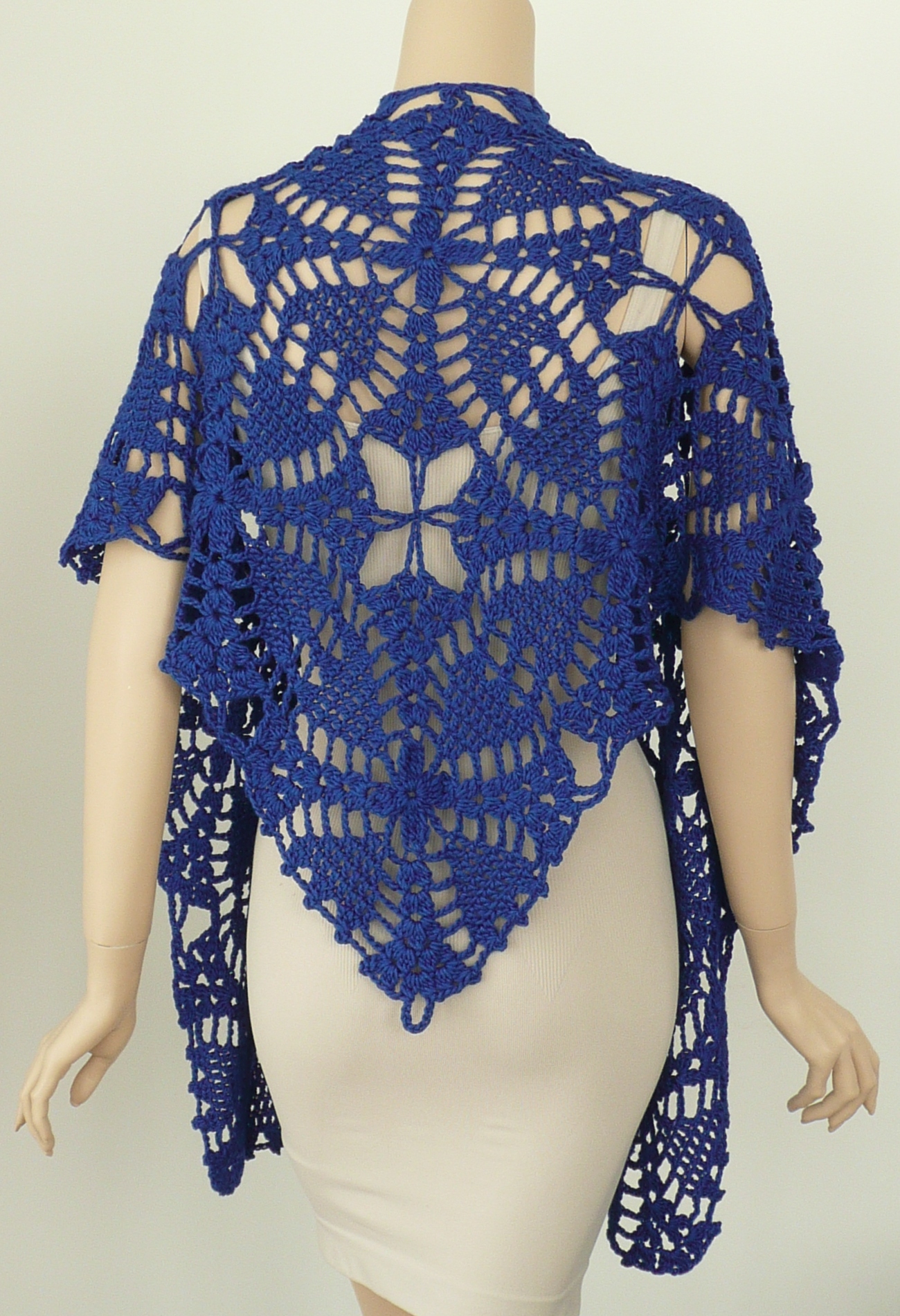
Somebody has to tell me when to stop writing.  The pattern for DJC2: Tank Girl isn’t all that long or complicated, but topping 40 pages the pdf is enormously bloated with information.  Along with  full written instructions for  a fine-gauge, seamless lacy tank or vest in 8 sizes from Girl XS/6 to Junior M/5 in two lengths with options for waist and hip shaping for Junior sizes, I stuffed the pattern with a fitting guide, alteration and yarn substitution tips, multiple stitch diagrams, construction tutorial and the usual blocking guide and caveats, plus images of adorable DJC2 model, Maura.

This slideshow requires JavaScript.

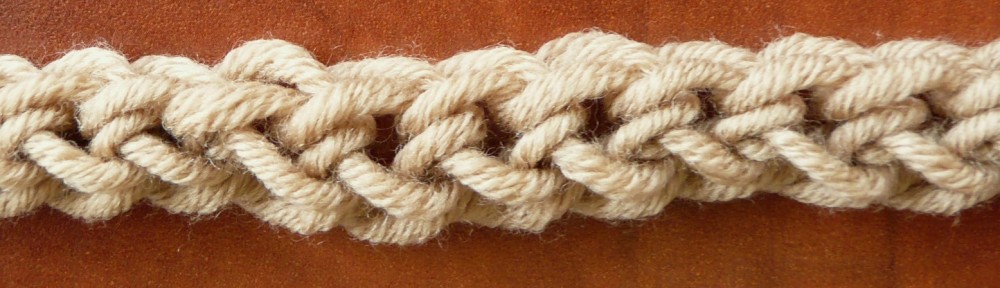
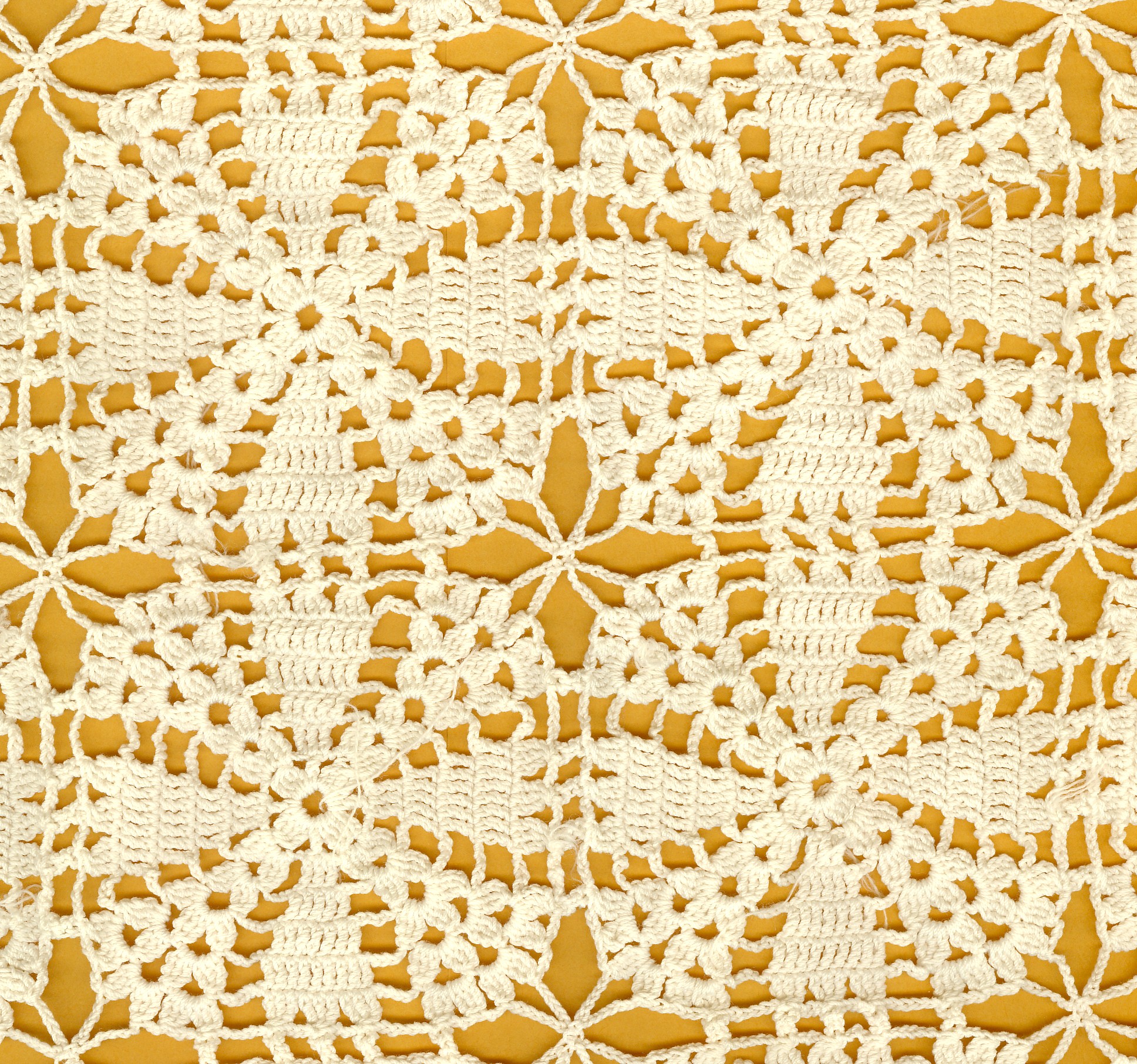
Pay particular attention to this lace stitch pattern.  Coming later this summer you will find out how to take this same pretty lace from the fine weight gauge used for Tank Girl to DK and worsted gauge to crochet the next two DJC2 designs, the versatile sweaters Cardi Girl and Rainbow Girl, just in time for back-to-school.

And if you are a petite or tiny skinny woman, these can be made to fit you, too.  Just saying.  🙂

Backstory: Yokohama Mama

On Mothers’ Day I feel most comfortable assuming the role, not of the mom, but of the daughter.  Of course I own up to the fact that I am the mother of two sons and deeply cherish all that those two rascals have brought to my life.  Never one to wallow in sentiment (like my father in that respect, but so unlike him in other ways) I have nonetheless fondly preserved nearly every gift that the boys have given me over the years.

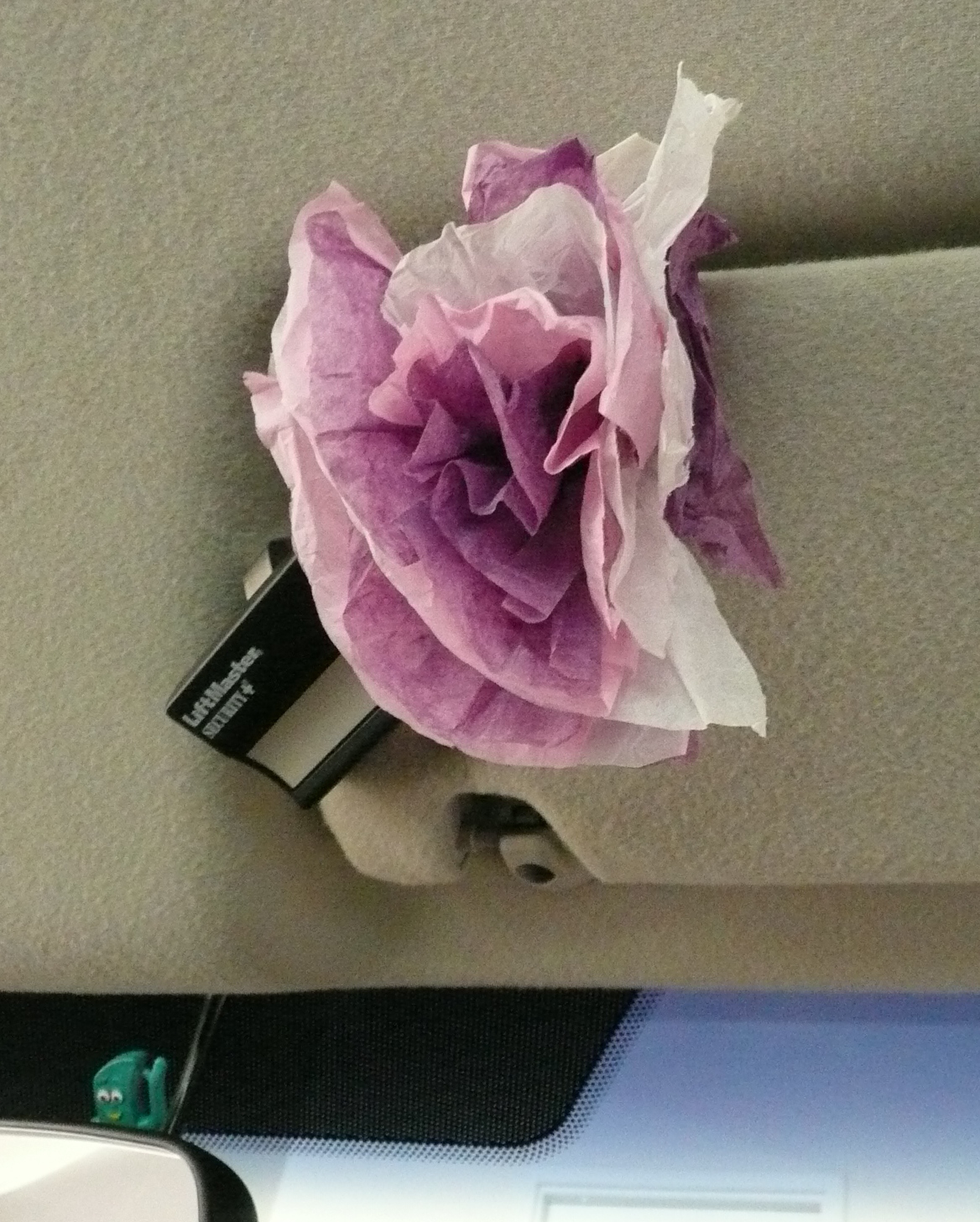
This is a crepe paper flower from Harry that serves as a good luck charm hanging from the passenger side visor of my car.  Yes that’s Gumby.

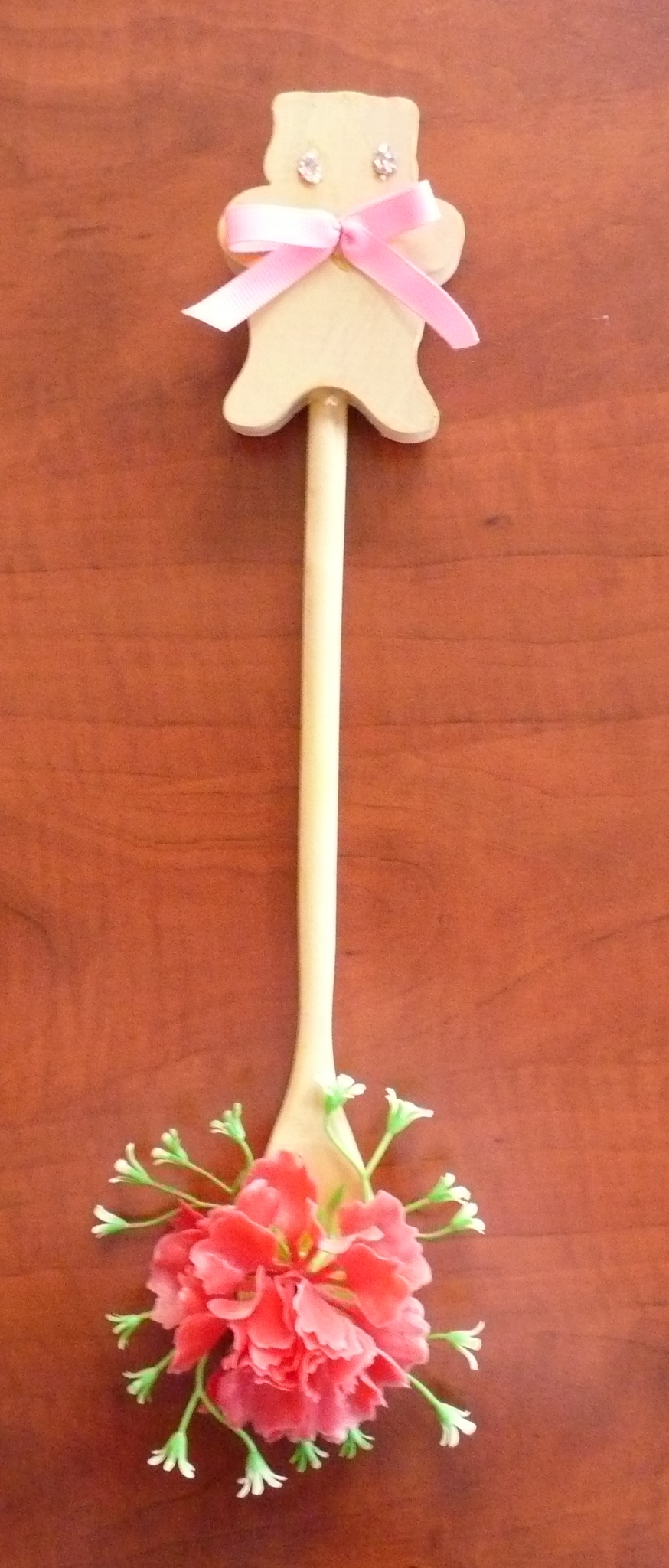
This is a bear-spoon-flower from Harry.  Don’t ask.

This is a portrait of me rendered by Nick on a ceramic tile, and as you can see from the brown rings, used as a coffee mug coaster.  Mercifully for him, he has other wonderful talents.  Have I mentioned that he is the World’s Best Beat-Boxing Actuary?

There is one infamous gift that I couldn’t show you because it is in a box buried beneath, what else, cases of stashed yarn.  One day Harry came home from school covered with gack.  He had globs of white stuff smeared all over his clothes and shoes, in his pockets, under his fingernails, stuck in his hair, even some in his ears.  It took major soaking and scrubbing and complaining before we got him reasonably clean.  A few days later on Mothers’ Day, I learned what all the mess was about.  A well-meaning teacher in Harry’s class helped the kids make plaster hand prints for their moms.  Right.  Thanks.  I keep that sweet little hand print to remind me how memory is selective.  We remember the good and forget the gack.

My mother is also a saver of keepsakes.  I never knew how many seemingly inconsequential things she had kept, probably without my dad knowing. Dad was a so-not-sentimental kind of guy, practical in all ways.  He could not imagine wanting to collect anything (and never in a million years would he have understood the concept of yarn stashing). There wasn’t room in his life or his home for too much stuff that wasn’t useful or needed right now.  It’s not that he would throw things out for no reason, because he abhorred waste.  It’s just that his concept of waste applied to wasted space as well.

Just after my dad died, whether she was feeling her own mortality and needed to pass on some of her belongings while she could or whether she just wanted to clear out some of the old junk and make room for new junk, Mom went through most of the attic and gave me dibs on anything I wanted to take away, with the implied threat that anything I did not claim would end up in the trash.  How could I refuse such an offer?

From among the souvenirs, mementos, knick-knacks, crates of mis-matched china, stacks of her hand-embroidered linens, she pulled out a tattered piece of thread crochet.  I remembered seeing that doily on top of Mom’s dresser when I was a kid, but that was many decades and nearly as many dressers ago.  It was the only bit of crochet in there and, as I was to discover during my research later, the only piece of crochet from her original trousseau that survived.  My mom was about to toss it in the trash pile, but something made me stop her.

Fast forward a few years.  I had begun a career as a crochet designer and was working on my first book, Amazing Crochet Lace, the introduction to which is a huge tribute to my mom.  Naturally, I had to include an image of the vintage doily that I saved from the attic that day.

I had planned to create a garment design based on the thread motif she used, but publishing being what it is, that exploded motif vest ended up on the cutting room floor so to speak.  I had seriously run out of real estate (book pages) and had to set the idea aside.

Fast forward another few years.  I received a call for designs from Piecework, the sister magazine to Interweave Crochet.  Piecework delves into the history of needlework, all types of needlework.  I had never thought to submit any of my crochet designs for publication there because none of my work actually has any history.  But something made me revisit the attic doily. I called Mom and through our conversation I pieced together the story of her crochet, this doily and my proposed design.  This time I kept the concept simple.  This time the pattern came in under three pages! This time the idea took off and the result is Yokohama Mama, featured in the current Spring 2011 Lace issue of Piecework.

Although the Yokohama Mama project and the accompanying little history I wrote could be considered a Mothers’ Day gift from me to my mom, for me it will ever be a treasure that she gave me, a tiny seed rescued from the attic that she planted in my heart and encouraged to grow.

My Shiny New Flamie Awards!

WOWSERS!  An embarrassment of riches!   I now proudly display the TWO 2011 Flamies I took home from last night’s Third Annual Crochet Liberation Front Flamie Award Ceremony:

Congratulations to all the winners.  A million thousand thanks to the CFL and Fearless Leader Laurie Wheeler for shouldering the monumental task of producing the awards every year; to Mary Beth Temple and Josh Mckiernan, genial hosts of last night’s live presentation on Getting Loopy; to Darlisa Riggs, designer of these gorgeous virtual awards; and my gratitude to all who voted.

I foolishly wrote a speech, jotting down some notes to keep me mindful of all I wanted to say when accepting the awards.  What was I thinking.  All preparedness and caution go out the window at these things. So if you missed the show, you can listen to it in archives and hear how we all sort of burbled and gushed our way through the night. Go here, scroll down to the Flamies episode, enjoy.

A major contributing factor to the tendency toward on-air burbling was…  how can I put this delicately… the, uh, the festive atmosphere off mic.  Not only was there a gala CFL party going on in Georgetown, Texas, but there was a rowdy gang piled thirty deep in the Getting Loopy chat room providing support and heckling for each other.   I do hope no serious damage remains at either venue as a result of the night’s frivolity.

And, for the record, the game that was mentioned, wherein all were encouraged to down a slug of whatever libation was in hand or take a bite out of a chocolate Easter bunny (chocolate-covered Peeps may have been substituted) every time the word “crochet” was uttered during the show, that was merely a suggestion.  I didn’t force anyone to play, so am totally not responsible for any overindulgence or questionable behavior resulting from it.

Curiously, I notice this morning that half a bottle of wine is gone and a huge dent has been made in my stash of chocolate-covered Peeps. 🙂

You can see the complete list of 2011 Flamie Award winners  here at the CLF blog.  Congrats to all!

Blocking Crochet: Just Do It

Yes.  Block.  Yes.  Even if your project looks good to you right off the hook it will look even better blocked, with keener stitch definition, more even edges and proportions, and an overall professional finish. Most of my designs feature seamless, one piece construction and are blocked after they’re done. For projects that are created in separate sections (back, fronts, sleeves) it would be wise to block each piece to measurements before assembly. Yes, that includes motif afghans.

I get a lot of complaints from fans and readers about blocking. Not to perpetuate the perception of crochet and knitting as US vs. Them, but apparently, knitters just do it. In every single knitting pattern I have ever read, particularly for designs requiring the sewing of seams, the Finishing section routinely begins with the words “Block pieces to measurements”. Why, oh why is that same instruction in a crochet pattern greeted with so much fear and loathing?

It’s not because we are slackers unconcerned that our work look its best. The more I interact with crocheters the more I suspect that our attitude about blocking derives from our personal experience with crochet. By far the largest segment of the crochet population comes from a place of craft yarn and from making not-garments.

I was hardly surprised by the recently published results of the 2010 U.S. Attitude & Usage Study by the Craft & Hobby Association (CHA) wherein crocheting shows up as third (with 17.4 million doers) among the Top Ten Crafts by Household Participation (knitting is ninth with 13 million). Crochet ranks seventh (with over a billion dollars) in the Top Ten Craft Segments by Sales.  Knitting does not even appear on that  list.

You really can’t compare these statistics with what we were told in the survey from The National NeedleArts Association (TNNA, a summary of The State of Specialty NeedleArts 2010 is available to the public) because the two studies are, like, apples and oranges… or Boyes and Bates.  I did it anyway.  Picking apart the differences in survey methodology, the statistical significance of the sample sizes (the actual number of crochet respondents in each of the studies), and myriad ways these statistics may be interpreted, I feel the numbers back up something we already knew.  Crocheters spend an uncontested, undeniably big fat whopping gang of money on craft yarn  and not as much money (at least not as much as our knitting sisters) on yarn shop yarn.

Between the lines of these surveys lives the traditional and stereotypic inference that crochet is all about afghans and home goods; knitting is about sweaters and socks.  In my experience the difference is very real.  I have never met a knitter who has not knitted at least one wearable for self.  Can’t say the same about crocheters.

So it is no surprise that millions of crocheters coming from a place of craft yarns and craft projects have never blocked any of their work. Most craft crochet doesn’t truly  need it. I readily concede that there are fibers, project categories and constructions that you don’t want to block, and that we make some things that wouldn’t be any better if blocked so why bother: obviously,  jewelry and beaded/embellished masterpieces; anything crocheted in little bitty pieces or destined to be stuffed (toys, amigurimi, dolls, scrumbles); anything crocheted very firmly and solidly (“hard” crochet meant to stand up on its own); anything for everyday household use (potholders, coasters, tissue covers, dishcloths);  most bags, belts and other accessories like hair doo dads.  No block, no worries.

HOWEVER, day by day more crocheters are coming to my lace garment designs after years (decades for some) of non-garment crochet.  I am overjoyed every time I meet a long-time craft crocheter who has caught the excitement, newly determined to make something wonderful to wear, taking the first steps toward the Dark Side. Once you start down the Dark Path, forever will it dominate your destiny, consume you it will.  🙂

To you I offer these words of encouragement.  I do not berate you for not knowing what you don’t know through experience.  But from this day forth you will block.  Yes you will.  Really.

Blocking is in part for the benefit of the yarn, to bring out the qualities of the fiber that are not apparent in the hank, or to attenuate the qualities already there. In other words there’s more than meets the eye/hand, particularly with many animal fibers like wool and mohair and to some extent alpaca and cashmere which are expected to soften and full (plump up or halo out). You would never have seen this happen with acrylic where blocking makes no discernible change in the fiber.

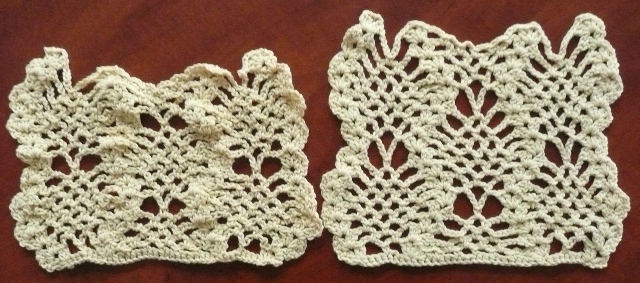
But it’s not just about the  yarn.  The major goodness of blocking is about the crochet stitches and the fabric.  If the yarn is kinky or twisty out of the skein, if the stitch pattern has bunchy bits, holely places, shaping (like ripples, increases or decreases, short rows), blocking helps to lock the stitches in place and smooth out the hinky bits. I did these swatches for an article I wrote a while back.  They’ve been stored… kinda balled up and stuffed in a box all this time… but you can still see what happens.
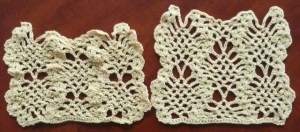
Do I have to tell you which is which?

To make that swatch come out so horrible I had to force myself to crochet without messing with it at all.  You can’t help but smooth, straighten, pull and stretch the work as you go; we all do it.  It’s part of being able to correctly read your crochet stitches and see what the heck you’re doing. So in that instance the work was artificially made to look really lousy off the hook on purpose.

What about if you finger block as you go and it looks decent off the hook?
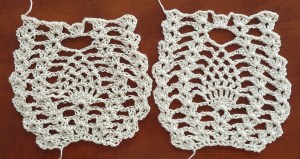
Still dont have to say which is which.

Then it becomes an issue of fit and fabric. Blocking helps you achieve full measured garment dimensions and helps create the fabric that you’d most want to wear.  Most lace will gain in both width and length after blocking, but not always in the same proportions or in any calculable way, so you really have to do it to know the end result.  Most crocheted fabric will open up and have improved drape after blocking, be better able to bend, curve and mold around the body.  What you get is a better looking and better fitting garment.

Hey, I block afghans, too.  Especially lace stitch ones.  Even ones that are made in craft yarn granny squares. It never hurts and it always gives your work a smooth, even appearance that spells “hand-made” instead of “home-made”.  Know what I’m saying?

So if I’ve cajoled you into just doing it, check this separate page for an expanded excerpt from one of my DJC Designs patterns that addresses the technique.  Trust me, it be OK.