>The Best Way to Get Answers

>OK. Here’s the thing. It is nearly impossible in blog format to answer crochet questions person to person in an efficient way. So, if any readers need answers about any of my books, designs, patterns and such, please hold that thought and go over to Ravelry.

Ravelry is the site where we play. All fiber enthusiasts are welcome to sign up and join the fun, whether it’s crochet, knitting, spinning, weaving… it’s all good. This is a free ride, no fees, no hassles, no junk e-mail, pretty much no downside. Well, actually there is one fairly significant downside. You’ll find yourself spending so much time there that you won’t get anything else done. Trust me.

The site is the brainchild of Jessica and Casey Forbes, a young, brilliant, adorable couple. Jess is the knitter; Casey is the code monkey. Together they built this central web site where we can share and organize information about the fiber arts. In just a couple of years, Ravelry has grown to include nearly 350,000 members from all over the world.

When you click on the link I’ve provided, you can put yourself on a waiting list. Being asked to wait really sucks, but this has nothing to do with exclusivity. I understand the waiting list is necessary for technical reasons. Hey, you don’t want the site to crash, do you? So please don’t be put off. In a couple of days you’ll receive an invitation to join and all will be worth the delay.

Once you’re in and you’ve looked around, search “Doris Chan” and you’ll get to my design pages, where you can find practically everything I’ve ever done, with images, information and links to available patterns. Please wander over to a Rav group that is dedicated to my designs, Doris Chan: Everyday Crochet. On the group’s forum you’ll be able to ask all your crochet questions for me and the posse, hundreds of friendly crochet fans who are eager to help.

Thank you for your interest in my stuff. Hope to see you at Ravelry! 🙂

>A Man’s Garden

>Last week marked the 12th anniversary of the death of my father. Dad might have approved of my activities on that day. I was spring cleaning and for the first time since moving into this house I was able to see the floor of my crochet workroom/sweatshop. Gee, nondescript beige carpet. Who knew?

For some reason last week’s cleaning process extended far beyond the limits of what I normally call “straightening up”. In other words, I did not just go through the motions of waving a Swiffer duster and shifting the boxes, bags and stacks of stuff around until I could man-handle the closet doors, cabinets or drawers shut. I actually opened the boxes, bags and waded through the stacks.

At the back of a drawer in a file folder (suddenly I have an overwhelming urge to sing “Among My Souveniers”, the 1959 hit recording by Connie Francis) I found a yellowing newspaper section. It was a Philadelphia Inquirer Magazine (a Sunday supplement) dated 13 July 1986 and I could not think why I saved this thing. Eager for any excuse to stop cleaning I began leafing through the pages and stopped when I got to the “Our Town” column. There in black and yellow was the first piece of professional writing I ever did.

The word “professional” is used here in the broadest of terms. I think I got fifty bucks for this essay. Last week, in that moment of deep nostalgia, on that particular day, having nothing to do with inflation or higher fees, these words were priceless.

I had offered this piece with the title “A Man’s Garden”, but the editor changed it to “Portrait in Green”. No reason given. I did not sign a contract at the time, and no written agreement exists as to the rights to reprint it today, but I’m going to do it anyway. If anyone at the newspaper has a really long memory and has problem with this, I will give them back the fifty bucks, OK?

He wishes he could see it from his doorstep, but it’s a good 200 yards to his garden, the plot we enclosed with chicken wire hung with pie pans to fend off assaults from the Greek family’s goats, rabbits and fowl. Before the bankruptcy of his New Jersey truck farm, my father used to walk me around the 40 acres of his domain, telling me of his visions — Chinese vegetables just leaping from those muddy red beds and into crates bound for Chinatown. Today I wander alone from his “after” home, a rented cottage on a solvent-somebody-else’s farm, in the direction my mother points.

“He always goes out there, ” she sighs. “Now there’s no more football, he never stays inside Saturday, Sunday, all the time outside.”

Through my father’s eyes, this garden bursts with the exotic and the sublime: sweet crisp snow pea pods, pungent Chinese parsley, Chinese broccoli, long beans, water spinach. I see only a wretched, badly sloping corner of land nobody else wants and whose sole bounty is of the igneous, sedimentary or metamorphic variety.

I find him bent over a particularly stubborn weed in the back-breaking process of turning the soil by hand. I have only to imagine on his head a coolie straw hat to see him as he was, a sturdy brown peasant boy learning how to coax vegetables from the earth, long ago in Canton province. The dirt-floor shack that sheltered him and eight brothers and sisters also housed the pigs.

“Oh, those pigs, they were like money for us,” he once told me. “We took them inside every night. All animals were very valuable.”

“You kept pigs as pets?” I asked. We kids had been lobbying for a dog in those days and wondered why we never met with much success.

“Nobody in China had pets!” he would snort. “If the animals don’t help you grow food or you can’t eat them, they’re no use.”

“Didn’t you have any pets at all?” I hoped, still trying.

“We used to play with the water buffalo,” he said, mischief animating his old/young face. “The smaller village boys like me, our job in the paddies was to take care of the water buffalo. They were big but not too stable. If you got on their sides, you could push them right over. Ay-ah, those legs, not too stable sideways.”

Today I swing open the chicken-wire gate and wish my father didn’t work so hard on this rock pile.

“At least back in China, you had water buffalos to plow the fields. Why don’t you rent a Rototiller?”

He straightens, and in his crinkled eyes I see fire. “I went down to that renting place. They want $60 dollars a day for one of those things. For $60, I can buy vegetables all summer. What I need that for?” He shrugs. “I can still work. I do it myself.”

And in that moment of perverse pride I can see a rice paddy, a village boy and the smile he has on his face, having just pushed over his first water buffalo.
>OOOOPS

>I just tonight discovered that, due to the way it has end flaps that fold over to the insides of the front and back covers, my second book, Everyday Crochet, is fairly impervious to spilled coffee.  As long as the slick cover receives only a moderate splash (less than half a cup), the temperature of the spill is reasonably lukewarm and you rush your butt to grab a miracle cloth to mop it up, then there’s no harm done.

This does not imply that I have in any sense relaxed my self-imposed rules regarding beverages anywhere within 5 yards of my yarn, projects, books or computer. This does assume that I messed up and broke the rule and am now vewy, vewy sowwy.

>BACKSTORY: KDTV Episode 208

>Today online registration opened for The National NeedleArts (TNNA) summer 2009 show in Columbus, Ohio. This is the place where industry exhibitors show off their wares to needlework retailers, where yarn shop buyers get to preview and order the new yarns and products over which we will all be drooling next season, where editors and publishers keep tabs on what’s happening. TNNA shows are not open to the general public. But they let us designers hang out. Hokey smokes, they even throw yarn at us!

This show is a must-see for the sheer sensory overload of so much yarn. I swear I go home with a stiff neck from days of whipping my head around every time someone exclaims “Oh My God, look at that!”. Aside from the primary yarn objective, for me TNNA is also about people and opportunities, the chance to grab quality face-time with colleagues, yarn company reps and editors. You’d be surprised (or maybe not surprised) how many industry relationships are created and cemented over drinks at the Big Bar on Two at the Hyatt Regency Columbus.

My happy anticipation for this year’s event is way different from the angst I experienced last year. See this post from June 2008, my post-TNNA recap. I have not yet seen this episode of Knitting Daily TV, on the topic Seamless Construction containing the segment we recorded last June. But I understand that it has aired and is available for purchase.

Here’s a still taken right before the shoot. On the right that’s Kim Werker, host of the segment and editor of Interweave Crochet at the time, looking so poised and prepared. The other one is me, like a rabbit gone “tharn” or a deer in the headlights. Please, please, please tell me I didn’t look so completely petrified throughout the entire thing. 

The yellow top next to me is the design we featured during the segment, the Bell Sleeve Pullover taken from the now legendary Tahki Crochet 2006 book. When I was working on that garment in 2005, I was not yet sensitive to the need for extra pattern sizing nor was I skilled enough to provide it. Thanks to KDTV and segment sponsor Tahki Stacy Charles I was given a rare gift; the chance to go back, revisit the design and make up for such a shameful omission.

The revised pattern with re-proportioned sizing to fit up to 3XL (55″ finished bust circumference) is now available as a free download from Knitting Daily TV. You will need to sign up before you can click through.

BTW, here’s a link to the TNNA application form for Affiliate membership, the category which includes designers, teachers and publishers

>Take a better look at: Beaded Edge Scarf

>


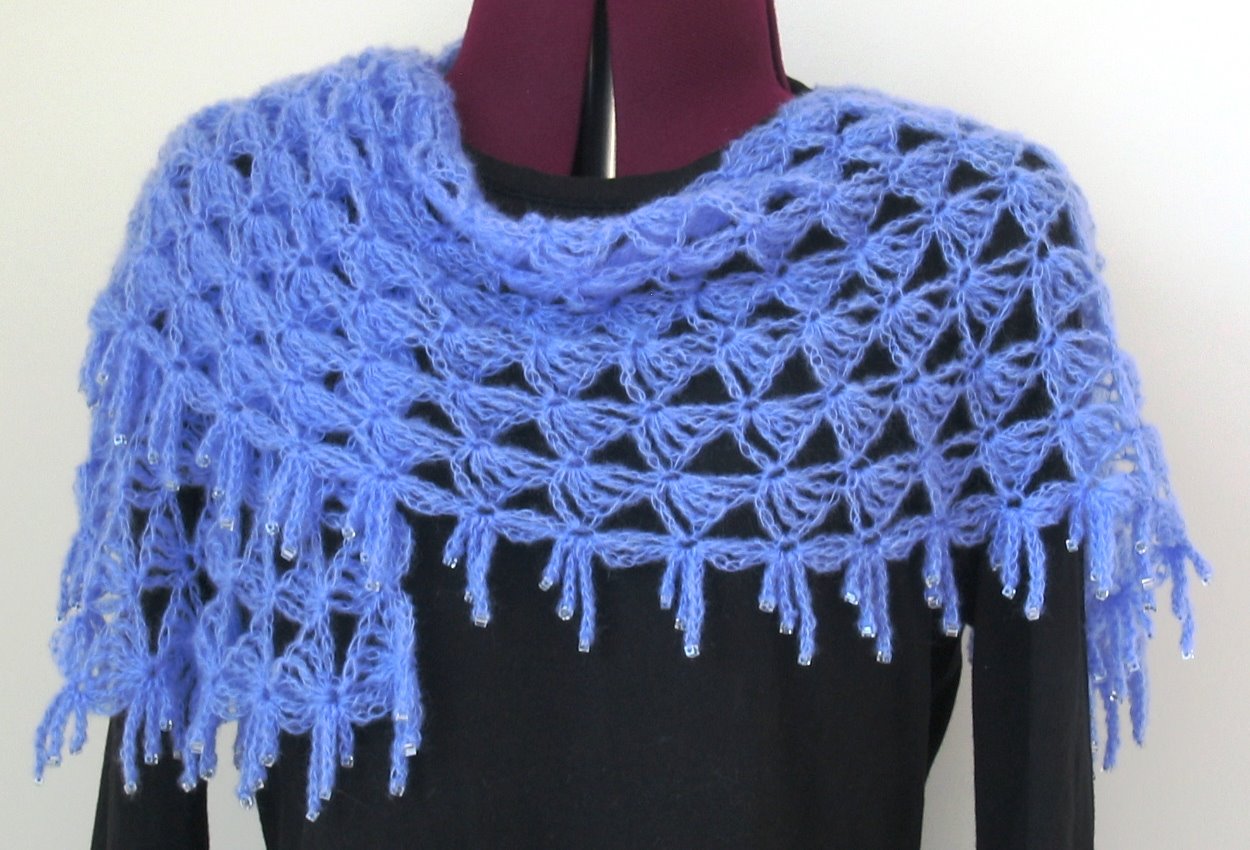
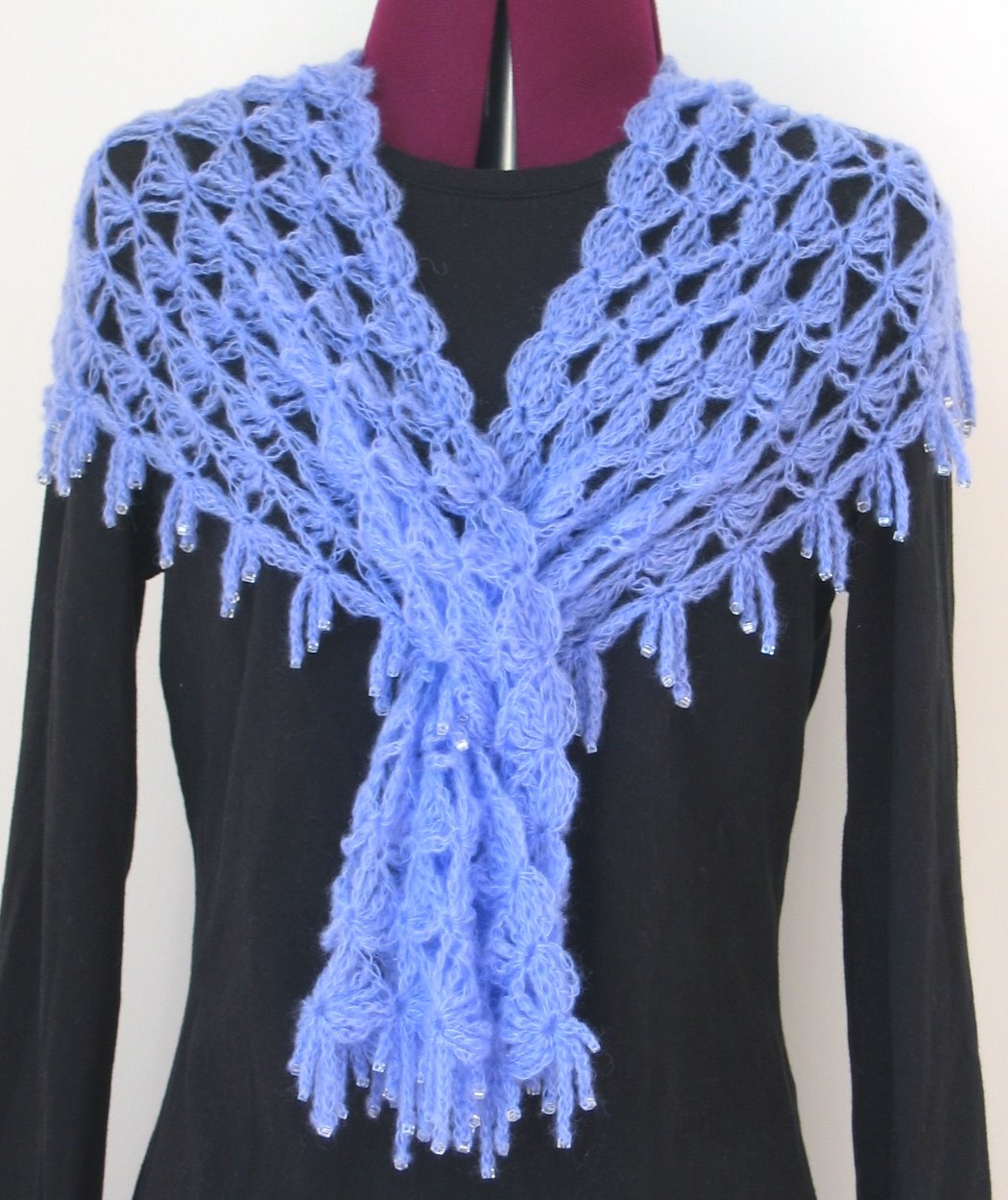
I wish I had the time, energy, skills (and software!!!) to make you fully realized 3-D images of certain designs. Often the true scrumptiousness of a garment is not apparent in print fashion photography. Take the Superior Crochet book from Filatura di Crosa (Tahki Stacy Charles, February 2009), featuring designs by me and by Kristin Omdahl. Don’t get me wrong. This book is incredibly beautiful. This is not a criticism of the images, the photographer or the publisher. This is a sidebar that speaks to a generation of readers who have been spoiled by electronic media to the point where one picture is not worth a thousand words anymore.

Gee whiz, with the waggle of a finger (you don’t even have to press buttons anymore!) you can enter virtual worlds where it is possible take virtual sightseeing tours, examine virtual shoes from Chucks to Choos, get 360 degree looks at everything from laptops to trucks.

I know this is not going to be the same. My amateur photography sucks. It’s a total insult to the professional shootist I am fairly certain was responsible for the gorgeous book images. Yup, those shots have that classy, understated Jack Deutsch touch. Sorry dude.

But I thought you might like to see the back of the Beaded Edge Scarf, which comes to a point:

and a couple of alternate ways to wear it:


If you choose to crochet this pretty little accessory, please do put on the beads. Fringe that is weighted with beads is so flirty and swingy and it really does make the most of this extra-fine, soft yarn with a brushed texture, a luxurious blend of cashmere and silk.