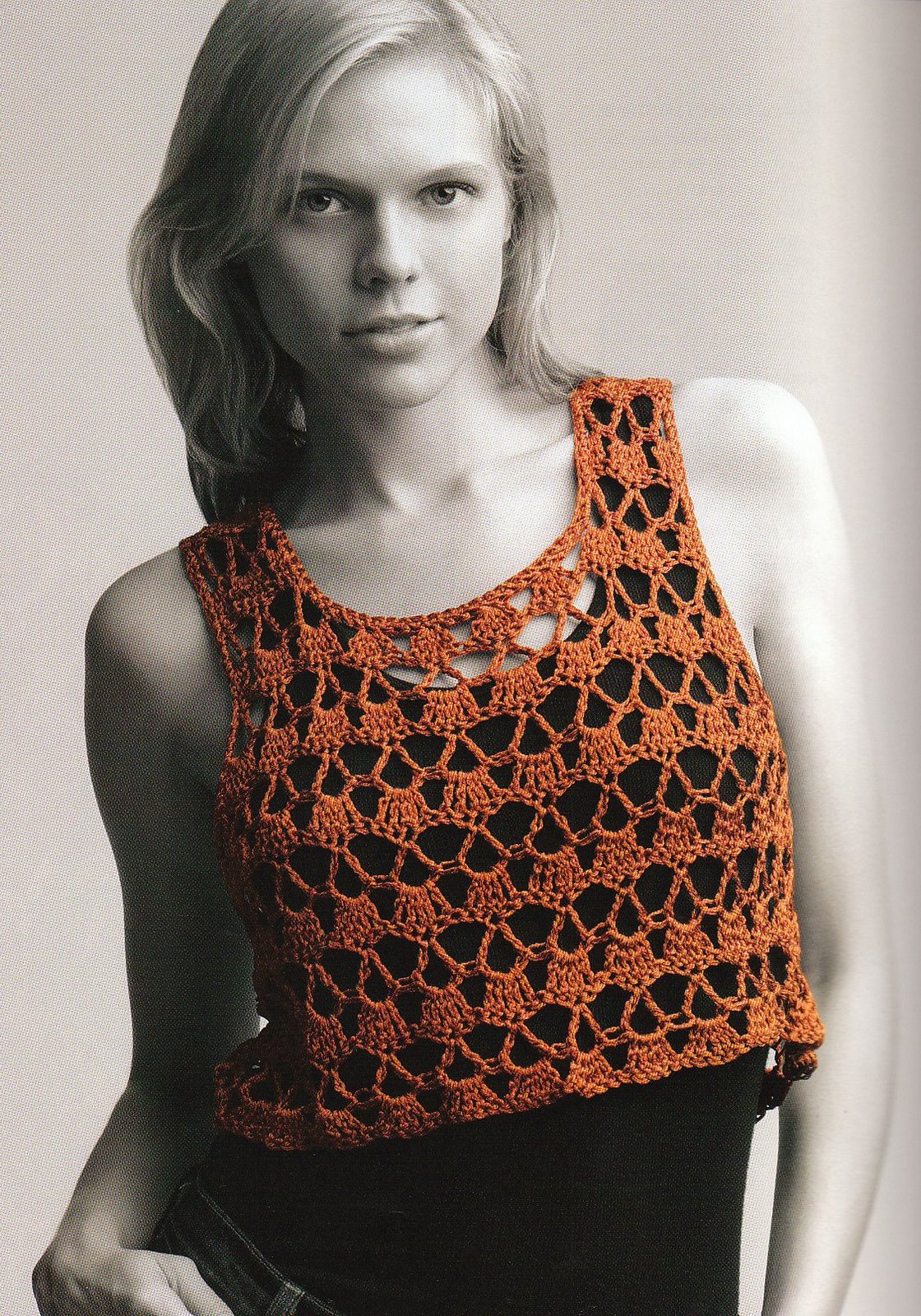
>What I’m not wearing today: Elegant Ewe All Shawl

>
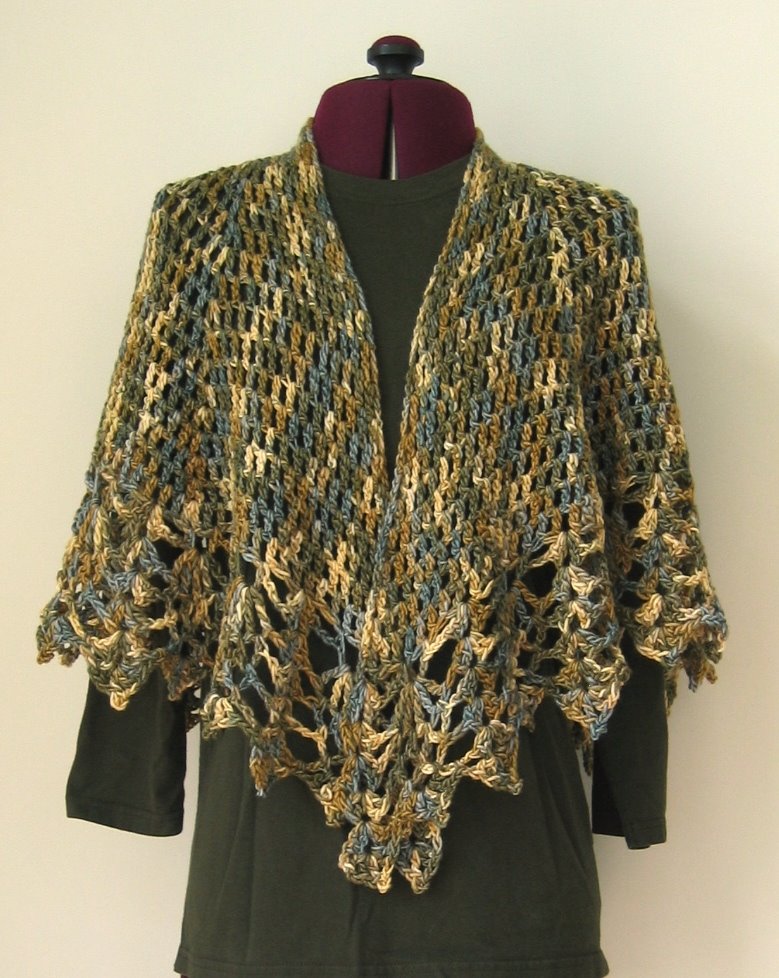
This is the All Shawl made for the Elegant Ewe, my book signing host for 2008 CGOA Chain Link in Manchester NH, in a stunning new colorway with which Marci had fallen in love. As is my usual method of procuring materials for design purposes, I contacted the distributor, begged and begged and held my breath. Luckily I did not have to miss much oxygen, because Lisa at Fairmount Fibers sent this yarn before I had barely begun to turn blue. 😀 Thanks, Lisa!

Alas, my amateur photography does not do justice to this fabulous yarn. It is Manos del Uruguay Silk Blend in the variegated colorway Olivewood. The true colors are much warmer and golden than the image, trust me. And even though these are not MY colors and even though I can’t wear wool, I am so tempted to keep this. Ah, heck. Too late.

With the handsome, taller-than-me Marci and Kelly in mind, I fashioned this version to be better proportioned and a touch fuller for extra fling and drama. It required perhaps 100 yards more yarn to do one this way, but worth every inch. Here are the specifics:

SIZE 20” back length, 50” front edge

MATERIALS
Manos del Uruguay Silk Blend; 30% silk, 70% Merino Extrafine Wool, Kettle Dyed; 1.75 oz (50 g)/150 yd (135 m)
4 hanks in 3120 Olivewood (approx 540 yds used)
Size J-10 (6 mm) crochet hook

GAUGE
In edc mesh, 9 sts = 4″; 4 rows = 3″

INSTRUCTIONS
Make a medium length, fuller version of the basic All Shaw by: Fsc 9, with 9 V’s in Row 1 (18 sts), work mesh body to 20 rows total (170 sts). Continue with lace trim, making 21 lace pattern repeats.

I wish this was a petting blog so you could feel the luxury of this fabric!

>Forgiven, Not Forgotten

>Upon hearing the news about the passing of George Carlin, I sat shocked and saddened. And then I think I smiled, because I immediately thought of those classic Carlin monologues that never fail to crack me up. Laughter is his legacy; what better tribute than to ROFLMAO!

One Carlin bit that came to mind, perhaps the only one that may be repeated in polite company, is the tirade about storing your stuff. My initial smile led to thoughtfulness, which led to my blog (why are you not surprised?), where I now follow my stream of consciousness.

Ever wonder where your stuff goes when you lose it? Odd socks, earring backs, loose change, pens, and the many small implements of crochet, yarn needles, stitch markers and hooks, where do they go? When I was a kid I thought I had the answer. I thought I had ALL the answers. I now realize that I did have all the answers… I’ve just forgotten them.

In 1963, Mrs. Hill, my third grade teacher at Fleetwood Elementary School, sent us home with a summer reading list and unknowingly changed my life. I am not sure how many of the books on her wonderful list I got to read, but I do remember three in particular. Black Beauty (1877), by Anna Sewell, A Wrinkle in Time (1962), by Madeleine L’Engle, and The Borrowers (1953), by Mary Norton. The first reaffirmed my love and respect for horses. The second touched off a life-long fascination with science fiction and fantasy literature. The third, in the eyes of an 8-year-old, provided a possible explanation for one of life’s biggest mysteries.

In The Borrowers and the sequels that followed, Mary Norton wrote about tiny people who lived down the mouse holes, behind the wainscoting and under the floorboards of a quiet country house in England. They “borrowed” stuff from the “human beans” to use as furniture, tools, for clothing and food. It’s like “Land of the Giants”, only we are the giants and they are not here by accident. They bore a similarity to mice I knew; Jerry, of “Tom and Jerry” fame, Gus-Gus and Jacques, chatty mouse pals of Cinderella.

Unlike cartoon mice, the borrower folk preferred to remain hidden from our view, sneaky and furtive. So we don’t see them. That doesn’t mean they aren’t there. People believe in lots of things that you can’t see, measure or prove. I suspected I had borrowers in residence, messing around in my room while I was away or asleep. And I was certain they were stealing my stuff.
I kept quiet about my suspicions.

Hey, there were worse things around. Real borrowers would have been cuter, neater and less creepy than the spiders I was warned would breed in the dusty, dark corners of an improperly cleaned room. After a fashion I felt sorry for them. Hey, if they did exist they couldn’t have jobs in order to earn a living. They HAD to borrow what they needed to survive.

I began to excuse and then forgive them for taking those trivial items I thought I had lost. I started leaving things out as an invitation to borrow. They might like some of the fussy clothes and accessories my mother crocheted and sewed for my dolls. Nothing I offered of this nature was ever taken, and I couldn’t say I blamed them for passing on it.

Compared to borrowers, the following theories are pretty mundane, but they now seem more plausible.

I now know that upholstery eats crochet hooks. Any seemingly friendly, innocent, comfy upholstered sofa or chair can become a tool-ingesting beast. It is totally maddening to know your F hook is down there, deep inside, wedged between the cushions and framework just beyond the reach of your fingers. Automobile upholstery is the worst. It is possible, though difficult, to turn an offending sofa upside down and rip out its guts to get at your hook. You can’t do the same with a car, especially when the upholstery is leather and HE really cares about it. There are at least three late model used cars being driven around, the owners of which have no idea of the treasure that’s buried behind the back seats.

My dog steals stuff. He is a neurotic little fluff-head. At 7 pounds, which is fat for a Chihuahua, he is smaller than an average house cat. A real dog would walk right past a plastic split ring stitch marker on the floor as too insignificant to bother with. To Cookie it is a toy. Luckily, he is not a chewer, and so far he has not swallowed any of his tiny finds. He merely makes them slobbery, carries and tosses them around. But every time I lose a needle, marker, button, bone ring or bead I run over and pry open Cookie’s mouth. Maybe that’s why he is so neurotic.

The vacuum cleaner sucks up the rest. That unnerving, loud “CRACK” is the sound of a lost bead or tool entering the maw of your vacuum. It has been suggested that one can simply search through the contents of the vacuum bag or dirt receptacle for lost stuff. That has been suggested by people who have never in their lives emptied a vacuum bag or dirt receptacle.
>What I’m wearing today: All Shawl Take 2

>WOWSERS! I am pleased to announce that my book signing host last season, the Elegant Ewe, will have me back this year. WHOO-HOO! So I’ve just made arrangements with Marci Richardson for a couple of “smile, you’re it!” sessions at the Elegant Ewe booth in the Market at 2008 CGOA Chain Link in Manchester, NH later in July.


Marci and Kelly are both terrific models for my garment samples, so much so that this year I want to make special pieces for them to wear during the event and display in their store. Eventually I will know what yarns they’d like to use, but for now I am tinkering.

And I think I’ve got it. Messing around with some Tahki Cotton Classic over the weekend, I took the basic All Shawl body and added an alternate lace edging. It is a “grain” pattern adapted from a vintage thread placemat, transformed into a big, bold statement when crocheted in this DK weight mercerized cotton yarn. Sorry Marci and Kelly, this one’s MINE!

>PATTERN EXTRAS: Abydos

>Life rarely offers the chance for a do-over. When the opportunity arises, you gotta grab it.

I have learned so much since I first started working on the designs for Amazing Crochet Lace three years ago. My pattern writing skills, I am glad to announce, are MUCH improved. Also I gained more experience in extrapolating sizes. Things I had not thought necessary at the time or even possible are now completely doable.

I’ve been fielding requests for extra sizing for the design Abydos, which is one of the more accessible garments in the book. I look back at what I originally wrote and I can hear my inner voice screaming at me, “WHAT WERE YOU THINKING?”, because the solutions are so clear today. At the time I was convinced that adding more ease to the garment by increasing the width at the underarm would be disastrous and would result in bad proportions. Re-making a sample vest has shown me that this adjustment can and does work well.

So, you say, it’s about time. Here are my suggestions for making the Abydos vest (pages 128-130), sized for approximately 42, 48 and 52″ finished bust.

For 42 (48, 52), make same as Size MED (LARGE, LARGE ) until Joining Row for underarms.

42 (48, 52) JOINING ROW: Instead of 7 (11, 11) BASE/CH/SC, make 9 (13, 15) BASE CH/SC at each underarm.

42 (48) BODY RND 1: Ch 4, *sk next 2 sc of underarm, V in next sc, [sk next 3 sc, V in next sc] 1 (2) times, sk remaining 2 sc, V in 3rd tr of next 13 shells*; repeat from * to* , except omit last V, instead work tr in same tr as beg, ch 1, hdc in top of beg ch, turn.

52 BODY RND 1: Ch 4, *sk next sc of underarm, V in next sc, [sk next 3 sc, V in next sc] 3 times, sk remaining sc, V in 3rd tr of next 13 shells*; repeat from * to *, except omit last V, instead work tr in same tr as beg, ch 1, hdc in top of beg ch, turn.

Then work even on 28 (32, 34) pattern repeats for desired length. When finishing with armhole edging, make sc in each of the additional chains at each underarm.

My thanks to all who hounded me into this. Really. Thanks.

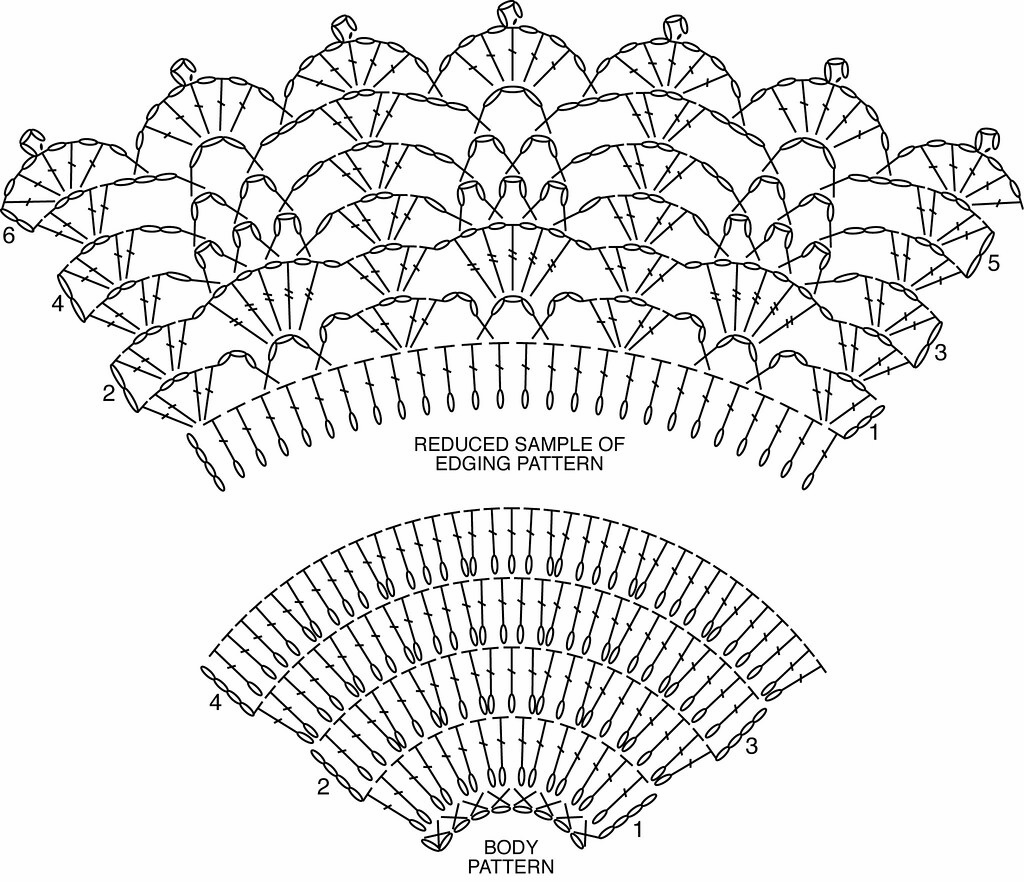
>All Shawl Stitch Diagrams

>Every time I look at a stitch diagram of one of my designs I feel as though I am seeing the pattern, really seeing it, for the first time. There is such a sense of clarity and satisfaction I get from these little bunches of symbols that’s hard to describe. These, done by Karen Manthey for the All Shawl, are a joy to behold.

My mother knew about these things all along. She learned to crochet as a girl growing up in Japan, where the symbol language was developed. The vintage pattern books she showed me when I was starting to crochet were written in Japanese. She did not read English. But we both could understand and follow every diagram, stitch by stitch, letting our hands create the patterns our eyes saw, needing no translation.

But more than making it possible for crocheters to transcend language barriers and share stitches, symbol diagrams are an enormous boon to those of us who learn visually. If my early stitch dictionaries had offered only written instructions I might never have been so attracted to and obsessed by lace patterns. Fortunately for me I stumbled upon the original Harmony Guides volumes 6 and 7, which are chock full of symbols and now an indispensible part of my crochet life. There is now a new set of Harmony Guides from Interweave Press, updated and user friendly, ready for the next generation. They’re on my Christmas list but I don’t hold out much hope that Santa will be bringing them. After all, I never did get that pony.

Oh, if you have already downloaded the free All Shawl pattern, but want the latest edition that includes Karen’s lovely stitch diagrams, please click that link again to get the All Shawl edit 2.pdf. It’s worth the effort.