>What I’m Wearing Today: Lacy Jacket

>After a storm front or cold front has pushed through this area, blasting away some of the mid-August heat and humidity, there’s a refreshing chill in the nighttime air that hints at delights to come. Autumn is my best season. That’s when I am the most energized and productive. Designing with wool, cashmere and alpaca becomes doable after a long hot summer of abstinence. Buried under piles of garment samples deep within the recesses of a storage closet, my favorite crocheted jackets and sweaters are once again speaking to me.

There is one event left in this detestable month that I really anticipate. Despite the fact that I know it is a non-event staged by retailers, totally commercial and crass, I truly enjoy the “Back-to-School” thing. Let me be clear. I detest school, always have. The mere thought of entering a school building gives me the willies. And I’m not talking about the migraine-inducing shopping one is compelled to do when there are kids at home. Now that my nest is empty and those headaches are a vague memory, I find I just love shopping for school supplies.

Is it heaven wandering up and down the aisles, eyeing the reams of loose-leaf and printing paper, stacks of pristine composition books, tabbed dividers and report covers, orderly racks of Sharpies (hey, you know they got Sharpie pens now that don’t bleed through???) and ink refills, boxes of fresh pencils. Doesn’t the smell of cedar pencil shavings make you drool? My favorite pencils are Ticonderoga, for no other reason than I have positive associations with the name. One of the loveliest rock ballads from my days as a disc jockey is the little known album track “Ticonderoga Moon” by Orleans.

One can easily rationalize excessive back-to-school buying. Prices are better. Many supplies being offered are useful and necessary for my work. At least that’s what I tell myself as I am loading up the cart (s). Aren’t pencil boxes amazing? Perfect for storing crochet hooks and double-point knitting needles and stitch markers as well as the odd pencil. Toward my goal of being less wasteful, I endeavor to work electronically whenever possible using as little paper as possible. But there are crochet design tasks that require pen or pencil and hard copies. I still scrawl patterning notes, diagrams and schematics in notebooks, filling them with abandon. If you have paper, you need paper clips, right? Wow, those clear plastic rulers are indispensable for measuring gauge.

And just like the yarn and crochet tool acquisition syndrome, it doesn’t matter how many packages of stuff you already have squirrelled away; impulse purchases made the same time a year (several years) ago. One can never be too rich or own too many spiral-bound notebooks.

But if I were going back to school (shudder), this is what I’d wear: jeans and T-shirt (why are you not surprised?) topped with the Caron Lacy Jacket. Because I can’t wear wool and other animal fibers, I often work in non-allergenic Simply Soft. So here’s mine in the shade Denim Heather. Cropped does not work for me, so I added three rows to the body length to get the peplum trim to hit at top-of-hip. And as I suggested at the end of the pattern, I steamed the lace trim to get it to lie smoothly.
What you don’t see is my most recent and prized back-to-school purchase. On my feet are my newest high-top Converse All-Star Chuck Taylors. One green and one blue. 🙂

>All Shawl Stitch Diagrams

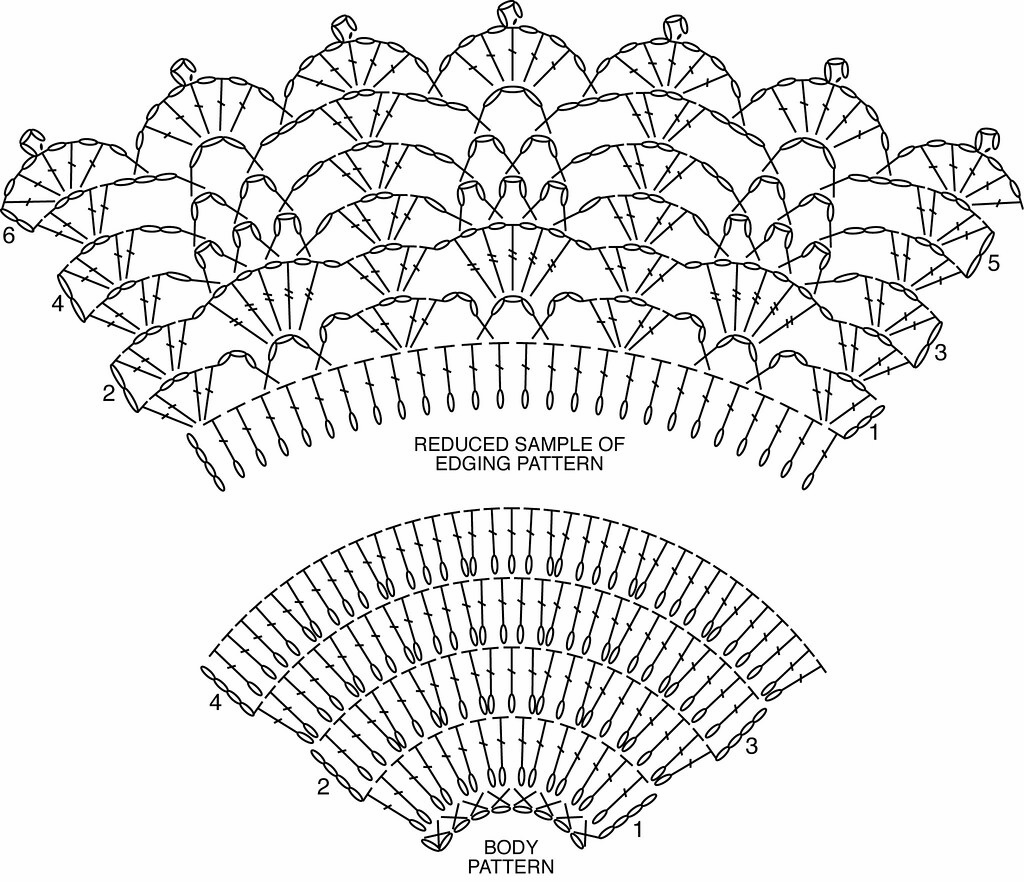
>Every time I look at a stitch diagram of one of my designs I feel as though I am seeing the pattern, really seeing it, for the first time. There is such a sense of clarity and satisfaction I get from these little bunches of symbols that’s hard to describe. These, done by Karen Manthey for the All Shawl, are a joy to behold.

My mother knew about these things all along. She learned to crochet as a girl growing up in Japan, where the symbol language was developed. The vintage pattern books she showed me when I was starting to crochet were written in Japanese. She did not read English. But we both could understand and follow every diagram, stitch by stitch, letting our hands create the patterns our eyes saw, needing no translation.

But more than making it possible for crocheters to transcend language barriers and share stitches, symbol diagrams are an enormous boon to those of us who learn visually. If my early stitch dictionaries had offered only written instructions I might never have been so attracted to and obsessed by lace patterns. Fortunately for me I stumbled upon the original Harmony Guides volumes 6 and 7, which are chock full of symbols and now an indispensible part of my crochet life. There is now a new set of Harmony Guides from Interweave Press, updated and user friendly, ready for the next generation. They’re on my Christmas list but I don’t hold out much hope that Santa will be bringing them. After all, I never did get that pony.

Oh, if you have already downloaded the free All Shawl pattern, but want the latest edition that includes Karen’s lovely stitch diagrams, please click that link again to get the All Shawl edit 2.pdf. It’s worth the effort.

>Look, Ma… no seams!

>Welcome to my long over-due blogging debut. I agonized for days about what I should say in my first post. As usual I find myself blathering. See? I’m blathering right now.

The following is an essay, an introduction to me, that got kicked from my first book. WOWSERS, my editors were so strict.

My search for ways to avoid sewing is a recent development. Sewing was always a part of life. My parents kept a big old Singer treadle machine in the back of the laundry for replacing customers’ buttons that got mangled by the shirt presses and for making alterations. And while I observed my mother sewing for us at home, I didn’t pick up a needle and thread myself until 7th grade Home Ec. My teacher, Mrs. Johnson, made us sew a sampler as part of the course. I sewed a brilliant red blanket stitch edge around my square of school-bus yellow fabric (my favorite colors in 7th grade). Mrs. Johnson was kind, diplomatic and unstinting in her praise of my hand stitching, but I only got a B in her class due to an incident with scrambled eggs totally not my fault.

The next class project in sewing was making a simple garment with a set-in zipper. I made the first of many little skirts. I disliked wearing skirts and dresses and wouldn’t have but for the school dress code, which prohibited the wearing of pants by girls. Miraculously, one morning during homeroom it was announced over the PA system that the school board had lifted the ban. If you weren’t there you cannot imagine the din of a thousand girls raising up their voices to cheer as one. But that wouldn’t happen for another two years. Meanwhile, I was dutifully wearing skirts that my mother sewed.

My hope is that I was diplomatic in telling my mother that I no longer wanted to wear the knee-length, gathered, bouffant skirts she made for me. Pop-culture insisted that fashionable skirts be tight and scandalously short. I’d like to say that I convinced her how much more economical short skirts would be. A mini-skirt needed yards less fabric. But what probably happened was she got sick of hearing me complain and just gave up.

My favorite of all the skirts I made during that two-year period was cotton, navy with white pinstripes, the closest I could get to denim. It was majorly flawed, since I didn’t have enough fabric to properly match the stripes. In future I was to become an obsessive pattern matcher, but then, hey, it was close enough. That skirt was worn until it was rags, worn until the fateful PA announcement that obviated the wearing of it at all.

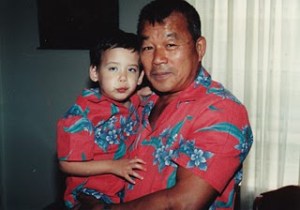
Sewing for me was never about the process. I did it at first in order to have clothes that fit. Then I sewed for my sons lots of adorable little overalls. I made matching Hawaiian print shirts. My dad wore his grudgingly; my sons had no choice. Hey, Magnum P.I. had nothing on MY guys!

My greatest accomplishment in those years was getting the flowers on the breast pocket of each shirt to align perfectly with ones on the shirt front. I was well on my way to pattern obsession by then. And I was the only one who thought matching shirts were cute. The guys merely put up with them as another eccentricity of mine. How twisted was that? My sons equated Hawaiian shirts with motherly love.

Sewing was never fun. Sewing became for me endless rounds of fussing. You press the tissue paper pattern, press the fabric, pin the pattern matching grain lines, cut the fabric leaving seam allowances, pin the seams, sew the seams, *rip the seams, re-sew the seams*, rep from * to * until your fingers bleed and the crooked seam starts to look not that crooked, clip the seams, press open the seams. If there has to be interfacing, lining, zipper or button holes, make that double and triple the fuss. And to top it all off there’s the finishing, hand sewing buttons, tacking down facings, hemming hems.

It’s no surprise that I abandoned sewing once I re-discovered first knitting and then crochet. Gone were the hours of fooling with pre-made cloth and precise, rigid seaming. Crocheted fabric is personal and organic. It can be grown any-which-way through the skill of your hands from balls of yarn, it’s alive. It molds, stretches, breathes and drapes. Eventually I stumbled upon the secrets of out how to coax the fabric to grow, seamlessly, into beautiful garments, the joy of which I share with you in my books and designs.