Crochet Obsession: Trellis

This happens to me often.  Certain crochet stitch patterns keep pinging around in my brain and I can’t let them go until I’ve pushed them into the Cth dimension. By no means the only stitch currently in my head, but certainly the one that pinged the most insistently this season is Trellis.

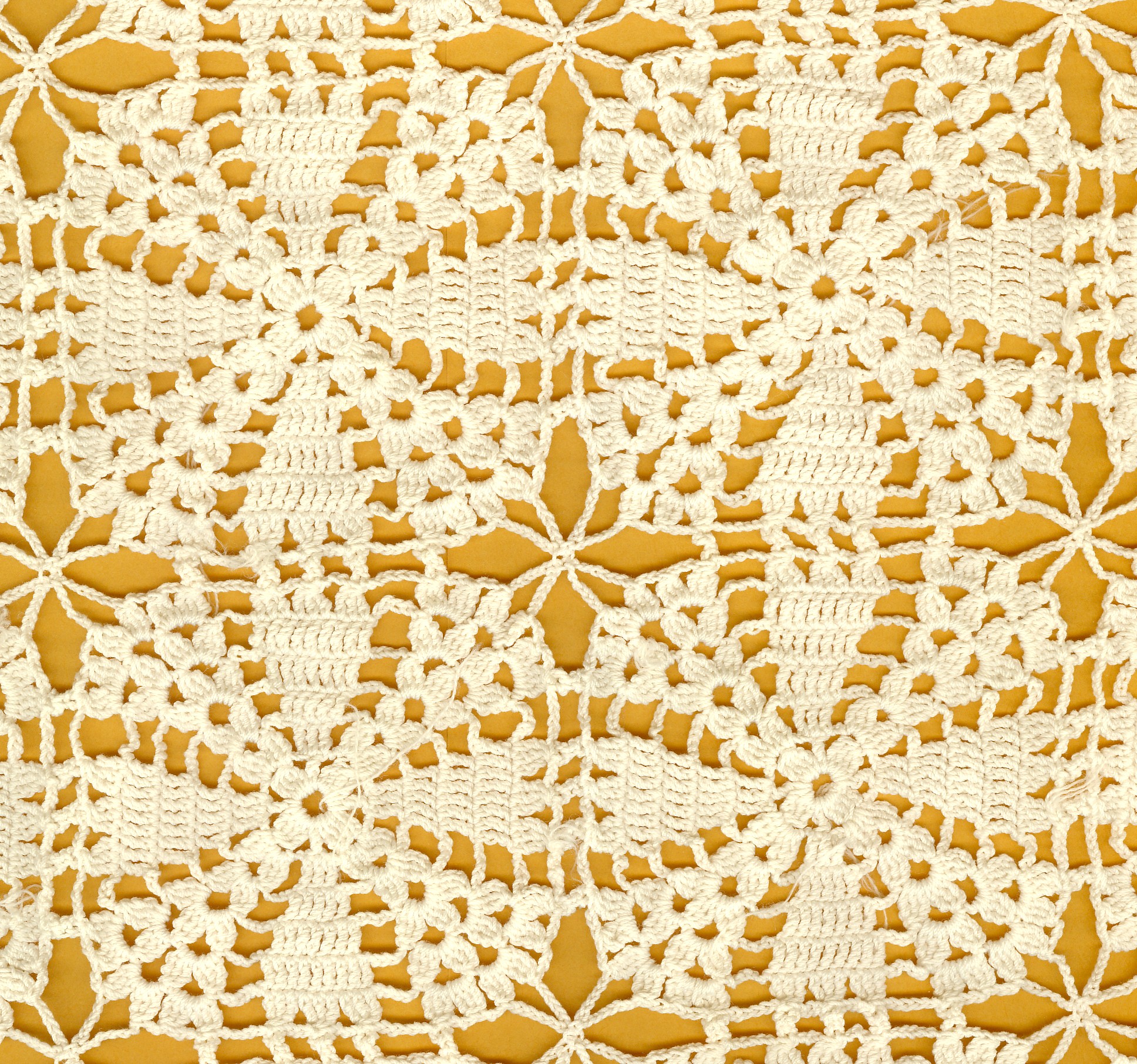
Adapted from a vintage thread crochet table runner, Trellis resembles filet crochet technique where the rows form a grid.  The stitches make either filled or empty blocks and, when viewed as a whole, the alternating blocks create a positive/negative design, pattern or picture.

Trellis starts out as though it’s going to be just a little variation on filet.  But once you’ve grown a good length of fabric, magic happens.

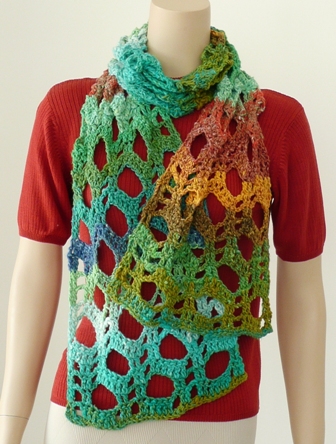
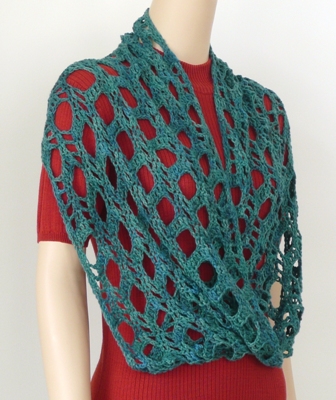
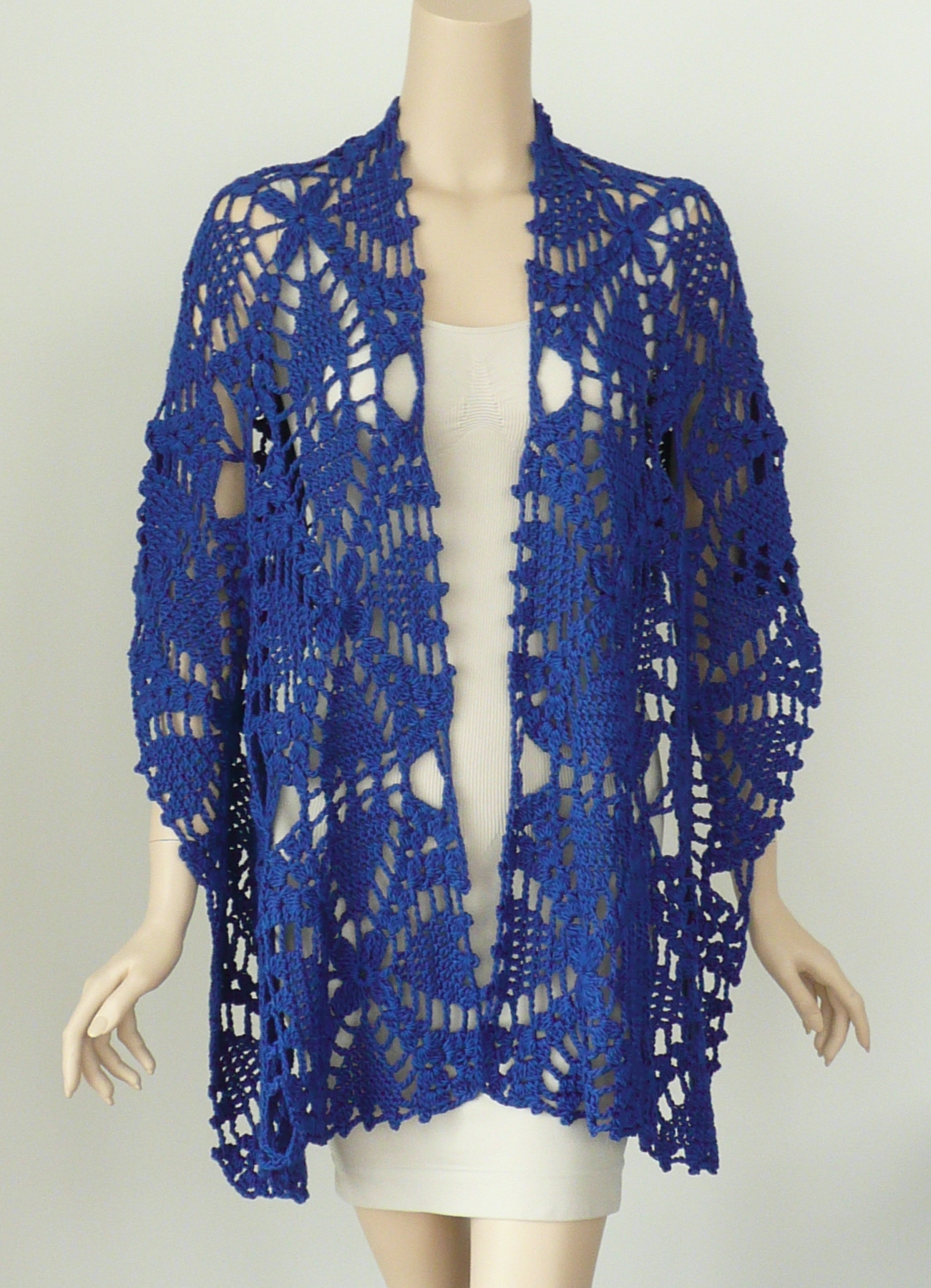
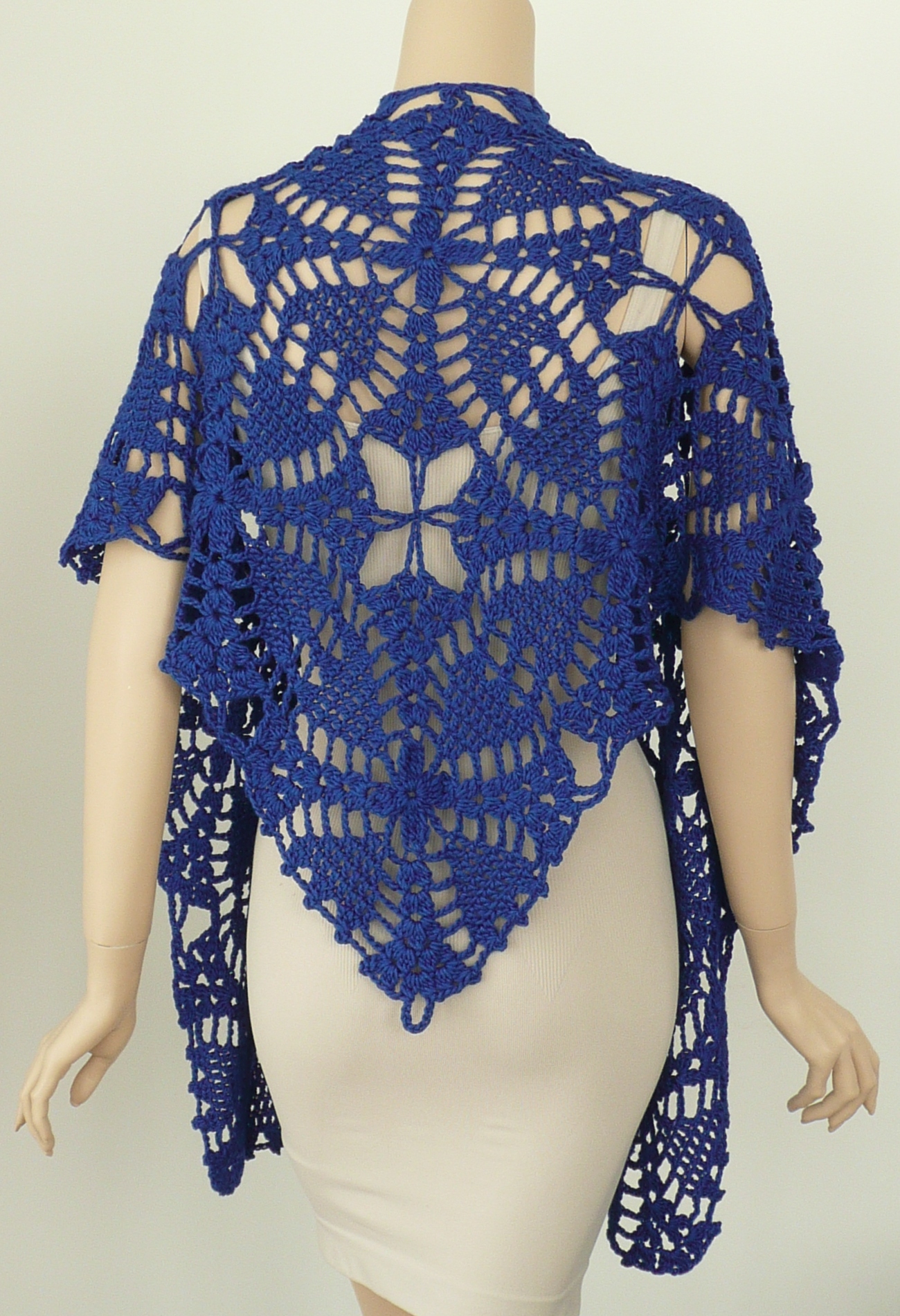
Blocked and draped on the body, the rows shift and stretch, tilting the neat vertical/horizontal alignment to the bias.  What you get is a pattern of holes that have distinctly diagonal movement. I love when that happens.

I thought when I turned Trellis into a lovely fine-gauge stole for the e-magazine Knitcircus, Spring 2011 issue, that I was done with Trellis. But Trellis wasn’t done with me.  It took a week of intensive yarn/weight/gauge/shape swapping before it finally squirmed out of my head as two new versions, the Trellis Multi Scarf in a long color repeat full worsted weight yarn;

and the Trellis Cowl Wrap, in a tonal DK weight yarn.

So what was I supposed to do with the Spawn of Trellis?  I could just add them to my crochet wardrobe.  I love the colors.  Or I could put them aside for gifting (if the day comes when I can part with them!). Or I could share the Trellis obsession with  you.

I went with the latter. Now available exclusively at DesigningVashti.com, the new DJC: Trellis booklet includes the original Trellis Stole plus the Scarf and Cowl Wrap, packaged with full written instructions, stitch diagram, and tips for making any of the three in practically any yarn you like.  Finally the pinging has stopped.

Backstory: Yokohama Mama

On Mothers’ Day I feel most comfortable assuming the role, not of the mom, but of the daughter.  Of course I own up to the fact that I am the mother of two sons and deeply cherish all that those two rascals have brought to my life.  Never one to wallow in sentiment (like my father in that respect, but so unlike him in other ways) I have nonetheless fondly preserved nearly every gift that the boys have given me over the years.

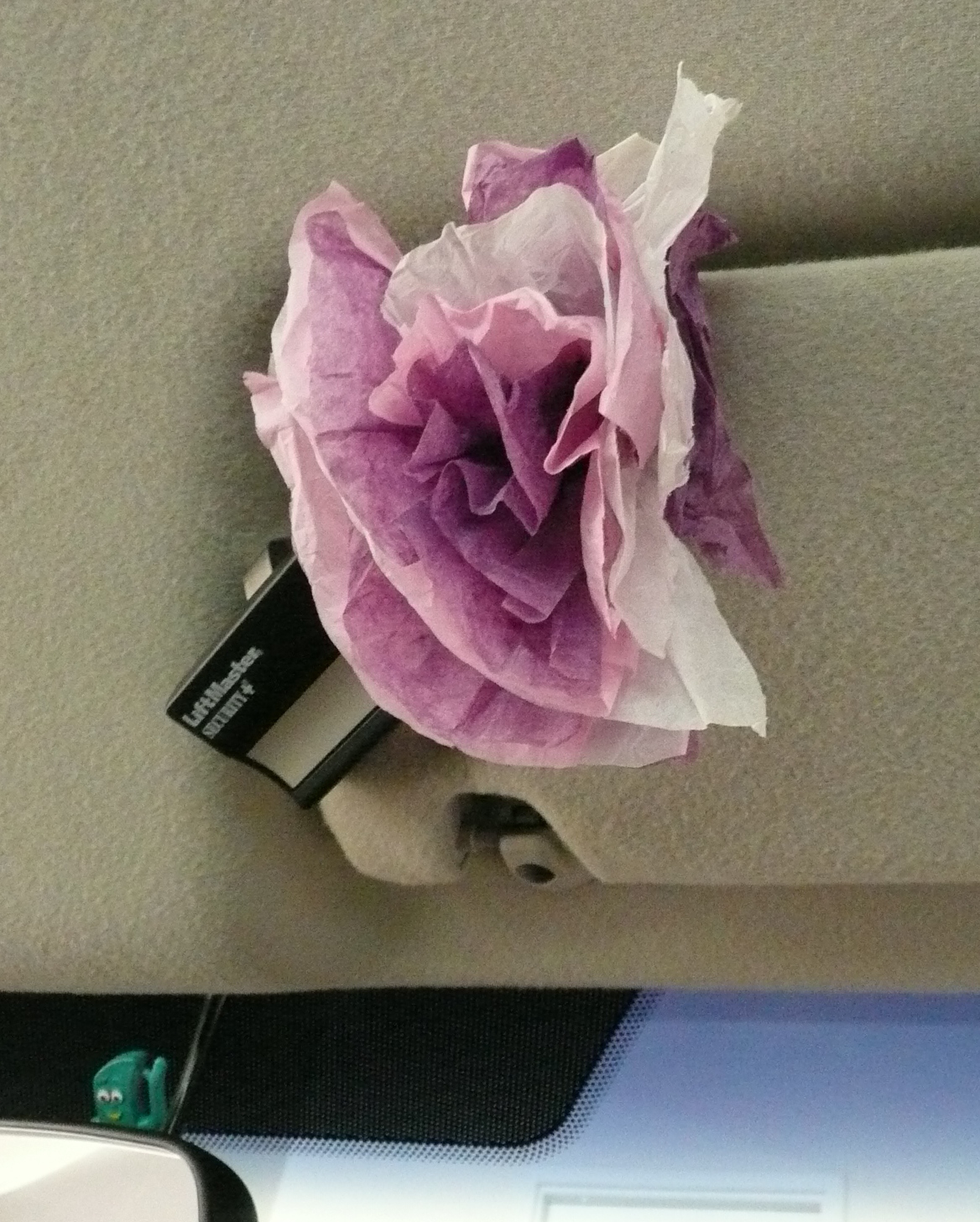
This is a crepe paper flower from Harry that serves as a good luck charm hanging from the passenger side visor of my car.  Yes that’s Gumby.

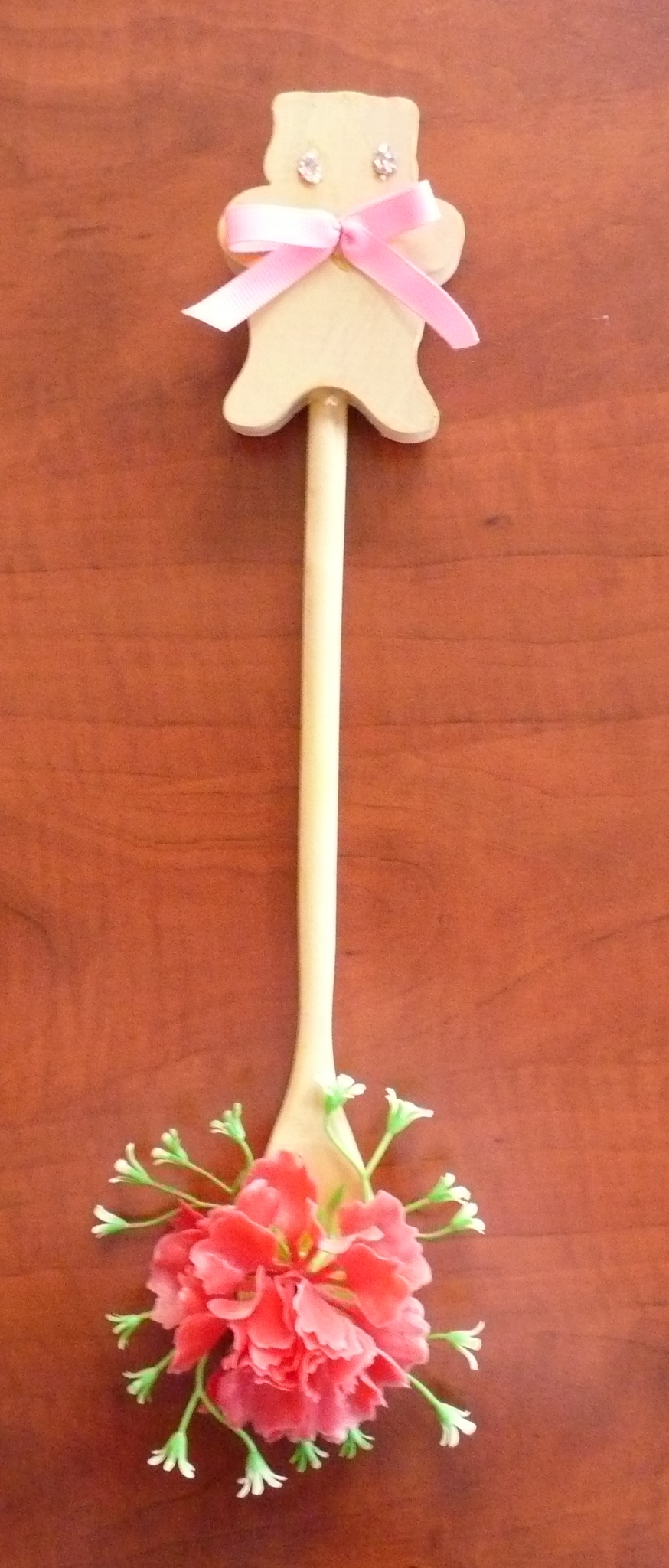
This is a bear-spoon-flower from Harry.  Don’t ask.

This is a portrait of me rendered by Nick on a ceramic tile, and as you can see from the brown rings, used as a coffee mug coaster.  Mercifully for him, he has other wonderful talents.  Have I mentioned that he is the World’s Best Beat-Boxing Actuary?

There is one infamous gift that I couldn’t show you because it is in a box buried beneath, what else, cases of stashed yarn.  One day Harry came home from school covered with gack.  He had globs of white stuff smeared all over his clothes and shoes, in his pockets, under his fingernails, stuck in his hair, even some in his ears.  It took major soaking and scrubbing and complaining before we got him reasonably clean.  A few days later on Mothers’ Day, I learned what all the mess was about.  A well-meaning teacher in Harry’s class helped the kids make plaster hand prints for their moms.  Right.  Thanks.  I keep that sweet little hand print to remind me how memory is selective.  We remember the good and forget the gack.

My mother is also a saver of keepsakes.  I never knew how many seemingly inconsequential things she had kept, probably without my dad knowing. Dad was a so-not-sentimental kind of guy, practical in all ways.  He could not imagine wanting to collect anything (and never in a million years would he have understood the concept of yarn stashing). There wasn’t room in his life or his home for too much stuff that wasn’t useful or needed right now.  It’s not that he would throw things out for no reason, because he abhorred waste.  It’s just that his concept of waste applied to wasted space as well.

Just after my dad died, whether she was feeling her own mortality and needed to pass on some of her belongings while she could or whether she just wanted to clear out some of the old junk and make room for new junk, Mom went through most of the attic and gave me dibs on anything I wanted to take away, with the implied threat that anything I did not claim would end up in the trash.  How could I refuse such an offer?

From among the souvenirs, mementos, knick-knacks, crates of mis-matched china, stacks of her hand-embroidered linens, she pulled out a tattered piece of thread crochet.  I remembered seeing that doily on top of Mom’s dresser when I was a kid, but that was many decades and nearly as many dressers ago.  It was the only bit of crochet in there and, as I was to discover during my research later, the only piece of crochet from her original trousseau that survived.  My mom was about to toss it in the trash pile, but something made me stop her.

Fast forward a few years.  I had begun a career as a crochet designer and was working on my first book, Amazing Crochet Lace, the introduction to which is a huge tribute to my mom.  Naturally, I had to include an image of the vintage doily that I saved from the attic that day.

I had planned to create a garment design based on the thread motif she used, but publishing being what it is, that exploded motif vest ended up on the cutting room floor so to speak.  I had seriously run out of real estate (book pages) and had to set the idea aside.

Fast forward another few years.  I received a call for designs from Piecework, the sister magazine to Interweave Crochet.  Piecework delves into the history of needlework, all types of needlework.  I had never thought to submit any of my crochet designs for publication there because none of my work actually has any history.  But something made me revisit the attic doily. I called Mom and through our conversation I pieced together the story of her crochet, this doily and my proposed design.  This time I kept the concept simple.  This time the pattern came in under three pages! This time the idea took off and the result is Yokohama Mama, featured in the current Spring 2011 Lace issue of Piecework.

Although the Yokohama Mama project and the accompanying little history I wrote could be considered a Mothers’ Day gift from me to my mom, for me it will ever be a treasure that she gave me, a tiny seed rescued from the attic that she planted in my heart and encouraged to grow.

>My Dad, My Crochet

>We don’t visit the cemetery where my dad is at rest.  There is no need.  In a prominent corner of her dining room, my mother keeps a shrine housed in a lacquered display case shipped home with a great deal of fuss and at outrageous cost during a visit to her family in Japan eleven years ago.  Every morning my mother prays, makes an offering of fruit and a cup of coffee fixed just the way my dad used to like it.  There is incense and a little gong which she gongs three times.  It’s all ooga-booga to me, but if this routine, this small, beautiful and perfect moment of reflection, reverence and remembrance is what my mother needs to carry on, then it’s OK.

My dad never got to see the blossoming of my crochet career.  Crochet to him was that stuff my mom and I did with the strings and sticks.  As long as we didn’t make too much noise while the ballgames were on TV, he hardly noticed.  Dad learned to love baseball as a teenager while working off his debt to the people who “adopted” him.  They paid his way to America from China, and in return they expected from him indentured servitude in their Chicago laundry.  Throughout those hard years the radio was his only company. He never said, but I imagine that the games on the radio that helped him through the long hours of drudgery were played by the Cubs… or maybe the White Sox.

By the time I knew him, he had  become a Boston Red Sox fan, that is until 1962.  That was the year of the major league expansion that created the New York Mets.  (Oh, Dad still followed the BoSox, particularly the career of Carl Yaztremski.  Does anyone else remember Yaz bread?)  By the time the fledgling team moved to Shea Stadium in 1964, my dad had become a Mets fan.  My god the Mets were lousy at first.  But I guess my dad loved rooting for the underdog, because he stuck with them.  I so vividly remember the “Cinderella” year, 1969, when the Mets won the World Series.  There was a lot of “I told you so” in our household that season.

So when Stacy Charles of Tahki Stacy Charles yarn company, on behalf of The National NeedleArts Association’s Stitch N Pitch event, asked me to share with my blog readers the details of one very special and monumental Mets game, I agreed.

On June 5th, at Mets Citi Field, crocheters will attempt to set the Guinness Book of World Records for Most People Crocheting Simultaneously.  Please check out the site to find out more about Stitch N Pitch, or download the flyer for details about this event.

I wonder what my dad would think.  It’s one thing to be in your living room sharing the sofa with two crocheters while the Mets game is on TV.  Quite another thing to be sitting in a section at a stadium among potentially hundreds and hundreds of crocheters.  I would like to think my dad would approve, even be impressed if the record got set.  But not so impressed that he wouldn’t be disappointed if the Mets lost the game.  Really.

BTW:  Final Score, NY Mets 6, Florida Marlins 1; Crocheters 419, Guinness World Record for Most People Crocheting Similtaneously set.

>Hitting a smaller target: Part 2

>It helps consumers of my patterns to know that I totally suck at imaginary counting.  What I mean is I am incapable of coming up with absolutely correct counts where the stitches are extrapolated for pattern sizing, not actually in my hands as tangible crochet.  Obviously, I work really hard {really really really hard} at crunching the correct numbers for all sizes, but in reality, the only set of numbers in my patterns that I can guarantee to be perfect and consistent are the stitch counts for the garment sample I have myself crocheted. Any other string of numbers will simply swim in front of my eyes, a downside to advancing age. I can clearly see what stitches have to happen, where, when and how often.  But don’t ask me to count those suckers.

So you could conclude that I am a visual person, a tactile learner, a hands-on designer.  I describe my design approach as organic.  I cannot make crochet design without making crochet.  I’ve heard that there are designers who work differently, for whom the entire process is virtual.  They make a sketch of the design, plug the variables of stitch pattern and gauge into their own particular standard pattern template, then pass the mess along to a contract stitcher who crochets the sample and often fixes the pattern writing to conform to the real object.  This could be an efficient way to crank out a limitless body of work in seemingly no time.  Not for me.

With my paltry few years professional designing experience and the hundreds of designs I’ve done, I still don’t know if a design works until I do it.  Likewise, I honestly won’t know if the sizing extrapolations I’ve calculated will actually work for real unless and until I have crocheted that particular pattern to those exact finished measurements myself.  And as I just spilled a couple of paragraphs ago, I wouldn’t be able to give absolutely reliable stitch counts for any of those imaginary pieces.

As quickly and as efficiently as I crochet, and depending on the project and the number of loose ends (!), it still takes me from three to ten days to nail down a crochet design (complete the sample to the point where I know it works).   Deadlines are usually pressing.  I routinely have less than two weeks to devote to any one design.  Most editors and/or yarn companies provide enough materials to complete the sample, with not much to spare. So, there is never enough time or materials to physically crochet multiple samples of a design.  Nor do the design fees offer enough compensation for the extra work.  Even for designs with publisher guarantees that they have been pattern tested, not every size of every garment has been crocheted.  When my patterns take written form, all those extra sizes and all those stitch counts are, and will remain forever imaginary.

That’s where you come in.  I rely on feedback from crocheters who have worked from my patterns and crocheted the other-than-model sizes.  You guys are brilliant at tracking me down, showing and telling me what works. Spotting you wearing  your finished projects at events is one of the reasons I look forward to events. Your on line comments and critiques on the construction and fit help me do the next one better.  The group at Ravelry.com dedicated to my designs, Doris Chan: Everyday Crochet,  is my chief contact with fans.  Each time a Raveler posts to the forum, asks a question, begs for pattern support, points out a pattern error {usually a stupid stitch count!}, shows pictures of finished projects, cheers on other crocheters, commiserates with others over ripped rows and wonky gauge…  every word teaches me something.  Hundreds of somethings.

So what am I hearing right now from my legion of crochet whisperers?  Aside from the background hubbub of excitement upon discovering crochet empowerment, I am hearing a tiny plea that could be growing into a more significant groundswell of discontent concerning, of all things, not plus sizing but smaller sizing. You may wonder how this issue even exists, since according to the first lesson in Part 1 I learned that I have to crochet design samples that look good on skinny models, but there is a limit to how low you go.
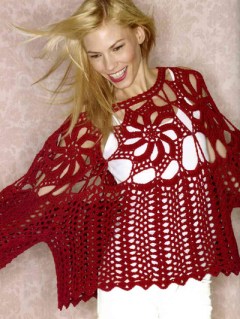
Claudia modeling Rosalinda

I was invited to {more like I jumped up and down and held my breath until they allowed me to attend} the photography shoot for my book Crochet Lace Innovations.  The design samples I provided were carefully and deliberately sized to fit fairly skinny humans.  But nothing prepared me for the range of body shapes that we encountered among the three gorgeous models, Claudia, Chanel and Eva.

Chanel modeling River Song
Eva modeling Jadzia

You’d think one fashion model might be interchangeable with another fashion model.  HA!

Claudia was lithe and coltish at a size 2.

Chanel, the curviest of the three {she gets the hubba-hubba award}, was a graceful, perfectly proportioned size 4.

Little Eva, who was certainly not underage, but appeared so young and underdeveloped, like a blossoming12-year-old, was a solid size 0.  Even the stylist, Kristen Petliski, couldn’t have planned for the different clothing sizes that were needed to coordinate with the crochet.   Some samples and clothes had Chanel spilling over a little {the hubba-hubba factor!}, but were playful and flowing on Claudia; some stuff was just too loose on Eva. That’s probably why you never see the back of the Jadzia jacket in photography.  Eva’s shorts are clipped in the back!

No one at the shoot touched any of the crochet samples; I wouldn’t allow it, and none suggested it.  We played musical crochet until the right model was matched with each outfit.  So what you see in those images is the real shape of each crocheted piece.

But here’s the thing.  Nothing in the book was supposed to fit a size 2 or 0.  Hardly anything I design goes there. As much as we exalt those fashion model figures, in real life few consumers need patterning that small. For mass market publishing, I have found no call for sizing smaller than 4 and no comment when I don’t provide it. My recent design output illustrates that I have learned all too well the second and third lessons from Part 1.  I have to produce patterns containing as few words as possible, and those patterns must offer plus sizing.  There is the trade-off and why the entire process is doomed to lead to disappointment among small sized crocheters.  If we go bigger, we make the choice to drop the smaller in order to keep the patterns to manageable length.

More next time.  Oh, and if you’re wondering how I got to be so stubborn and cute (!), check out my piece in this issue of Crafter News, the newsletter from my publisher, Potter Craft.
>New to Crochet?

>Hokey Smokes!  March is flying by and still I have not joined in the celebration of National Crochet Month.  You’d think I could come up with something extraordinary to contribute.  As a professional designer and author I spend most of my time in my own crochet alternate reality.  There are days and weeks on end where I hardly talk to anyone but other crocheters who deign to come out of their own crochet alternate realities.  I have to be reminded that not everybody speaks the language.

Chloe and Clarity Cardigans, Interweave Crochet, Spring 2010

So today I am sticking my head out of my timeless tunnel and offering a few words to newbie crocheters. Meanwhile, for any avid crocheters who have ventured this far into the post, I will put up some images of designs I have out this season, sprinkled like fairy dust throughout this long tirade. Hey,  I do hope that you are coming to the craft as a result of reading or hearing about NatCroMo, and that the hype has sucked you in, because a lot of people have done a whole lot of work this month just to get to you. Perhaps you are a knitter or other fiber artist and you’re now looking to add crochet to your skill set.  Or maybe you’ve never before held a skein of yarn in your hands, but you’re attracted to this thing we do.  I have three words to say.  Crochet ain’t easy.

Tokyo Vest, Tahki City Crochet
Man, we all hate moments when we are made to feel unbalanced, stupid and foolish.  It’s like fussing with the back of your hair or trimming your bangs while looking in a mirror.  Don’t you always go the wrong way?  Doesn’t it make you feel dumb?  Or it’s like tying a bow tie on yourself.  It’s supposed to be exactly like tying your shoelaces.  But damned if the fact that you’re looking at it from the other direction makes it so much harder. Hey, my guy still can’t do it for himself.
Graceful Lacy Cardigan, Crochet Today, March/April

Our human pride begs us not to go there.  Avoid those situations that can only lead to awkwardness.  Life is too short to spend any of it undermining your ego.   So how can I convince you that my beloved craft is worth it?  There is no question that learning to crochet is often frustrating, with agonizing hours spent fumbling around and pitiful little to show for it.  At first you have to think about the movements of every fracking muscle in your hands and wrists as you struggle with using the hook and maintaining tension in the yarn.  And there’s the hitch.  Thinking.  What has to happen is that you must remove the cognitive process from the equation and fly on purely physical auto-pilot.

It’s like driving. I can get in my car and arrive at the supermarket and not remember driving there.  This is not about being careless, preoccupied, distracted or asleep at the wheel.  I am certain that it was uneventful, even pleasant, and that I have driven quite well and lawfully, but the trip was on total auto-pilot.  I am so used to my vehicle and the route to the destination, so accustomed to performing the actions of steering, braking, accelerating and adjusting for traffic and conditions, that I don’t actually think about any of it.  I just do it.

Marseilles Jacket, NaturallyCaron.com

Not having taught crochet a great deal, and with limited experience teaching absolute beginners, and not the slightest memory of actually learning to crochet as a girl (it might have been by osmosis!), I can still feel your pain.  I am the world’s worst student. That rascal Dee Stanziano, in her class Pushme-Pullyu, forced me to examine my so-called skills from a different perspective.  She made us crochet backwards, first with our other hand (for me that’s the left) and then with our regular hand.  It made me feel as though I didn’t know how to crochet.   At the time I am sure I cursed Dee and the devilishness of it all.  But it turns out the embarrassing experience in that class gave me a greater appreciation for what it must be like for a newbie.

The hands are eloquent when the brain is mute. The moment your body “gets it” and your brain stops thinking about each tiny motion and nuance, and you let go of the beginners’ mantra going round and round in your head (I particularly like “hook up, hook down, pull through”, but each teacher will dispense her own), that’s the epiphany.  The goal and the ultimate reward is getting to that point where your hands “know” what to do, smoothly and automatically.

Kylara, Crochet Lace Innovations, April 2010

So what will it take?  Another brand of teacher might admonish you to practice, practice, practice.  Wax on, wax off. That makes it sound so boring.  The word practice has such negative connotations.  Visions of working back and forth and back and forth with the same stitch though a gazillion yards of yarn.  Sort of like {shudder} swatching.   I prefer to say play.  Take up your hook and yarn and play, play, play.  The more you play the closer you’ll get to nirvana.

Melisande, Crochet Lace Innovations, April 2010

And then you can start feeling cocky.  Don’t worry about what you think you know or what skill level you’re at.  Pick a project that appeals to you.  One that has you drooling.  Try it.  Wing it.  Fly.  So what if you mess up.  So what if it’s not perfect.  So what if you have to learn stuff as you go.  There are all kinds of ways to find help, online tutorials, pattern support from designers and other crochters.  I hear all the time from fans on my forum at Ravelry, Doris Chan: Everyday Crochet (where I lurk), that sometimes the first time through one of my patterns is the learning curve.  They work and rip, work and rip some more and beat themselves up all the while. But, watch out!  The second one be brilliant.

As for how long will it take, it depends.  I have taught knitters to crochet in 15 minutes.  On the other hand it might be better for a student to approach crochet without any particular yarn experience or bias.  No habits to unlearn.  But here’s my belief.  If you can tie your shoelaces, you can crochet.  And when crocheting feels as natural as tying those laces, then you’ll understand what all the fuss is about. Do you trust me?