>REVIEW: Etimo Crochet Hooks

>This post is all about teaching an old dog new tricks. It is not my imagination. I can tell, with each passing year, that I am losing brain function along with 1) patience, 2) near vision, 3) a waistline. I am extremely crabby now and have become my dad about some petty things (“my way or the highway”), but I hope I can remain open-minded, flexible, adaptable about the important things. Those who cannot adapt are doomed to extinction. However, when it comes to crochet tools, I am stubborn (some would say loyal) about my hooks.

I remember my mother teaching me to crochet, but not the exact hooks she put in my hands. Today I see she uses Boye hooks, so I assume Boye hooks were the ones of my early experience. I also see that Mom holds her hook with a pencil grip and wraps the feeder yarn firmly around her fingers. It dawns on me why I never took to crochet as a young girl. I must have tried it her way, learning by example. No wonder I ran away. It musta been awkward and uncomfortable. There was no way for me to have known that crochet could be done differently.

As an adult, I figured out that I’m a knife-hold crocheter, that I could relax the tension, and that I much prefer Susan Bates hooks. I’ve used Bates aluminum hooks for twenty years and have had little reason to try any others until recently. With so much crochet work on my plate as a designer, I’m finding the standard aluminum handles are cold and thin, two major contributors to hand fatigue.

I sampled all kinds of hooks in an effort to find a happy alternative, from plastic to bamboo to rosewood to maple and back again. My current favorite is a gorgeous hand crafted and carved hook from Grafton Fibers. It had better be perfect, after I beat up Tom over and over until he got it right! But I do not use my custom hooks for design work. Plastic hooks do not work for me at all. Bamboo hooks are nice, they are warm, but do not have a flattened grip to help me keep the tip from rotating, so they caused even more fatigue. When Susan Bates came out with a bamboo handled aluminum hook a couple of years ago, that became my go-to tool, and I was satisfied.

So understand, when my friend Vashti steered me to an exhibitor at the recent TNNA show in Columbus, Tulip Co., a Japanese manufacturer of handcrafting tools, I was ready to dig in my heels and resist. Kang Hyo Min, manager in Planning and Development, showed us Tulip Co.’s latest hooks, Etimo. Mr. Kang encouraged us to play with hooks and yarn provided, and we dutifully swatched up some stuff. WOWSERS! I could not let go of this hook. At the risk of sounding like a fracking commercial, this is the ultimate crochet tool on the planet.

The hook head is aluminum, but incredibly smooth, more highly polished than any I’ve seen, shaped somewhere between the bulbous Boye type and the in-line Bates type. In other words, the tip is tapered like the Boye, but with less of a bulb. The throat is not as pinched, is shorter, and returns to proper hook diameter sooner than the Boye. Etimo hooks have a shallower slot than my usual Bates, very similar in that way to the silhouette of Clover hooks. And unlike some other overseas manufacturers, Tulip makes their hooks in millimeter sizes that correspond exactly to American standard sizes, including the hard-to-find G-7 (4.5mm). That alone is enough for me to stand up and cheer! But there’s more to love.

The handle is made from a special kind of rubber, elastomer (as opposed to the hard ABS plastic grip of the Clover Soft Touch), that is bouncy, with a suede-like texture. The grip is hand shaped (as opposed to the cylindrical grips of the Addi and Bates Bamboo handle hooks) and the “fit” for me is perfect. One real problem I have with the Bates Bamboo handles is that the finish gets sticky, especially if you slather hand cream as frequently as I do, and it is a stickiness that never goes away. The Etimo elastomer handles never get sticky or tacky, no matter what. The surface actually seems to thrive on rich hand cream.

Mr. Kang sent me a set of Etimo hooks to try and they have become my tools of choice. I admit, it took a bit of getting used to at first. The shallower slot means that the tip is less hook-y than my usual Bates. In order to keep the yarn from slipping out of the hook, I find myself applying a teeny bit more tension and a touch of rotation. These subtle changes could ulimately affect my gauge, particularly when crocheting tall stitches, but no matter. I am a convert.

Etimo hooks will not be cheap, probably a dollar or two more than the other more widely distributed Japanese rival hooks, Clover Soft Touch, which retail for $6.99 each. But this tool will last a long time, and must be considered a worthwhile investment. As of today I am aware of no USA distributor or retailer of Tulip Etimo crochet hooks. But that will change.

>Killer Brownies

>Happy Birthday to me!

Here’s the recipe for the brownies I shared one night at the Big Bar on Two at TNNA Columbus 2009. Incredibly moist and meltingly smooth, these brownies should be kept refrigerated to extend freshness. They also freeze well. But that assumes there will be any left around to store. This pattern… uh, recipe… tells exactly how I make them, with specific ingredients to get the same results. Swap out at your own risk!

Skill Level No-Brainer

Size 8” by 8” square or 9” round, 1″ deep; to serve a gang of crocheters, unless you are Ellen Gormley, in which case serves two

Materials
14 tablespoons (7 ounces [200 g]) unsalted butter, cold, in chunks (Land O’ Lakes)
3 ounces (85g) chopped bittersweet or dark chocolate (Ghirardelli semi-sweet dark)
1/2 cup plus 2 teaspoons (1.75 oz [50 g]) unsweetened Dutch process cocoa, lightly spooned into cup (Pernigotti, an Italian cocoa with a touch of Tahitian vanilla bean)
1 cup plus 3 tablespoons (8.25 oz [238 g]) granulated sugar
3 large eggs, room temperature
2 teaspoons vanilla extract (Penzey’s Double Strength)
3 ounces (85 g) cream cheese, softened (Philadelphia brand original)
1/2 cup (2.5 oz [71 g]) all purpose flour, stir flour in container, dip cup, lightly sweep off excess (King Arthur)
A pinch of salt

Tools

Baking pan, metal, 8” by 8” square (or alternately 9” round), 2” deep
Aluminum foil, 8” by 16” strip or parchment paper
Nonstick baking spray (Pam for baking)
Microwave for melting stuff
Microwaveable 2-cup measure or medium bowl
Stand mixer with paddle attachment, great to have but not critical (KitchenAid), or hand-held mixer plus a large mixing bowl
Thin bladed spatula for spreading batter
Wire cooling rack
Toothpick or cake tester

Gauge not critical

Instructions
Batter
Preheat oven to 325 degrees F. Prepare 8” square baking pan by lining with aluminum foil, allowing a few inches overhang on sides for lifting brownies later. Alternately, line the bottom of the 9” round pan with a circle of parchment. Either way, spray sides and bottom of pan with baking spray (or grease lightly with a little butter or vegetable shortening).

Row 1 (RS): In a microwaveable 2-cup measure or medium bowl, place butter and chopped chocolate, microwave on high power until melted, approximately 1 1/2 minutes, stirring 2 or 3 times.
Row 2: Pour the butter mixture into a large mixing bowl (bowl of stand mixer fitted with paddle attachment) and beat in the cocoa — 15 seconds at medium speed.
Row 3: Beat in the sugar until it is incorporated — another 15 seconds.
Row 4: Beat in the eggs and vanilla until incorporated — about 30 seconds more.
Row 5: Beat in the softened cream cheese until you can only see tiny bits — about 15 seconds more.
Row 6: Sift in the flour and salt and mix only until the flour is fully moistened — a few seconds at low speed.
Row 7: Scrape the batter into the prepared pan and spread it evenly with spatula.

Baking
Row 1: Place pan in the middle of oven, bake for 30 minutes. Batter should be set around the outside but the top should still look moist and shiny in the center. A toothpick inserted 1 inch from the edge will come out clean.
Note: Avoid overbaking.
Row 2: Place the pan on a wire rack and cool completely. That’s the hard part, cause this requires a couple of hours of smelling chocolate but not being able to eat it.

Finishing
With clean spatula, loosen brownies from sides of pan. Using the foil overhang, lift the brownies out of the pan. Alternately, turn the brownies out of the round pan, peel the parchment off the bottom of the brownie round, then invert so the top is again on top.
Weave in ends. Block brownies into 2” square servings, 16 squares. Or one huge shark-bite for Ellen. Enjoy!

>BACKSTORY: Avalon

>

You gotta love a yarn company design director who respects crochet. From the first garment I sent to Cari Clement for Caron International in 2006 through the latest, this top for NaturallyCaron.com, our creative relationship has given me so many unique opportunities to explore my craft. This season Cari has spotlighted our latest design, Avalon, with a free pattern download and audio fashion show.

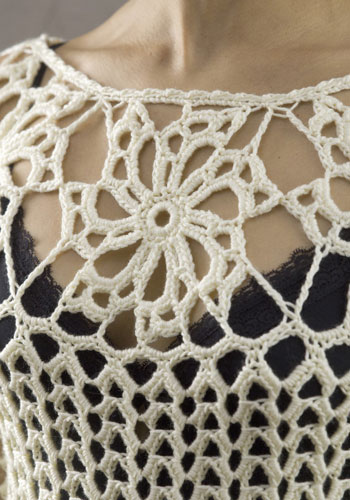
Avalon was inspired by home dec. Really. The motif is my adaptation of a swatch I saw in a vintage book, “Crochet For A Beautiful Home” (Sedgewood Press, 1987), one of among the countless treasures found by my mother over the years as she scoured her local flea markets and thrift shops. I know she paid just a couple of bucks for it, because if the penciled-in price on the inside cover had been any more than 2 dollars, she would have beaten them down to 2 dollars, trust me.

The motif features spiraling arms consisting of solid single crochets over chain spaces. I just so happened to see a coordinating pattern stitch in a Japanese stitch dictionary , “Crochet Patterns Book 300” (publisher and information in Japanese and therefore indecipherable by me!). The motif and stitch worked so well together that this top practically designed itself.

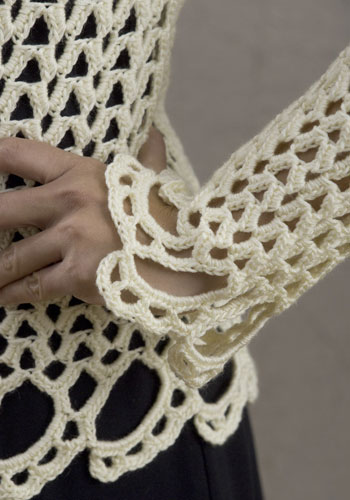
By deconstructing the motif I discovered a cool way to make the spiral arms into a trim for the body and sleeve bottoms.

Avalon has a soft, dense drape and generous, slinky stretch thanks to the yarn, NaturallyCaron.com Spa, a blend of Microfiber and Bamboo. The body and sleeves may easily be lengthened or shortened as you please before finishing with the trim, one of the benefits of top-down construction. Beware, though, as the stitch pattern will relax when blocked and you may end up with more length than you imagined.