Theoretical Ball Winding and Crochet

Having blogged here about yarn twist, I was asked if it mattered which end of the yarn skein you pull first, the outside tail or the inside tail.  I had to think about that.  Eventually I came to realize that it does not make any difference in the twist.  Once there is a twist in the strand, that twist is the same no matter which end is up, because S or Z twist are determined by looking at the strand laid flat and is the same upside down or downside up.  Does that make sense?

It took a while for me to come to that conclusion. I am the one for whom the retort “No, your other left” was created. Left, right, east, west, clockwise, counter-clockwise, RS, WS… it all gives me a headache. This mild disorder of mine is the reason why I (and any of my employing editors who are wise or forewarned) grudgingly fork over large sums of money for technical editing.

A world-class crochet tech editor is worth her or his weight in dilithium crystals, make that naquadria, or at least well worth the 30-plus US dollars per hour that is the current standard fee. Considering that on my part, the process of designing, crocheting the sample, writing and sizing the pattern for a crocheted garment design (depending on the complexity) can consume well over 40 hours of my time, this hardly seems fair. I will never in my lifetime be offered $1200 for a single design that took me 40 hours. The way things are, I often don’t make minimum wage, and that’s the truth for most designers. But nobody said this career was fair.

Anyway, my problem with directionality was recently put in high relief when I began playing with my new in-line ball winder. A ball winder is a useful tool for any yarn work. It makes happy yarn cakes and is indispensable for turning hanks into usable form, for straightening up tangled skeins and for ripping.  My old one, a Royal ball winder has served me well for many years. The Royal winds with a tilting motion, but essentially spins carousel style.
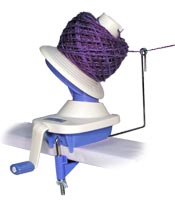
My new toy is a Lacis In-Line Ball Winder which turns Ferris wheel style.
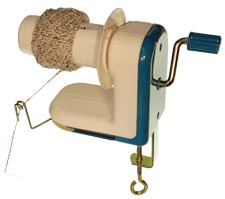
Why would I bother buying a second ball winder when the one I already own works fine? You sound like my mother, who might ask the same thing. I got the idea while making a sample for DJC: Spirals in ribbon yarn.Tess’ Designer Yarn Microfiber Ribbon is a flat, woven nylon ribbon, about 1/8″ wide. It has no twist, but it will show you how Z-twisty your yarn gets as you crochet because as we previously discovered, crochet puts Z-twist in the yarn.

Like many hand-dyed or specialty yarns, it is put up in hanks so you have wind the hanks into skeins or balls in order to use it.  This stuff is so totally slick and slippery that it cannot be wound in the customary way.  Trust me, the first time I worked with this ribbon I tried using my favorite wooden umbrella yarn swift to hold the hank along with my Royal ball winder.It was a disaster, where the hank kept sliding down off the swift and the balls kept flying apart on the winder. The trick, according to the warning on the back of the yarn label, which I did not see until too late for that first attempt, is to use the swift sideways, Ferris wheel style, so that gravity doesn’t cause the hank to fall off the spokes. So  I switched to the metal swift which can be tilted.

I don’t like this swift as much because there are metal fittings and rings that sometimes catch yarn strands.  But using this orientation coupled with winding the ball by hand and not with the Royal winder proved satisfactory, if a pain in the butt. It occurred to me that if I had a ball winder that worked Ferris wheel style in the same way as the swift, maybe it could be used for this and other similar problematic yarns.  So, ever the optimist, I got the Lacis In-Line.

But the orientation of the yarn cakes isn’t the only difference between these two tools.  When you turn the handle in the recommended clockwise motion (to the right, huh?), the spindle of the Royal turns in the same clockwise direction, but the Lacis spindle is geared differently and turns in the opposite direction, counter-clockwise.

The terms clockwise and counter-clockwise are not absolute; they depend on your point of reference. The prime example is the Earth’s rotation.  The earth rotates on the imaginary axis that runs from pole to pole toward the east. If viewed from the North Star Polaris, or if you’re standing at the North Pole, the Earth is spinning counter-clockwise.  But if you’re at the South Pole things get hinky and mirrored, so the Earth is spinning clockwise. Obviously the Earth hasn’t changed; only your perspective has changed.

BTW, the myth that water goes down the drain in opposite directions in the Northern and Southern Hemispheres is just that, a myth. It is true that due to the Coriolis effect on the rotational dynamics of our planetary atmosphere, cyclones (meaning not just tornadoes but large scale atmospheric disturbances that happen constantly) spin counter-clockwise in the Northern Hemisphere and clockwise in the Southern Hemisphere.  But at the level of a bathtub filled with water, the Coriolis effect is negligible.

So with that in mind, I should stipulate that the clockwise-ed-ness of the spinning is here being determined from the viewpoint of the end of yarn that you initially wedge into the slot. In the Royal winder, the slot is at the outer tip of the cone.  If you look down on the top of the cone, the end of yarn is going clockwise.  In the Lacis winder, the slot is in the disc at the base of the cone.  If you look at the disc from the bottom (your position while turning the handle), the end of yarn is going counter-clockwise. I know, too much information.  And I am just getting started.

Since we can see very clearly how twisty this ribbon yarn gets while crocheting, I wondered if it makes any difference which way the yarn cake (skein or ball) is wound?  You know I had to experiment.

With yarn that is spun and twisted, you can’t easily tell what the ball winding process does to the strand.  So I took a few yards of my ribbon yarn, fed it flat and untwisted onto the ball winder, carefully removed the mini cake, held both ends of the yarn and pulled it open.

Why was I surprised?  The Royal winder put S-twist onto the ribbon; the Lacis winder put Z-twist on it. This would not happen if we un-spooled the yarn in the same way we wound it.  In other words, if the cone or cake turns as we draw yarn, then the strand comes off without additional twist.  But we don’t do that.  The cake stays stationary, so the twist remains.

HOKEY SMOKES!  I never thought about that. I rushed to examine some purchased skeins to see in what direction they were wound and it was impossible to tell. When you look at skeins, the whirls of yarn look clockwise from one end and counter-clockwise from the other end. As I have said, the clockwise-ed-ness of the winding depends on the point of view of the beginning tail and with pre-skeined yarn you can never know which way the winding started.

So I looked at cones of yarn, where the beginning tail sticks out, usually visible at the base of the cone. Every cone I have, regardless of what yarn weight, fiber or twist, is wound the same direction, counter-clockwise, and therefore must create Z-twist in the feed as you draw it off the cone.

Oh, and one more thing I did.  I wound mini balls by hand as I would automatically do, without thinking too much about it.  Being right-handed, I see that I hold the beginning end of yarn in my left hand and tend to wind with the right hand, down the back of the ball and up the front.  Then I wound another ball in the other direction, down the front and up the back, which felt totally weird.  Each time I was careful to keep the ribbon feeding flat through the grip in the fingers of my right hand, but allowed the yarn to do whatever it wanted when it got past my grip.  Wanna know what I found?  Whichever way I wound the yarn, hand-winding added virtually NO twist.  YIKES!  Seems as though the instructions on the back of the Microfiber Ribbon ball are best.

My head hurts.  I honestly don’t know what this all means for my crochet, but you can be sure I’m going to do some more experiments when I am not so dizzy.
The Crochet Twist

Many times I have been asked to name my favorite yarns.  My answer, after considerable waffling, is always “well, it depends”. Do you mean what are the yarns I most enjoy using or which ones do I love for my own personal crochet? There is a difference.

Yarn is not only my passion, the stuff of dreams and stash, but as a professional crochet designer yarn to me is also the single most critical aspect of my work, an aspect over which I have zero control. You may not know that the yarns and shades used in the designs you see in crochet magazines and books are not necessarily chosen by the designers. For reasons not always apparent or transparent, yarn choices are made by or at least subject to the approval of the magazine or book editors, take it or leave it, like it or not.

That makes perfect sense to me.  Over the years I have learned to be flexible about materials for design and that has served me well.  Not only has it created for me a nice little  niche in the crochet publishing pantheon, but it has also given me the opportunity to handle yarns I might never have experienced. It is my job to make any yarn my employers throw at me look good in crochet. I have created hundreds of garments and accessories with everything from indifferent craft acrylic to luxury cashmere, in every weight from lace to super bulky.  I maintain that every yarn deserves good design. Even if it takes extraordinary effort, long nights of yarn whispering, cajoling and tussling, eventually every yarn must speak to me.

I know this sounds like a cop-out, but honestly, I have enjoyed almost every yarn I have been paid to use.  Well, there was that time with some horrible bulky acrylic rug yarn. No joke,  I was sent stuff with the words “rug and craft yarn” on the label, which would have been perfect for… well, for a rug.  But not so wonderful for a garment. Oh, and I can never forget that nasty metallic chainette that I had to finish with drops of fray-check to keep the ends from madly un-chaining. I coulda done without those two jobs.

But here’s the thing. Sometimes the yarns that were the biggest pain in the butt to crochet turned into the most agreeable fabric, with all the qualities you could want, supple hand, wonderful drape, great stitch definition. So you have to ask yourself, is it worth enduring torture to arrive at something pleasing? Well, it depends, doesn’t it?

So you will not hear me dissing any yarns, at least not by name. But let me get back to the question. Given that I can get my hands on practically any yarn, you might think that my personal choices would be high-end or at least esoteric. Not.

I have allergies and so does Cookie, the fat white Chihuahua who runs this household. We fear rabbit (angora) most of all. Next most disliked is mohair. We can’t wear wool. We barely tolerate alpaca and cashmere. That pretty much rules out over half of the field, including many of the yarns that are the current darlings of knitters. By default I gravitate toward plant fibers, plant derived fibers and man-made-chemistry-set fibers.

But just because a yarn is made from cotton, silk, linen, hemp or rayon from bamboo, soy or whatever does not make it completely happy. It has taken me years of messing with hundreds of yarns to finally understand why I keep coming back to certain ones. It’s all to do with twist.  My boss, Vashti Braha and I toyed with the concept of yarn twist, but she’s the one who wrote about it a couple of years ago. (Share her experience crocheting tall stitches on her blog, DesigningVashti.)

Most crocheters aren’t aware of how twist affects the crochet. All fiber (except, like, un-spun roving) has to be spun in some way to make it become a long continuous thing that then becomes yarn.  Some yarns are then constructed without any more twist, such as tubular, woven or ribbon type yarns.  For most conventional constructions, there is additional twisting together of plies, which can be done in two directions, clockwise and counter-clockwise. I hope I have this right, but the former gives you an S-twist, the latter a Z-twist. How can you tell? Simple. Look at a strand of yarn. See how the ply or plies all lean in one direction, either like the center stroke of an S or a Z.

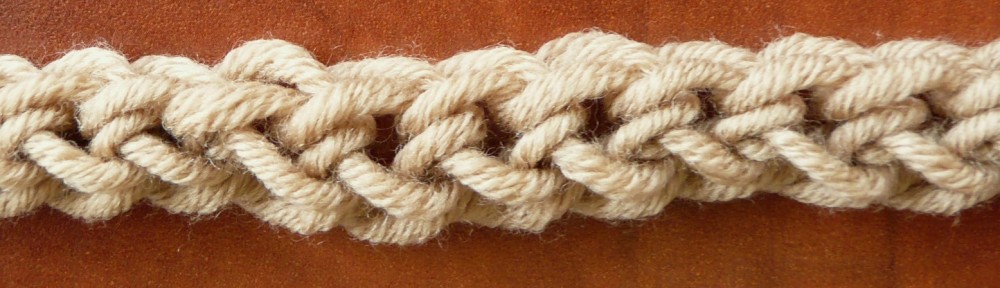
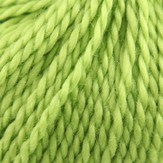
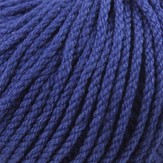
This yarn is S-twisted.

This yarn is Z-twisted.

I am sure there is a reason that mills use one or the other.  Someday I will stop being such a slug and do the research and find out. In another life.

For now, all I can say is that the staggering bulk of what is produced has an S-twist.  Most yarns are produced with knitting in mind.  I never understood why certain of those yarns are awesome in knitting but look crappy in crochet. Perhaps not in a scientific way, but intuitively I now know that knitting tends to reinforce S-twist and crochet tends to rebel against it.

I suspect the reason is that the knitting yarn over is in the opposite direction of the crochet yarn over. I both knit and crochet and never think about this because I naturally do the right thing with whichever tools are in my hands. The process of crocheting makes a Z-twist. Each time you yarn over and draw a loop through you are giving the yarn a little counter-clockwise nudge. When you crochet with S-twist yarn, you are un-twisting as you go. If you crochet, un-crochet, crochet, un-crochet (as routinely happens in design) then a low-energy, loosely S-twisted yarn could lose all integrity before long. At the very least, the plies become separated and the yarn will be really splitty.

When I began examining yarns for their twisted ways, I thought to analyze my favorite yarns. Z-twist is almost always used with wool roving or singles like this:

Cotton is routinely Z-twisted, notably for sewing thread and crochet thread. And, as I discovered, the yarns I kept returning to time and again are not simply non-animal fibers, but they are also Z-twisted.

NaturallyCaron.com Spa (see Cari Clement’s blog post for NaturallyCaron.com about Doin’ the Z-Twist)

And the Tahki Cotton Classic family:

Twist (more accurately, the lack of twist) is partly the reason I’m drawn to tubular yarn, like South West Trading Company Oasis:

and ribbon yarn, like Tess Designer Yarns Microfiber Ribbon. With these constructions, you control the twist as you go.

Don’t tell my employers, but  I automatically wince when a design yarn arrives that has multiple plies that are loosely S-twisted because I know that project will be splitty crochet hell. And I grin from ear to ear when the yarn has the crochet happy twist.

Link

>Have I mentioned that one of the perks of being a crochet designer is that I never have to match any other crocheter’s gauge?  Given that I design the project, make the sample garment and write the pattern, I am allowed the luxury of setting the gauge.  I never realized how empowering it has become being the one to dictate the number of inches per a specific count of stitches or stitch pattern repeats.  It tends to make one unspeakably smug and self-righteous.  Can’t match my stated gauge using the exact same yarn?  Too bad.  Want to substitute another yarn?  Good luck with that!

All of it, every single fracking hubris-laden moment of my designing career, has returned to bite me in the butt.  This month I have promised to release the next design for my independent pattern line, DJC2: Tank Girl. I started working on Tank Girl not that long ago while the Northeast was still in the grip of stinging winter cold, snow and ice. At the time it seemed like a good idea to offer Tank Girl in a warmer, cozier fiber as a layering vest.  So the design began with the wonderful yarn in hand, Spud & Chloe Fine, a fingering weight blend of superwash wool and silk  that probably makes awesome socks, too. And, for fun, I also sampled a tank in Kollage Sockalicious, which is a softer, plumper yarn but worked perfectly to the same gauge.

Sample in DMC Senso, fine gauge

The universe being what it is, a gang of cosmic forces kept me from completing Tank Girl right away.  So now the seasons are threatening to change and think I should switch gears, stay ahead of the curve and make my tank samples more spring/summer-like.  I tossed the stash looking for substitute fingering weight yarns in cotton or blends with cotton, linen, bamboo, whatever would work to gauge and be kid-friendly, washable and durable.  I discovered that there aren’t a lot of choices for comfortable, easy-care yarns in this weight class, at least not to be found in this house.  So I amassed a few that came the closest and swatched them all.

Imagine my dismay when none of my intended swaps would work to gauge, partly due to the fact that wool and animal fiber yarns have some give or stretch, whereas cotton and other plant fibers have none. Also, most animal fibers have some surface texture and stick-to-itself qualities that many plant fibers do not. Whatever the reasons, I found I could get the cotton/plant yarn swatches to match either stitch gauge or row gauge but not both.  I switched hook sizes.  I switched hook styles.  I wound and rewound balls in case the tension off the skeins was making any difference.  I cursed, I prayed. I did everything except crochet standing on my head and still I could not get any of the non-wool, warm weather choices to match my own gauge.

What I swatched:

  • DMC Senso, a soft blend of microfiber and cotton that is listed as a Size 3 crochet thread.  Not a thread, trust me.  It is a lovely fingering weight yarn and is terrific for fashions.
  • Aunt Lydia’s Size 3 Crochet Cotton, not as soft but workable.
  • Red Heart Lustersheen, a cabled acrylic fingering weight, very soft, a better color range than the cotton threads.
  • Elsebeth Lavold Hempathy, a sportweight blend of hemp, cotton and rayon; not as fine as the above, but would make a terrific spring tank.
  • Tahki Cotton Classic Lite, a sportweight mercerized cotton in awesome colors, but a touch heavier than all of the above.
DMC Senso, Spud&Chloe Fine, Tahki Cotton Classic Lite Swatches

I also tried a few fingering weight yarns that I’d be loathe to use for kid wear.  Fine gauge silk and fine gauge linen. Still no joy. Looking at the swatches this way, it doesn’t seem as though there’s much difference, but when the gauge is multiplied over the width and length of a garment, it really gets messed up.

Tahki Cotton Classic (pink), Kollage Sockalicious (blue)
Elsebeth Lavold Hempathy (green), Spud&Chloe Fine (pink)

My solution?  Heck, if the yarn won’t come to the gauge, then re-tool the gauge to fit the yarn.  This would not be possible in traditional pattern publishing where space is a limiting factor.  We don’t worry about word count in download land, which leaves me free to offer as many sets of instructions in as many gauges and variations as necessary to cover the bases for the range of yarns you might want to use.

It’s going to be a crap-ton of work, but worth the extra pages, trust me. Barring any unforeseen shifts in the universe, you should be able to find DJC2: Tank Girl, a seamless, lacy layering vest sized for girls, tweens and teens, in a couple of weeks at www.designingvashti.com.

>Free Crochet Pattern with "Hand Candy" Purchase

>Hand Candy (aka yarn).  Works for me.  Thanks for the term, Renee!

What goes great with hand candy?  A free crochet pattern comes to mind immediately.  Almost immediately.  Right after coffee (which habitually comes to my mind whenever I have to think about anything), wine (the libation that liberates creative passion and floats the mind past pragmatic crochet concerns like how in the heck is this stitch construction ever gonna work?), and chocolate (for which no rationalization is ever necessary).

For all my crochet friends coming to Vogue Knitting Live in New York City this weekend, 21-23 January 2011, Tahki Stacy Charles Yarns, Knitty City (the upper west side destination LYS) and I have created this awesome promotion.  Please stop by the Knitty City booth at the VKL marketplace (booths 2301, 2303, 2305, 2307) to see our lovely design, Variations, a set of three projects in Filatura Di Crosa Superior (the most satisfying hand candy I’ve had the pleasure to sample).  Choose your shade of Superior, a gorgeous fingering weight luxury blend of cashmere and silk, and with your purchase, you’ll get this free pattern.

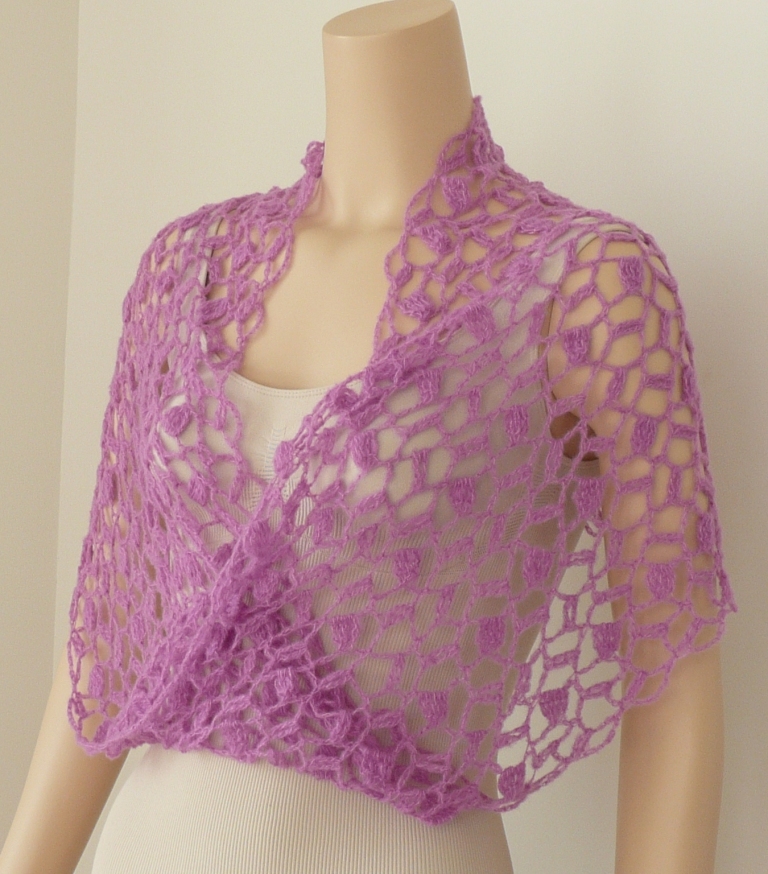
Here is the Wrap Variation, a twisted infinity style wrap.  Also included are instructions for a scarf and a stole.

I will be wandering around throughout the event, but if you want to catch me being good and still, find me hanging out at the Tahki Stacy Charles booth from 1 pm on Saturday and signing books at the Knitty City booth from 1 pm on Sunday.  Wear crochet so we’ll know each other!

>Colloquial Crochet: Yarn By Any Other Name

>As a writer, I am all for having fun with language and amuse myself finding other ways to say the same thing.  This approach is not always appreciated by editors who would rather I use fewer words and a less colloquial, more formal tone in my prose.  And I agree that much of the crochet writing I produce (think patterns) has to be clean, clear, pithy, precise, concise and…. well… boring.  But this is the blogosphere, the wild west, where anything goes and usually does. I understand that using jargon, slang and euphemism in writing may mean that some readers will not understand what the frack I’m talking about.  I can live with that.

Obviously the way we speak is not the way we are supposed to write. What I was taught in school, Standard American English composition, today seems static to the point of moribundity.  In contrast, spoken American English, like all living languages, is dynamic and constantly changing to meet the needs and coolness of the speakers. I don’t say we should have no standards for grammar, syntax, usage, spelling and such. I do say that there is a richness, texture and much humor to be found in personality prose, what I call this relaxed style.  I guess I want to express my joy and relief that I don’t have to obey all the rules here.

Naturally, we invent the greatest number of non-standard terms and euphemisms for the things that most interest us, what we humans think about and obsess over or are not allowed to talk about in plainer English.  For instance, there must be hundreds, no, thousands of slang terms for sex, the internet, bodily functions and parts, sex, technology.  Illicit activities and substances.  Money.  Hokey smokes, I can easily bang out at least two dozen words for money or dollars.  Bucks, buckos, buckaroos, simoleons, greenbacks, green (which probably doesn’t make sense in countries where currency is multicolored), smackers, clams, cabbage, kale, bananas, coconuts, dough, bread, potatoes, beans, bacon, cheddar, guacamole, lettuce (this is beginning to sound like a fast food order!), moolah, filthy lucre, dinero, paper, scratch, wad, Jacksons, Benjamins/Franklins (although I think only bank tellers and drug dealers ever handle those any more) and the related terms dead presidents and big faces.

Another category of slang I can appreciate addresses lack of either intelligence or sanity. Colorful and evocative, all deliver the sting of insult without being mean about it. So instead of saying stupid, brainless twit we can use dim bulb, low pressure zone, not firing on all eight (or all six), not the sharpest crayon in the box. I like some of the alternatives to crazy such as loony tunes, bats in the belfry, lights on-nobody home, bonkers, wacko, space cadet and my favorite, a french fry short of a Happy Meal.

Some words are more potent in print because they are difficult to pronounce or would come off as too effete in speech.  I use lots of scary words in writing that I’d never say in conversation because I am not an asshole. And I have to agree that most colloquialisms are better heard than viewed in print because our voices carry important cues for emphasis, emotional content and nuances that can’t be typed in, except perhaps by the lame use of emoticons.  🙂   But since I “read” out loud in my head, I can still crack myself up in writing, no problem.

So (here’s the payoff), we have a million thousand slang words for this other stuff that’s important to us, like sex and money.  Why are there no happy, amusing slang terms for yarn? Yarn is something I think about all the time. Don’t you? I find myself typing the word y-a-r-n so often that the labeling on those keys has worn off.  This annoys my partner no end.  He types by hunt and peck and if he can’t see which key is “A” then he is totally lost. It would be nice to give some of those other keys more action, to kind of even things out.

A better question would be, do we actually need a euphemism for yarn?  Is yarn considered shameful or taboo in any way? That would depend on your upbringing and how big your stash is, I suppose.  But wouldn’t it be cool to have our own word?

Imagine the possibilities.  “OMG, that LYS gives great [yarn]!”.  “This cashmere [yarn] is to die for.”  “Did you [yarn] today?” “So much [yarn], so little time.”

I’m gonna work on it.  Slang for the “Y” word.  Something that doesn’t have the letters Y, A, R or N in it, please.  Just saying….