>BACKSTORY: Zen Jacket

>

Zen.  Such an evocative name, a peaceful, tranquil sort of name.  You’d never guess that the prototype of this design was born in the aftermath of a wild and daring midnight airport rescue.
It was July 22nd, 2007, and the Crochet Guild of America Chain Link National Conference was about to begin in Manchester, New Hampshire.  The usual suspects, having hauled ass all afternoon setting up for the next day’s opening event, Professional Development Day, were gathered at the venue’s only restaurant/watering hole, in the mood for some serious unwinding. Spirits were high that night, perhaps due to the spirits that were flowing, but mostly due to the joy of meeting up with good crochet friends and getting to eat dessert for dinner.  Don’t ask.

But disaster was brewing, in the shape of massive storm delays and rumored airport worker strikes that would ground countless critical flights up and down the East Coast. One flight in particular, the one that was supposed to deliver two friends from Atlanta to Manchester, was unceremoniously canceled, leaving Jacqueline Kurman and Vashti Braha stranded until the next morning.  Jacque was beat, having spent the entire day traveling from the West Coast and was on the verge of despair. Vashti had just flown into Atlanta from Florida, so was the clearer-headed of the two and also the more desperate of the two.  Vashti was scheduled to teach during PDDay and was going to make it to Manchester no matter what she had to do.

The no matter what she had to do proved to be calling us.  It was around 8 pm, I had just scarfed down my chocolate cake, and the gathering at the bar was a little loud.  Although it was difficult to hear, comprehend and then share the news about Vashti’s lousy luck, eventually it was decided that Plan B would be put into action.  Plan Boston.  Vashti would get Jacque and herself on the next flight out, which would land them at Logan in a matter of hours. From there they would find a way up to Manchester.  Yeah, right.

“What, are you NUTS?”, I must have ranted,  “Logan is no place to be wandering around in the middle of the night looking for a ride.  You’ll be fifty miles away. What are you expecting to find at that hour?  Taxi?  That’s absurd.”

And then, before I had time to think about it, the words came out of my mouth.  “I’ll drive down and get you.” Done deal.

It was the logical decision.  I had driven to the conference that day and had my car with me.  Why not?  It might be fun, in a surreal kind of way.  So I ordered some coffee and asked who was coming along for the ride.  The night was drizzly.  Although I knew how to get to Boston, I hadn’t been to Logan in ages.  I could really use a navigator.  The gathering grew ominously quiet.  Not one of our buds volunteered.  All were either too tired, too preoccupied with preparations for the morning, too waffled to care.  All except one.

Amie Hirtes.  We had only met that evening, and I wasn’t sure if I wanted to spend a hour in the car with somebody I’d just met riding shot-gun.  I even told her as much.  Good thing Amie’s such a good sport.  Anyway, turns out I shouldn’t have worried, since she showed herself to be funny, outspoken, companionable, and totally uncritical of my driving; my kind of shot-gun.

The spotty drizzle made my windshield horribly streaky, but otherwise it all went splendidly.  The drive back to Manchester that took us well past midnight was a strange relief and a happy ending for all. Vashti, ravenous, munched on some chocolate I had stashed in my bag.  Practically in tears, Jacque, poor thing, simply could not believe that anyone would go out of her way to perform such a rescue, and was grateful beyond words.  So grateful that, a few weeks later, she sent me a thank-you surprise, a bag of wonderful yarn that she had brought back as a souvenir from a trip to Australia.
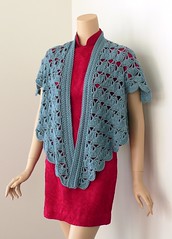
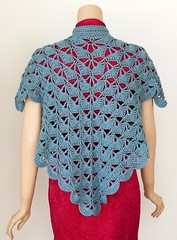
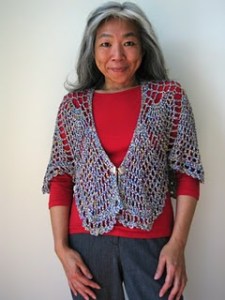
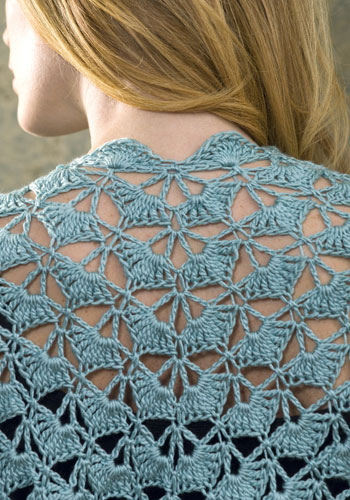
By the time the usual suspects met up again at the 2008 CGOA conference, again in Manchester, I had turned Jacque’s gift yarn into a lacy wrap-with-sleeves and made sure I modeled it for her to see.

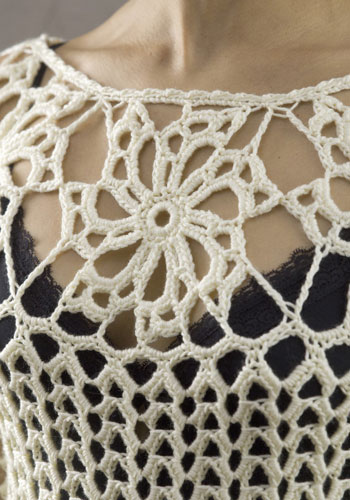
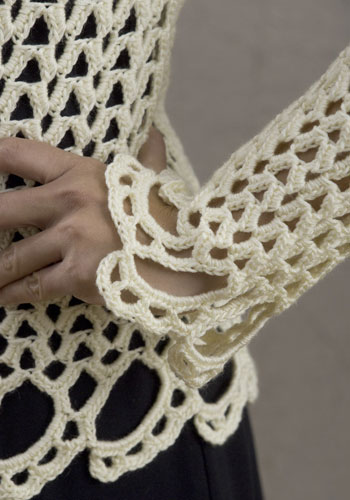
That garment was the prototype for what would become, a few months later, beautifully re-envisioned and re-made in NaturallyCaron.com Spa,  the Zen jacket.  The pattern is available as a free download from NaturallyCaron.com.

I have since mounted other airport rescues, but none as daring as that night’s.  And I have designed many other lace garments, but none with such a memorable backstory.

>BACKSTORY: Avalon

>

You gotta love a yarn company design director who respects crochet. From the first garment I sent to Cari Clement for Caron International in 2006 through the latest, this top for NaturallyCaron.com, our creative relationship has given me so many unique opportunities to explore my craft. This season Cari has spotlighted our latest design, Avalon, with a free pattern download and audio fashion show.

Avalon was inspired by home dec. Really. The motif is my adaptation of a swatch I saw in a vintage book, “Crochet For A Beautiful Home” (Sedgewood Press, 1987), one of among the countless treasures found by my mother over the years as she scoured her local flea markets and thrift shops. I know she paid just a couple of bucks for it, because if the penciled-in price on the inside cover had been any more than 2 dollars, she would have beaten them down to 2 dollars, trust me.

The motif features spiraling arms consisting of solid single crochets over chain spaces. I just so happened to see a coordinating pattern stitch in a Japanese stitch dictionary , “Crochet Patterns Book 300” (publisher and information in Japanese and therefore indecipherable by me!). The motif and stitch worked so well together that this top practically designed itself.

By deconstructing the motif I discovered a cool way to make the spiral arms into a trim for the body and sleeve bottoms.

Avalon has a soft, dense drape and generous, slinky stretch thanks to the yarn, NaturallyCaron.com Spa, a blend of Microfiber and Bamboo. The body and sleeves may easily be lengthened or shortened as you please before finishing with the trim, one of the benefits of top-down construction. Beware, though, as the stitch pattern will relax when blocked and you may end up with more length than you imagined.

>BACKSTORY: KDTV Episode 208

>Today online registration opened for The National NeedleArts (TNNA) summer 2009 show in Columbus, Ohio. This is the place where industry exhibitors show off their wares to needlework retailers, where yarn shop buyers get to preview and order the new yarns and products over which we will all be drooling next season, where editors and publishers keep tabs on what’s happening. TNNA shows are not open to the general public. But they let us designers hang out. Hokey smokes, they even throw yarn at us!

This show is a must-see for the sheer sensory overload of so much yarn. I swear I go home with a stiff neck from days of whipping my head around every time someone exclaims “Oh My God, look at that!”. Aside from the primary yarn objective, for me TNNA is also about people and opportunities, the chance to grab quality face-time with colleagues, yarn company reps and editors. You’d be surprised (or maybe not surprised) how many industry relationships are created and cemented over drinks at the Big Bar on Two at the Hyatt Regency Columbus.

My happy anticipation for this year’s event is way different from the angst I experienced last year. See this post from June 2008, my post-TNNA recap. I have not yet seen this episode of Knitting Daily TV, on the topic Seamless Construction containing the segment we recorded last June. But I understand that it has aired and is available for purchase.

Here’s a still taken right before the shoot. On the right that’s Kim Werker, host of the segment and editor of Interweave Crochet at the time, looking so poised and prepared. The other one is me, like a rabbit gone “tharn” or a deer in the headlights. Please, please, please tell me I didn’t look so completely petrified throughout the entire thing. 

The yellow top next to me is the design we featured during the segment, the Bell Sleeve Pullover taken from the now legendary Tahki Crochet 2006 book. When I was working on that garment in 2005, I was not yet sensitive to the need for extra pattern sizing nor was I skilled enough to provide it. Thanks to KDTV and segment sponsor Tahki Stacy Charles I was given a rare gift; the chance to go back, revisit the design and make up for such a shameful omission.

The revised pattern with re-proportioned sizing to fit up to 3XL (55″ finished bust circumference) is now available as a free download from Knitting Daily TV. You will need to sign up before you can click through.

BTW, here’s a link to the TNNA application form for Affiliate membership, the category which includes designers, teachers and publishers

>BACKSTORY: Abydos Vest

>Not to be taken for Abydos, an ancient ruined city in central Egypt, this Abydos is named after the planet encountered during the first trip through the stargate (Stargate the film and Stargate SG-1 the series). Although the accepted pronunciation of the ancient city is uh-BYE-des, I prefer the less awkward AB-ih-dose as used by SG-1. Don’t think me odd. If you create a Venn diagram with science fiction fans in one set and crocheters in another set, you will find me (along with MANY others) waving at you from the intersection!

The Abydos Vest from Amazing Crochet Lace has nothing to do with ancient Egypt or science fiction and everything to do with exploded stitch patterns. The inspiration for this design was drawn from a pattern booklet published in 1970, Bernat presents Moods in Fashion; “The Open Look”, which my mom picked up for me at a flea market for, like, 50 cents. How cool is Mom!

What immediately impressed me was how these garments, considered trendy nearly 40 years ago, have once again become trendy. It seemed everyone was falling all over themselves to rediscover and resurrect crochet fashions from the 70’s. I was totally enthralled. With just a bit of tweaking, an injection of modern yarns, resizing for current body standards, nearly everything in that booklet could be made and worn today.

I started with one of the bold, open stitch patterns featuring rows of triple crochet shells and V’s, and worked out a pullover vest in my usual MO (seamless, top-down). It was astounding how quickly I could get a wearable to fly off my hook. That year I must have made half a dozen vests to give as holiday gifts to relatives and friends.

Those gift vests were crocheted with fairly thick yarns for cold-weather layering and in hindsight were a tad clunky. So a couple of years later, when I decided to give this design a place in my first book, I knew I had to swap out the yarn for something dressier and more refined. I considered two yarns that are sportweight, some might say fingering weight, and made two garment samples, one cropped short and one tunic length, worked in a relaxed gauge for maximum laciness.

GEE WHIZ, I couldn’t choose between the two yarns OR the two lengths, so I included both versions in the book. This vest is a cinch to adjust for length, so don’t feel you have to go with what’s in the photography. Heck, I didn’t when I made my own Abydos.

Mine is done in Filatura Di Crosa Brilla, #404 a milk-chocolatey brown. Doubledogdangit if I couldn’t match my own gauge, so I had to mess with the stitch count. I added one repeat each side when I got to the underarms. Yes, I cheated. So sue me! I also made mine an inbetween length; long enough to cover the midsection yet short enough so I can still reach my pants pockets.

Pineapples and Fish

BLUE CURACAO from Amazing Crochet Lace

The iconic crocheted pineapple has played a recurring role in my designs. I was not always so enchanted with them.
Native to the Caribbean, the pineapple was offered by inhabitants as a gesture of welcome to early explorers of the 15th century. If the natives had foreseen how screwed they would be by letting those guys into the neighborhood, they would have taken back their luscious gifts, I’m sure. But it was too late. On his second voyage, Columbus brought the pineapple back to Europe, where it was prized as a culinary delight.
Reverence of the pineapple later reached all the way back across the ocean to colonial America, where the fruit became the ultimate symbol of hospitality, an important part of colonial life. So costly and rare was this fruit that to merely display one as a crowning touch on one’s table was proof of the household’s taste, wealth, power and resourcefulness.
The pineapple worked its way into fine and decorative arts, in paintings, carved into wood, cast into metal, glazed onto china. Needleworkers also took to the pineapple and stitched, wove, embroidered and needlepointed it into treasured heirlooms and decorative items of all sorts. During the classic era of the 30’s and 40’s, the crocheted pineapple was ubiquitous, and it’s shape, wide at the base, dwindling to nothing at the tip, became a familiar and much beloved motif.
The next explosion of pineapple popularity came in the 50’s after WWII. Although not native to Hawaii, pineapples were successfully commercially cultivated in the Hawaiian Islands, and quickly became widely available and inseparable from Hawaiian lore. I suspect that the attack on Pearl Harbor and the ensuing war in the Pacific theater served to focus the nation’s attention on those peoples, cultures and foods. Today we’ve forgotten how exotic the islands must have seemed, and how much interest there was when, the way the pineapple was a crowning touch to colonial tables, Hawaii became the crowning glory as our 50th state.
Whatever the reason, through the 50’s and 60’s there was a fascination with everything Hawaiian. Loud Hawaiian shirts became associated with rude American tourists, don’t ask me how. Shot on the island of Kauai, the 1958 film version of one of the greatest musicals of all time, Rodgers and Hammerstein’s “South Pacific”, had us all humming the tunes. (My most treasured music box as a girl had a ballerina who danced across a little mirror to “Some Enchanted Evening”). In 1961 we flocked to see Elvis Presley in “Blue Hawaii” (Mom’s favorite Elvis movie). Native son Don Ho became a minor pop star and TV personality after his 1966 hit recording “Tiny Bubbles” (I know all the words).
Suburban backyards were routinely transformed into Polynesian wonderlands, bristling with tiki torches, the setting for luau themed parties complete with grass skirts, flower leis and drinks with pineapple spears stuck in them. I am not sure when, how or why those tiny paper parasols came to join the fruit. Protection against UVA and UVB? “Aloha” and “Waikiki” became real words. Hula girl icons danced on the dashboards of our cars. Hula-hoops. Need I say more? Pineapple crochet covered everything in the house, including ours.
Neither my mother nor I had any idea of the historical significance of the pineapple motif. Columbus who? We liked eating pineapple, but mostly it was out of a can; little tidbits mixed in with the fruit cocktail, chunks in my dad’s sweet and sour pork, or rings on top of a holiday ham. Even so, it didn’t make sense that she would have labored hundreds of hours with miniscule thread and hooks to celebrate dumb old pineapples. To me they looked like fish doilies. Now, fish I could understand.
You see, my dad went fishing. Considering how little leisure time he had, fishing must have been very important to him, as important as the baseball and football games on TV. Dad would have gone fishing more often, but he never took vacations or did anything that meant closing the laundry. He said if you give customers a reason to go somewhere else, they might not come back. So the fishing was limited to occasional Sunday mornings in summer.
We kids were welcome to tag along on Dad’s fishing expeditions, but Mom never went and I didn’t know why, since she put crocheted fish all over the house. Dad always seemed so proud of the fish he and my brothers brought home. I wanted approval as well, so one morning I decided to find out for myself what this fishing was all about.
I was woken up well before the sun came up. Dad cooked us a big breakfast, but I couldn’t eat, it was way too early. In the dark we were hustled into the car. Normally on long trips I would read to pass the time, but it was still so dim I couldn’t even do that. In reality it took maybe half an hour, but putting up with my brothers crammed into the back of the station wagon made the trip to the reservoir seem an eternity.
By then it was dawn, so I could clearly see what a mistake I’d made. I had to stand at the edge of the water, tall reeds and scratchy grasses all around my legs, yucky, marshy ground under my feet. I could sit if I wanted… on a slimy rock. I had to stick nightcrawlers on my hook. Well, I HAD to do this myself because in front of my dad and brothers I could show no fear or loathing. I was cold and hungry, squirmy and chewed to bits by mosquitoes, terrified of getting ticks. And worst of all, my butt was damp from the rock and there was wormy gack all over my favorite shirt. If there is a Zen of fishing, I missed the point and the fish knew it because I caught nothing.
It occurs to me now that Dad didn’t enjoy the process of fishing as much as he loved fooling with free fresh fish in the kitchen. I could have saved myself one hell of a miserable morning had I known that and just showed up later for the marinated charcoal-grilled catfish and eel dinner.
From that day on I was more inclined to see pineapples in my mom’s doilies instead of fish.