>Hitting a smaller target: Part 2

>It helps consumers of my patterns to know that I totally suck at imaginary counting.  What I mean is I am incapable of coming up with absolutely correct counts where the stitches are extrapolated for pattern sizing, not actually in my hands as tangible crochet.  Obviously, I work really hard {really really really hard} at crunching the correct numbers for all sizes, but in reality, the only set of numbers in my patterns that I can guarantee to be perfect and consistent are the stitch counts for the garment sample I have myself crocheted. Any other string of numbers will simply swim in front of my eyes, a downside to advancing age. I can clearly see what stitches have to happen, where, when and how often.  But don’t ask me to count those suckers.

So you could conclude that I am a visual person, a tactile learner, a hands-on designer.  I describe my design approach as organic.  I cannot make crochet design without making crochet.  I’ve heard that there are designers who work differently, for whom the entire process is virtual.  They make a sketch of the design, plug the variables of stitch pattern and gauge into their own particular standard pattern template, then pass the mess along to a contract stitcher who crochets the sample and often fixes the pattern writing to conform to the real object.  This could be an efficient way to crank out a limitless body of work in seemingly no time.  Not for me.

With my paltry few years professional designing experience and the hundreds of designs I’ve done, I still don’t know if a design works until I do it.  Likewise, I honestly won’t know if the sizing extrapolations I’ve calculated will actually work for real unless and until I have crocheted that particular pattern to those exact finished measurements myself.  And as I just spilled a couple of paragraphs ago, I wouldn’t be able to give absolutely reliable stitch counts for any of those imaginary pieces.

As quickly and as efficiently as I crochet, and depending on the project and the number of loose ends (!), it still takes me from three to ten days to nail down a crochet design (complete the sample to the point where I know it works).   Deadlines are usually pressing.  I routinely have less than two weeks to devote to any one design.  Most editors and/or yarn companies provide enough materials to complete the sample, with not much to spare. So, there is never enough time or materials to physically crochet multiple samples of a design.  Nor do the design fees offer enough compensation for the extra work.  Even for designs with publisher guarantees that they have been pattern tested, not every size of every garment has been crocheted.  When my patterns take written form, all those extra sizes and all those stitch counts are, and will remain forever imaginary.

That’s where you come in.  I rely on feedback from crocheters who have worked from my patterns and crocheted the other-than-model sizes.  You guys are brilliant at tracking me down, showing and telling me what works. Spotting you wearing  your finished projects at events is one of the reasons I look forward to events. Your on line comments and critiques on the construction and fit help me do the next one better.  The group at Ravelry.com dedicated to my designs, Doris Chan: Everyday Crochet,  is my chief contact with fans.  Each time a Raveler posts to the forum, asks a question, begs for pattern support, points out a pattern error {usually a stupid stitch count!}, shows pictures of finished projects, cheers on other crocheters, commiserates with others over ripped rows and wonky gauge…  every word teaches me something.  Hundreds of somethings.

So what am I hearing right now from my legion of crochet whisperers?  Aside from the background hubbub of excitement upon discovering crochet empowerment, I am hearing a tiny plea that could be growing into a more significant groundswell of discontent concerning, of all things, not plus sizing but smaller sizing. You may wonder how this issue even exists, since according to the first lesson in Part 1 I learned that I have to crochet design samples that look good on skinny models, but there is a limit to how low you go.

Claudia modeling Rosalinda

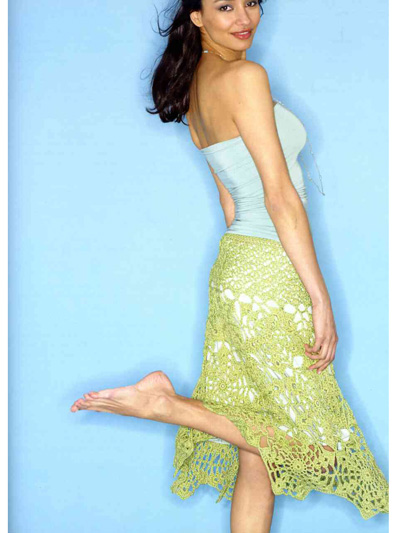
I was invited to {more like I jumped up and down and held my breath until they allowed me to attend} the photography shoot for my book Crochet Lace Innovations.  The design samples I provided were carefully and deliberately sized to fit fairly skinny humans.  But nothing prepared me for the range of body shapes that we encountered among the three gorgeous models, Claudia, Chanel and Eva.
Chanel modeling River Song
Eva modeling Jadzia

You’d think one fashion model might be interchangeable with another fashion model.  HA!

Claudia was lithe and coltish at a size 2.

Chanel, the curviest of the three {she gets the hubba-hubba award}, was a graceful, perfectly proportioned size 4.

Little Eva, who was certainly not underage, but appeared so young and underdeveloped, like a blossoming12-year-old, was a solid size 0.  Even the stylist, Kristen Petliski, couldn’t have planned for the different clothing sizes that were needed to coordinate with the crochet.   Some samples and clothes had Chanel spilling over a little {the hubba-hubba factor!}, but were playful and flowing on Claudia; some stuff was just too loose on Eva. That’s probably why you never see the back of the Jadzia jacket in photography.  Eva’s shorts are clipped in the back!

No one at the shoot touched any of the crochet samples; I wouldn’t allow it, and none suggested it.  We played musical crochet until the right model was matched with each outfit.  So what you see in those images is the real shape of each crocheted piece.

But here’s the thing.  Nothing in the book was supposed to fit a size 2 or 0.  Hardly anything I design goes there. As much as we exalt those fashion model figures, in real life few consumers need patterning that small. For mass market publishing, I have found no call for sizing smaller than 4 and no comment when I don’t provide it. My recent design output illustrates that I have learned all too well the second and third lessons from Part 1.  I have to produce patterns containing as few words as possible, and those patterns must offer plus sizing.  There is the trade-off and why the entire process is doomed to lead to disappointment among small sized crocheters.  If we go bigger, we make the choice to drop the smaller in order to keep the patterns to manageable length.

More next time.  Oh, and if you’re wondering how I got to be so stubborn and cute (!), check out my piece in this issue of Crafter News, the newsletter from my publisher, Potter Craft.

>Hitting a smaller target: Part 1

>Disclaimer: The following is some more crochet tech talk.  It may at first appear to be mostly harmless wingeing about poor, poor Doris, the long-suffering crochet designer.   It will be not-such-good reading for many casual visitors.  I beg your forbearance and promise that, eventually, through this first and the next installments, there will be a happy ending and a really excellent point to it all.


CYCA sizing guidelines for women

This, my crochet friends, is the sizing bible, the listing of standard body measurements suggested by the Craft Yarn Council of America, and for better or worse, it is the guideline for crochet designers who wish to have their work published in traditional print venues (books, magazines, pamphlets, yarn ball bands).  The CYCA sizes are graded in precise four-inch increments for bust circumference.  We are admonished to follow the size ranges and as accurately as possible state the kind of fit that the garment style offers (loose-fitting, standard-fitting, body-conscious, etc.).   On paper it looks tidy.

We all know for a fact how widely the sizing can vary among commercial clothing manufacturers.  I can’t begin to tell someone what my size is without listing all the exceptions.  Well, I am sort of a size 6 for tops but not bottoms.  I am sort of a size Small, but only if Small means 6-8.  If Small means 4-6 then I am a Medium.  But I like my T-shirts tight, so I sometimes wear XS if that’s a 4, but not if that’s a 0-2.  But I am also a Petite size being 5’2″, but only in tops in body (waist) and sleeve length, because some petite sizes also have narrower shoulders, too, which I don’t require.  I can sometimes wear Junior size 7 (and Big Girl Size 14 or 16!) but  it depends on the cut.  I am a Petite in skirts, but not always in pants because petite pants are sometimes too shallow in the rise, so it depends on how low the waist should fall.  If I go by my waist measurement I am a size 10 pants.  If I go by my hip measurement, I am a 4.  Go figure.

The more I can coax women (usually it’s only your closest friends who will share this level of personal information) into revealing their sizing issues, the more I understand that nobody is a perfect off-the-rack size anything.  So here’s the terrible truth, nobody is a perfect off-the-crochet hook size, either.

And that is why I started designing the the things I do in the way I do.  I could not get a good fit nor a nice fabric (I so suck at sewing crocheted pieces together that I began insisting on NO-sew construction) by following patterns that existed.  With departures so radical from what was written, I discovered I was, in essence, creating my own designs.

I get it.  Honestly, I do.  There have to be some standards and guidelines for knitting and crochet so we all have a common basis and speak the same sizing language. But standard size patterning only works if you posses a standard sort of body.  Nobody has a standard body.  Every body is unique.  So, although this set of guidelines is useful, it does not tell enough of the story about fit, garment ease and drape.

And the other, even more distressing issue is that standard pattern writing and size grading only works if you are doing standard crochet design.  Straying even the teeniest bit outside the box could lead the designer to a world of patterning pain.  Even if by some miracle the pattern adheres to the guidelines, there are still too many things that can go horribly wrong for the crocheter.

To help you see the issues I face every day, here are some of the unsettling lessons I learned:

What sells a design, pattern, garment or yarn to consumers is pretty pictures. Photography for fashion and advertising favors strikingly slim, tall models.  A designer cannot possibly know while crocheting the sample garment what size/shape model will ultimately be chosen to wear it.  It almost doesn’t matter what size garment sample you submit.  The model is always going to be two sizes smaller than the sample, and at least five inches taller than average height.  The stylist will bunch up the excess fabric and clip it tight, hopefully in an unnoticeable place on the model, in order to make a fashion image. Not every shoot goes this way and not every piece gets this much manhandling, but it happens enough that I know the difference.  No one can expect to look that way in her crocheted garment because the model in the sample didn’t even look like that without the “alterations”.

Because I began tinkering with crochet design by making things that fit me, my natural inclination was to recognize a certain set of proportions as correct.  I learned real fast to make my samples (usually the smallest size to be offered in the patterning) both narrower and longer, to the point where they seemed abnormal to my eye, but that’s what was needed. I also stopped working with colors, stitch patterns and yarn textures that don’t photograph well.  Already you can sense a certain reining-in of creativity.

Space is money. Printed page real estate is limited and precious.  There are horrible penalties to pay if your written patterns are longer than the editor deems necessary.  Contractually, you can face outright rejection of the design… or if the design is still accepted and the publication has to incur extraordinary costs for pattern technical editing, you can face having part of your fee withheld.  I have never heard of the latter happening to anyone, but strictly according to some design contracts it could happen.  And, in the course of that red pencil butchery, if your pattern is rendered unfathomable, you the designer have no say in the matter and no recourse.

Don’t get me wrong.  I appreciate and value technical editors more than I can say.  They have saved my butt on countless occasions and their changes and suggestions are usually right.  {GEEZ, it hurt me to say that} Interweave Crochet and Caron International are two of my employers who now routinely ask me to review pattern edits before publication.  I totally appreciate the opportunity.  But that does not always mean there is either agreement or joy in the process.

Plus sizing is now a reality of crochet design, not an option. It was not so long ago when pattern drafting was way easier.  Just look back at knit and crochet patterns in magazines and books from a couple of decades ago.  Three sizes were the norm.  Small, Medium, Large.  And remember, American clothing sizes went through a reality check in the 70’s.  I am right now looking at a  crochet booklet from 1965 where the body bust for size 10 is 31″, size 12 is 32″, size 14 is 34″, size 16 is 36″, size 18 is 38″.  Or look at vintage patterns from the early part of the 20th century where no sizing information at all is given.  No gauge, either.  Even today some high fashion designs and in particular, garment designs originating from outside the US are offered in only three sizes.

Without question, the plus size range of the crochet market has historically been ignored or under-served.  I do my best to extrapolate patterning for body bust at least 48″ in the designs where it is feasible and/or desirable.  But you gotta know that if it is in mind that I will eventually have to write the pattern to include sizes up to 2X or 3X, I find myself avoiding or abandoning design ideas that are too difficult to enlarge, too outside the box to hit the standard sizing guidelines, or would take too much real estate to explain stitch by stitch how to do for plus proportions.  Can you sense more reining-in of creativity?

That’s enough for today.  In the next installment I hope to tie this stuff together and make a point.

>My Flaming Crochet Blog

>Who’da thunk it?  Mary Beth Temple, during last night’s Getting Loopy podcast (go here to download from archives) of the Crochet Liberation Front 2009 Flamie Awards ceremony, mentioned that I had to be dragged kicking and screaming into blogging.  While accepting the award for Best Crochet Blog, I did not disagree.

Funny how you tend to take stuff for granted until someone shines a spotlight on it.  For nearly two years I have been wandering over here periodically to play and post about whatever was bothering/tantalizing/obsessing me on that particular day.  I was never a diary or journal keeper. The mere idea of writing a permanent record of my feelings and opinions was scary new.

The most horrifying aspect of blogging lies in its very nature.  I come from a background of traditional radio broadcasting where your work, including every little stupid flub, although glaringly public, was a passing parade.  The moment a syllable passed my lips it was sent out on the airwaves, then done and gone in an instant (unless someone like the station’s program director was recording my airshift, YIKES!).  In the disc jockey parlance of the day, flaming meant talking on and on and on, seemingly without internal editing.  But for all my flaming, I never had to hear and be tortured by my work ever again, and neither did anyone else.

Blogging and podcasting are forever.  Anything set free on the internet lives on.  Anything you write or say can only be intensified; vibrations that transcend time and space and could conceivably come back to bite you in the butt years later.  This truly frightens me.

But from the inaugural post on 17 May 2008, and over the course of dozens of deeply personal essays, silly tirades, crochet design backstories, self-promotional blurbs and several attempts at pattern support, I learned to relax and just do it. Hey, this blogging stuff is fun!

Now, imagine my mortification at lucking into this Flamie award, equivalent to having a 1.21 gigawatt beam focused here.

I will get over it.  Yes, I will. 🙂 Thank you, CLF and Fearless Leader (Laurie Wheeler) and to all for your vote of confidence.

>What’s in a Design Name?

>

Plenty.  During the Getting Loopy podcast of 5 April, Mary Beth Temple voiced the question that will be on readers’ minds as they peruse the list of design titles in my new book, Crochet Lace Innovations.  So, what the heck are all those unpronounceable names about?

My editors at Potter Craft suggested that all my book designs have interesting names.  So I found some REALLY brilliant ones this time that seemed to complement the crochet.  Other than a few personal choices that don’t have backstories, but just sounded evocative or nice to me, the group includes feminine names that read like a game of Trivial Pursuit.  Some are merely obscure, a few are esoteric, one or two are downright unfathomable.  Likely, if you are a fan of sci-fi or fantasy film, television series, or literature, you’ll get at least a few.  If not, then just view them as little Doris idiosyncrasies and don’t worry about it.

Among the femme names are:

  • flaming-haired “perfect being” from the film “The Fifth Element”
  • sultry Companion in residence on board Serenity in the series “Firefly”
  • blue Delvian priestess in the series “Farscape”
  • science officer and host to the Trill symbiont Dax in the series “Star Trek: Deep Space Nine”
  • mythical heroine imagined by Starbuck in a production number from the Jones/Schmidt musical play, “110 in the Shade”
  • introverted, geeky (and doomed) computer specialist of “Torchwood”
  • simple-minded scullery slave who is literally swept away by a winged vamipiric prince in the Tanith Lee short story “Bite-Me-Not Or, Fleur de Feu” (I did say esoteric, didn’t I?)
  • one of the pet names given to the main character by her father in the Newberry Medal winning book by Madeleine L’Engle, “A Wrinkle in Time”
  • stunningly beautiful woman who is separated from her lover by the curse of an evil bishop in the film “Ladyhawke”
  • archeologist whose relationship to a future Doctor is left to much speculation (“spoilers”) in the episodes “Silence in the Library” and “Forest of the Dead”, Doctor Who Series Four
  • heroine and embodiment of the “Golden Path” in “God Emperor of Dune”, the fourth novel of Frank Herbert’s Dune series
  • gun-slinger and mercenary who joins the morally ambiguous crew in the fourth and final season of the Terry Nation (creator of Daleks!) series “Blakes 7”
  • headstrong and sensual Weyrwoman whose mind is broken after her dragon, gold Prideth, dies during a mating flight in the Dragonriders of Pern series by Anne McCaffrey

One name is a not-girl.

  • if you were born before 1955, then it’s the duck from a charming children’s book;  if you were born after 1980 then it’s Mulan’s boy-alter-ego

And two from pop music:

  • crazy Latin dancing solo down in Herald Square
  • she whirled as the music played in Rosa’s cantina out in the West Texas town of El Paso

So, for a truly warped game of Jeopardy, before actually seeing the table of contents, can you surmise these design names?  No fair googling.

>Talk Fast, Crochet Faster

>Nobody has to remind me.  I know that I talk fast.  My pace must sound mad and maddening to listeners not indigenous to the Philadelphia-New Jersey-New York-metro-monstro-city.  I can’t help it. I’m just drawn that way.

I wish talking fast could hurry up certain conversations. Then I could get back to crocheting sooner.  And I wish I could crochet as fast as I talk.

Talking fast (the first kind) is not the same as fast-talking (the second kind: to persuade with facile argument, usually with the intention to deceive or to overwhelm rational objections).

Talking fast is not always a sign of mental agility or acuity.  People don’t necessarily talk fast because they are thinking fast or thinking well.

Talking fast is not due to having lots to say.  I can go full-throttle and say nothing at all.

Talking fast is not about making the most of the time allotted.  It’s not like I believe there’s a set number of monthly program minutes for talking, and lord help you if you go overtime.  Most of us have unlimited minutes.

The exception is broadcasting and broadcast advertising in particular, where talk is not cheap and time literally equals money.  For a couple of years my job was to write, produce, voice-over and schedule hundreds of 30 and 60 second wonders for various radio station commercial accounts. I am not proud of the fact that I specialized in fast-talking (the second kind), loud, obnoxious spots for certain advertisers.  Some clients, under the impression that those kinds of messages got the most attention, could not be dissuaded. Automobile dealerships and bankrupt furniture outlets were the worst offenders.  How many fracking times can you squeeze “Sale… hurry… last chance… offer ends soon… don’t miss this opportunity to save!” into 30 seconds? Those instances where I couldn’t talk fast enough, I had to go back and splice out every breath and pause.  Or sometimes I’d multi-track the voice-over and overlap my own words in order to get it down to time.  If I didn’t talk fast before, I sure learned the skill by the time I retired from broadcasting.

The reason I’m blogging about this, now that I’m getting around to mentioning that I will be the next guest on Mary Beth Temple‘s blogtalkradio show Getting Loopy, Monday, 5th April, 9pm EDT, is to warn anyone who tunes in that both she and I talk fast.  You may wish to engage the services of an interpreter.  Or skip the live show altogether and download the archived episode from iTunes later and maybe replay the unintelligible bits over and over until it makes sense.  I wonder.  In the same way you can electronically enlarge digital images, is it possible to e-x-p-a-n-d digital audio, somehow slow down my conversation with MBT to fill, say two hours instead of the 45 minutes we’ll have that night?

We are planning to discuss my new book, Crochet Lace Innovations, out this month.  MBT hinted at giving a copy away as that night’s contest prize.  Will she be able to let go of one?  And will we range so far off topic that I’ll have to download the archive myself to figure out what the hell I said?