To Button or Not To Button, Part Deux

Every so often a shirt would come out of the manglers with a dangling, sometimes missing or, very rarely, a crushed or melted button. My keen-eyed parents could spot a button issue from across the room and would always jump to remedy the situation before it became… well, an issue. By the time I hit junior high and my father expanded the laundry to include dry cleaning, many other kinds of buttons and categories of repairs/alterations to garments were required as well. I grew up learning to pay particular attention to buttons. Were they washable, dry cleanable, securely sewn, in good condition? Or was there going to be trouble?

I was never technically supposed to sew buttons, but I did my share. Shirt buttons back then were pretty much standard and nearly indistinguishable from one to the next, because shirts (at least the ones that came into the laundry) were indistinguishable. The overwhelming bulk, no surprise, was white with the occasional blue oxford. Very rarely a pale yellow or a conservative stripe or little silly checks would show up. It was possible to match the buttons on most of these shirts from a limited variety of replacements. Not so today. If you lose a button and didn’t think to save the spare that came with, then you are majorly screwed.

Now that I’m examining my button history, I realize why I shy away from buttoned-down collars. Those fracking tiny collar buttons are a source of misery. Unlike the rest of the buttons on a shirt, which are generally attached to fabric that is double-layered, interfaced or otherwise thicker, those collar buttons live on a single layer of cloth. Good shirtmakers put a small disc of interfacing behind collar buttons for insurance. But sometimes that’s not enough in a place fraught with peril. Most guys have extreme difficulty buttoning them, particularly if a tie is involved. The frustration and discomfiture is reflected in the staggering number of raggedy torn holes where collar buttons are supposed to be.

So I learned to hoard all spare buttons. Since I was always careful to take care of any loose buttons on my own clothes right away I never had to go to those back-ups. So began The Collection.

Over the years I worked my way up from simply saving buttons to seeking out and buying cool and unusual ones. Buttons were my souvenirs of choice, small tokens I hunted down in the course of my limited travels, easier to pack in your return luggage than, say, a lamp. I even coached my friends to bring me back one great button from every trip. This was before I had any awareness of yarn. Today I hear the siren song of the LYS in whatever city I’m visiting. If I can browse buttons there, so much the better.
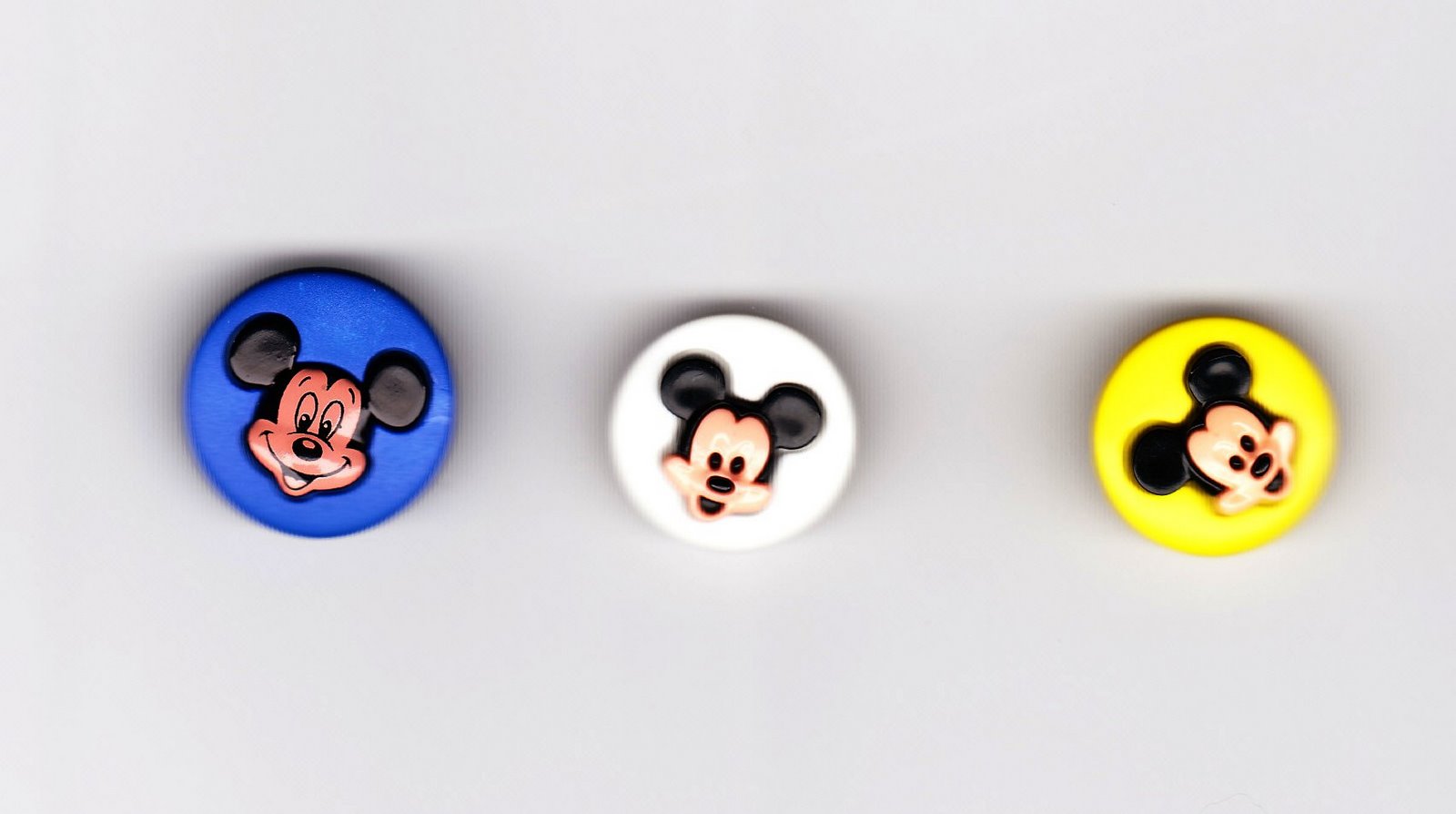
My absolute favorites are the ones I scouted at an open air market in a quaint square in The Hague, Netherlands. You might think me a total goof, traveling so far to bring back Disney. But that’s me.

I collect crummy old… uh, I mean, vintage specimens, too. My prize is a wonderful 50’s era carded set that includes a matching belt buckle. $1.50. WOWSERS. You can’t get one lousy new button for that much. Flea markets, antique fairs, thrift shops are horrible, dismal places to seek yarn but treasure troves for buttons. That’s also where I search and seize vintage crochet and lace patterns and books. But that’s another post.

The strangest new button I own is one I call “Mystic Pizza” after one of my favorite films. It was hand made in Australia by someone who musta had some great pharmaceuticals.

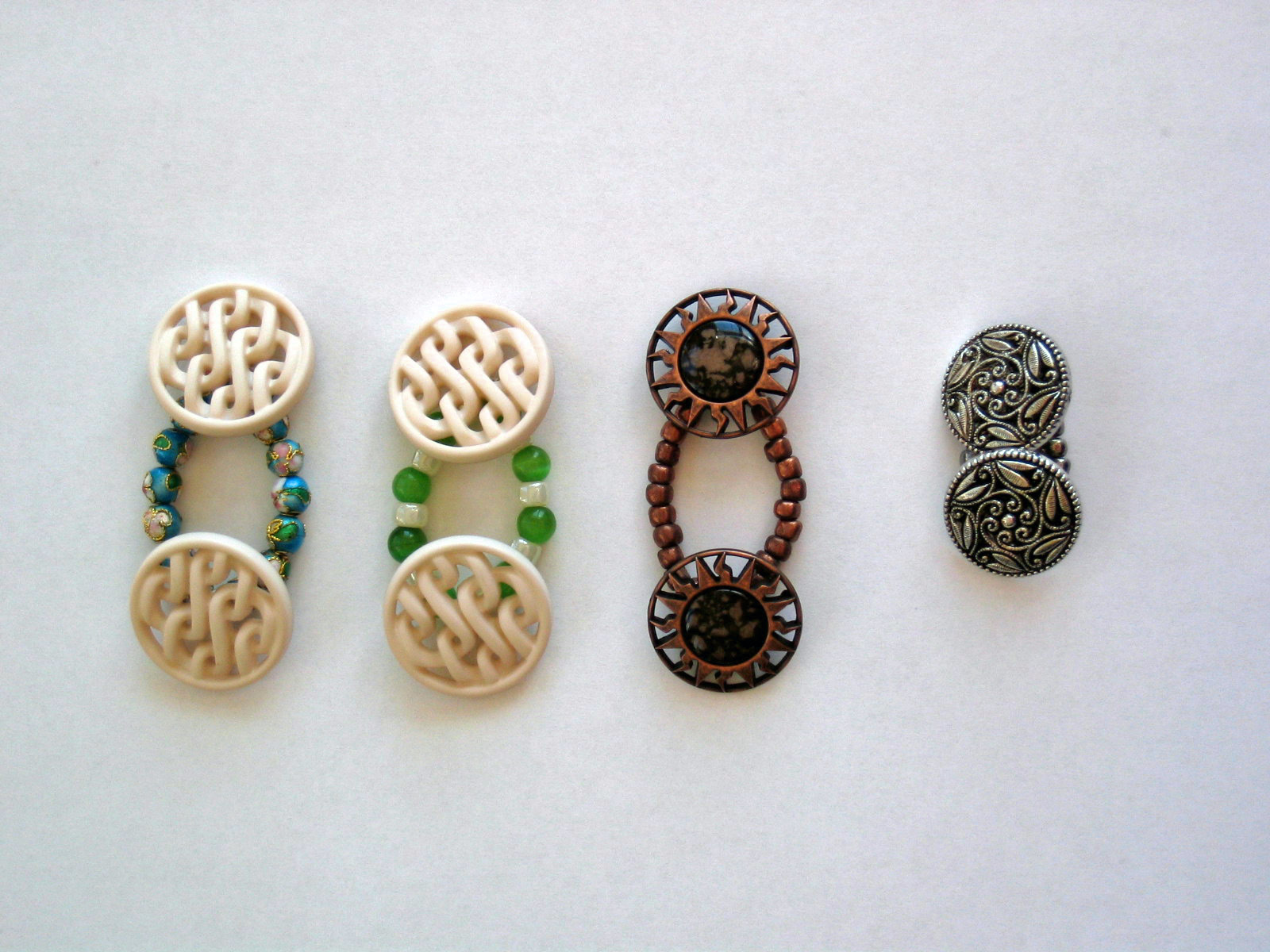
So, you ask, what do I do with my buttons since I obviously never sew them on my crochet. And that’s a valid observation. Once you create a button hole and sew on the button, then you are stuck with the closure. I like to design open fronts that you can wear anywhichway the mood strikes using alternative closures, links, pins and ties. Besides, my collection is so eclectic and consists of so many orphans that the whole lot is totally useless for anything but display purposes. Not that I display them. I keep them safely stored in my collection of cigar boxes.
To Button or Not To Button, Part One

Have I mentioned that I’ve amassed a sizable but eclectic stash of buttons? The button thing started ages ago, pre-dating all my other obsessions. It started when I was a kid and lived in the back of my family’s Chinese laundry.

Today we are largely a wash-and-wear society. You take non-washable stuff to the cleaners and perhaps let them do your dress shirts. But who would even think to send out sheets and towels, underwear and socks? I know for a fact that people did. How odd. The term “Chinese laundry” has little meaning today. But before political correctness was even a thought, many towns and neighborhoods boasted such establishments where Chinese people sweated to keep America clean and freshly ironed.

My grasp of history is tenuous and hazy. Let me paint a picture for you in broad strokes. I think the stereotype was born during mid 19th century, the era of the California Gold Rush and the building of the Transcontinental Railroad. Hundreds of thousands of Chinese, mostly men, fleeing war and poverty, left their farming villages and families behind, hoping for a better life in California, the “Golden Mountain”.

So many arrived that white landowners felt threatened by this “yellow peril” and unbelievably restrictive laws were enacted. For those Chinese who survived the intolerably cruel conditions in the mining camps and railroad crews (where masses were worked to death, or froze in the harsh winters or got blown up in the process of nitroglycerin tunnel blasting) the only opportunities available for people who by law could not own land, obtain citizenship or bring their loved ones over were positions of neo-slavery and servitude. That meant work as household domestics or in service industries, including restaurants and laundries. I suspect that the once ubiquitous Chinese businesses have been recently supplanted by Korean cleaners and corner grocers, Vietnamese and Thai restaurants. But I digress.

Things got better, but even a century later my immigrant parents found themselves running a Chinese laundry. They didn’t actually wash anything. The stuff, mainly bed linens and shirts, were sent to a commercial wet laundry and came back ready to be sorted, folded and wrapped in brown paper parcels, all but the shirts. Those came back still damp and were hand or machine finished on site using an array of irons, presses and manglers.

Each pressing station was designed to do a specific task. There was one with three curved sections for collar and cuffs, one with two arms that did sleeves. The body presser was amazing and scary. It was an upright rectangle around which you wrapped the shirt. Then you hit the green button and the body moved into the machine where two enormous flat irons hissed into place. It makes me think of those cartoons where the toon falls under a steamroller and comes out flat as a piece of paper.

Each station had a hand water sprayer so you could dampen anything that needed it. The metal nozzles, like small garden sprayers that sent out a fine mist, were connected to the water supply through narrow bore hoses that were suspended from the ceiling over each press area. The effect was eerily snake-like. In fact, the laundry floor had this whole jungle thing going on, with the steamy air, the dense forest of machine trees with spitting serpents dangling overhead.

If you look closely in the shop window behind those two laundry midgets (me and my brother in our “Sunday best”) you can just make out the display sign that shows an oriental kind of guy pointing to the words “wear CLEAN HEALTHY CLOTHES”. The assumption and the clear message was that patrons here were cleaner, healthier and better than the poor slobs who did laundry at home. Aren’t we Chinese clever? 😀

I helped out wherever I could. My brown-paper packaging skills were not nearly neat enough or fast enough to be useful. (I still can’t wrap presents. Thank goodness for gift bags and shrink wrap baskets). I wasn’t allowed to go near the shirt pressers or the dry-cleaning machines which came later, although my brothers and I couldn’t resist jumping up and grabbing the sprayers when my folks weren’t watching. Which was hardly ever. But it was better than squirt guns, trust me, and almost worth the hell that ensued if we ever got caught. I mostly did intake and outgo at the counter. But I also sewed buttons.

More soon.

>The Dress-Up Thing

>Only when absolutely inescapably necessary, like for State Occasions or crochet conferences, will you ever see me totally dressed up. I mean in a dress, with the obligatory high-heels, jewelry, accessories and make-up. Heck, most days it is rare to find me in anything but pjs. Shoes? What are shoes? Reading a few of the comments made here by my alleged friends, I feel I must defend my right to choose not to wear dresses. I can explain.

You assume I’m about to blame my mom, right? Isn’t she The Mother Who Longed for a Girly-girl and got me, the kid who ripped the bows out of her hair? Nah. I survived my childhood. The true dress-up trauma came later, much later.

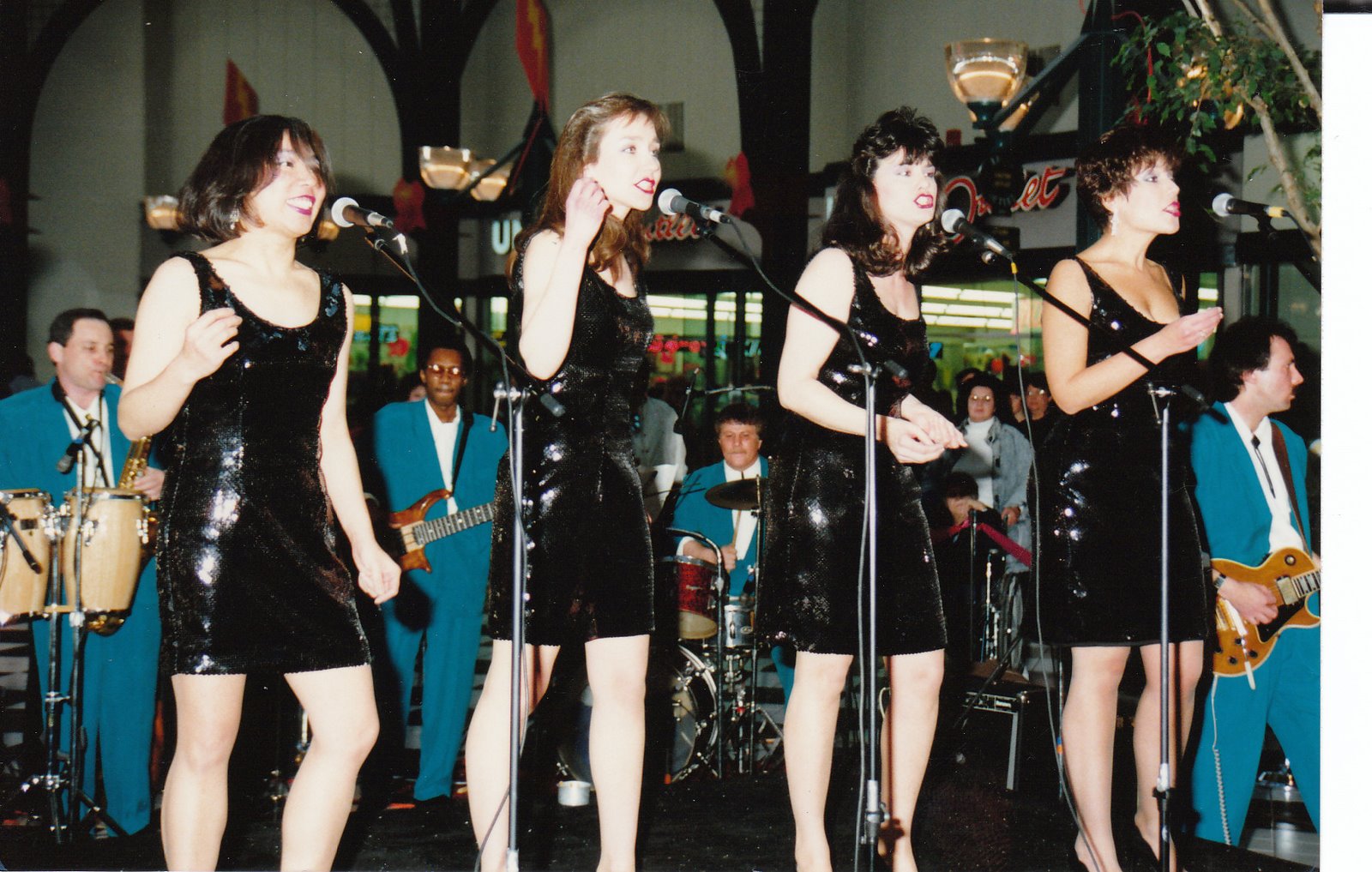
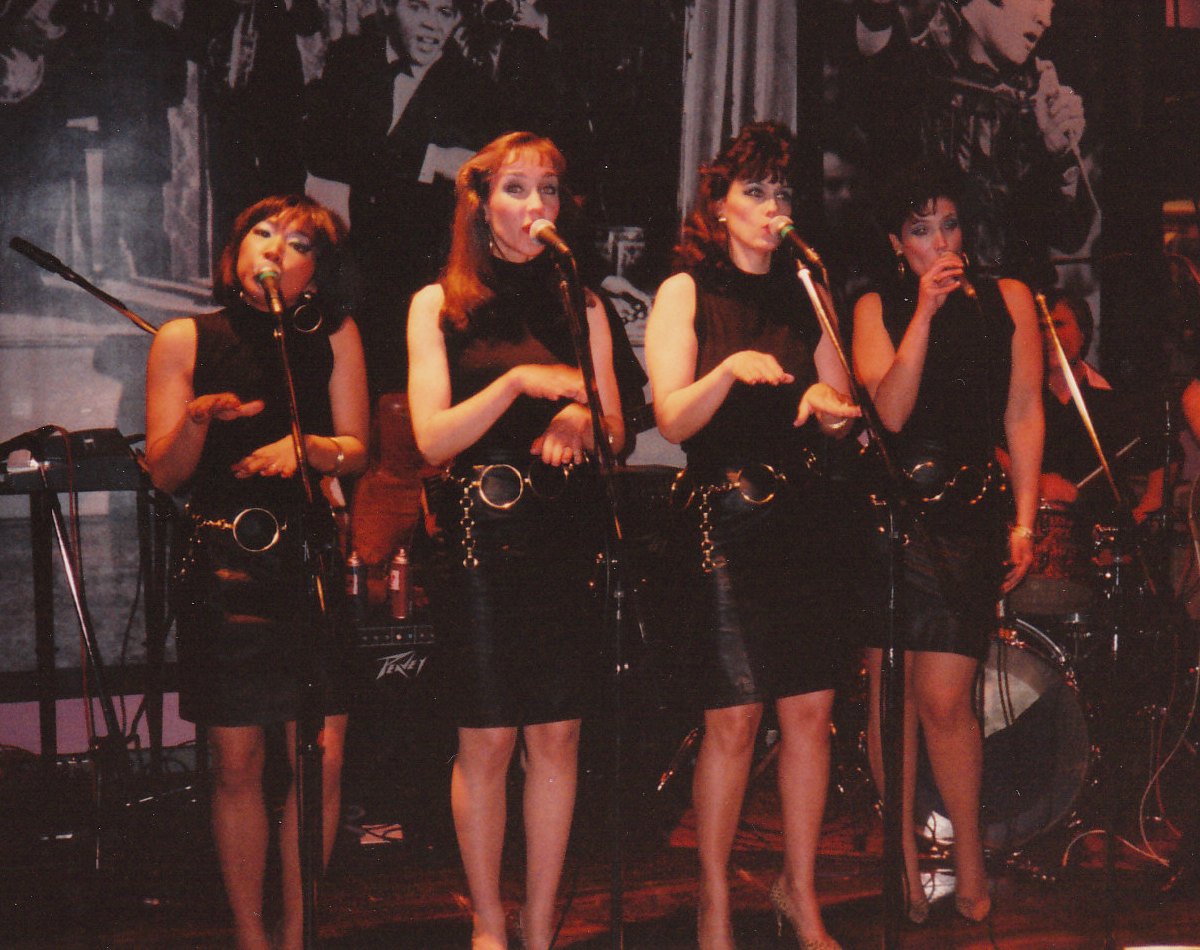
For a few years during the late 80’s/early 90’s I sang in a semi-professional oldies band. No, silly, that doesn’t mean WE were oldies (although I suppose we were all more mature than your typical garage band), but that we performed oldies music. We specialized in the sounds of 50’s doo-wop and 60’s girl groups, rendering nearly note for note recreations of some of the greatest hit recordings of the era. It was bizarre fun; it was horrible torture.

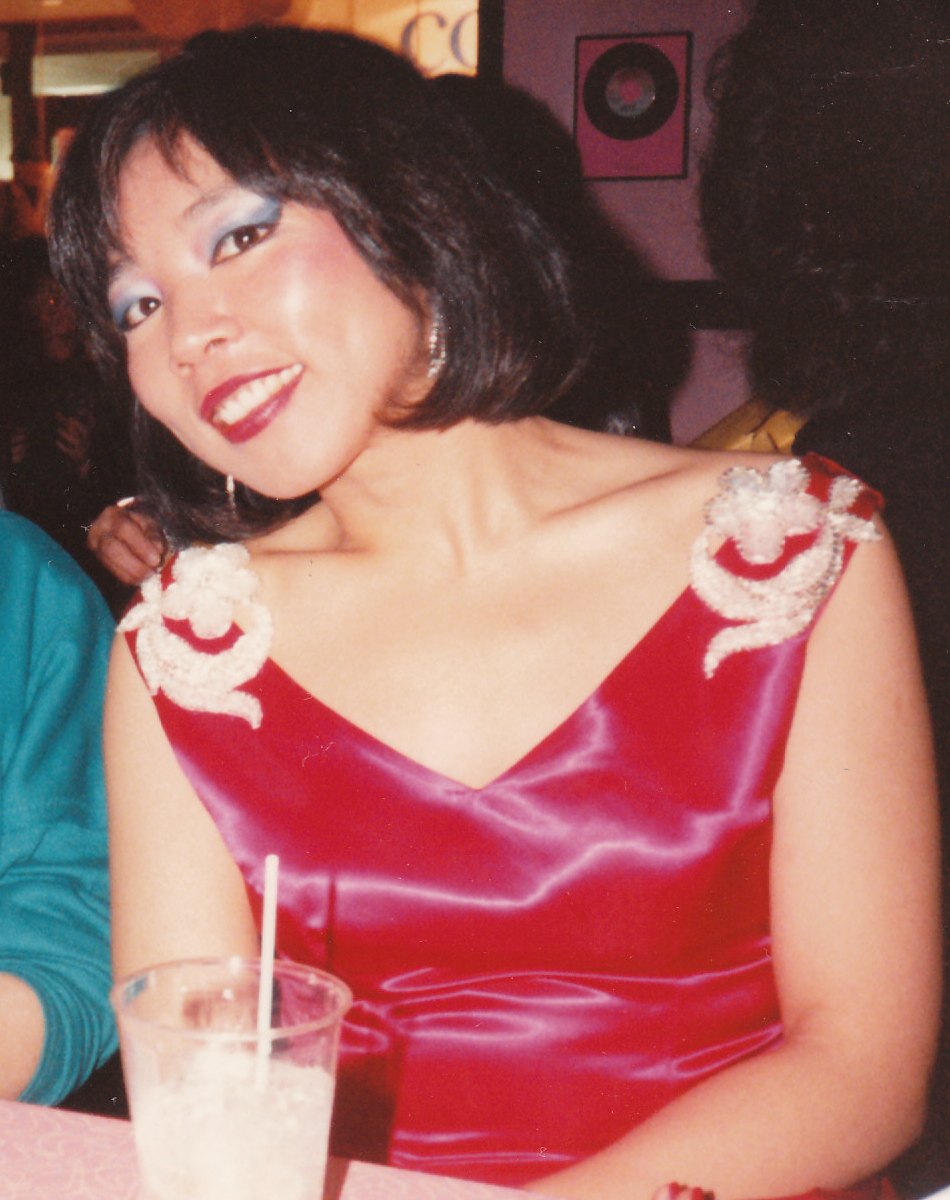
Not only did we four ladies, the Dialtones, have to sing (and dance) like the Ronettes, Chiffons, Supremes, Shangri-las, Vandellas, Marvelettes, Crystals, Angels and Shirelles (to name a few) but we had to wear costumes in a style typical of girl groups of the 60’s. To our costume designer that meant over-the-top matching outfits, with different looks for every set which meant three or four costume changes a performance.

Here’s a little gallery of what I endured for my “art”, including a pink satin baby-doll number with beaded and sequined appliques, a tiny black sequined dress that I had to be sewn into, a leather skirt and chain belt (our “bad girl” look). Mercifully not shown was a tight leopard-print outfit with layers of fringe. Every gig meant five or six hours in extreme stage make-up, stuffed in an array of silly dresses, teetering on different pairs of stiletto-heeled pumps while shimmying as though I were being held captive in a go-go cage.

So, yes, I know what it’s like to be a Barbie doll. Been there, suffered wrecked ankles, won’t go again.

>What I’m Wearing Today: Lacy Jacket

>After a storm front or cold front has pushed through this area, blasting away some of the mid-August heat and humidity, there’s a refreshing chill in the nighttime air that hints at delights to come. Autumn is my best season. That’s when I am the most energized and productive. Designing with wool, cashmere and alpaca becomes doable after a long hot summer of abstinence. Buried under piles of garment samples deep within the recesses of a storage closet, my favorite crocheted jackets and sweaters are once again speaking to me.

There is one event left in this detestable month that I really anticipate. Despite the fact that I know it is a non-event staged by retailers, totally commercial and crass, I truly enjoy the “Back-to-School” thing. Let me be clear. I detest school, always have. The mere thought of entering a school building gives me the willies. And I’m not talking about the migraine-inducing shopping one is compelled to do when there are kids at home. Now that my nest is empty and those headaches are a vague memory, I find I just love shopping for school supplies.

Is it heaven wandering up and down the aisles, eyeing the reams of loose-leaf and printing paper, stacks of pristine composition books, tabbed dividers and report covers, orderly racks of Sharpies (hey, you know they got Sharpie pens now that don’t bleed through???) and ink refills, boxes of fresh pencils. Doesn’t the smell of cedar pencil shavings make you drool? My favorite pencils are Ticonderoga, for no other reason than I have positive associations with the name. One of the loveliest rock ballads from my days as a disc jockey is the little known album track “Ticonderoga Moon” by Orleans.

One can easily rationalize excessive back-to-school buying. Prices are better. Many supplies being offered are useful and necessary for my work. At least that’s what I tell myself as I am loading up the cart (s). Aren’t pencil boxes amazing? Perfect for storing crochet hooks and double-point knitting needles and stitch markers as well as the odd pencil. Toward my goal of being less wasteful, I endeavor to work electronically whenever possible using as little paper as possible. But there are crochet design tasks that require pen or pencil and hard copies. I still scrawl patterning notes, diagrams and schematics in notebooks, filling them with abandon. If you have paper, you need paper clips, right? Wow, those clear plastic rulers are indispensable for measuring gauge.

And just like the yarn and crochet tool acquisition syndrome, it doesn’t matter how many packages of stuff you already have squirrelled away; impulse purchases made the same time a year (several years) ago. One can never be too rich or own too many spiral-bound notebooks.

But if I were going back to school (shudder), this is what I’d wear: jeans and T-shirt (why are you not surprised?) topped with the Caron Lacy Jacket. Because I can’t wear wool and other animal fibers, I often work in non-allergenic Simply Soft. So here’s mine in the shade Denim Heather. Cropped does not work for me, so I added three rows to the body length to get the peplum trim to hit at top-of-hip. And as I suggested at the end of the pattern, I steamed the lace trim to get it to lie smoothly.
What you don’t see is my most recent and prized back-to-school purchase. On my feet are my newest high-top Converse All-Star Chuck Taylors. One green and one blue. 🙂

>The Snaggle Ball

>When you’ve tinkered with enough yarns and fibers you get to know which ones are going to give you grief. I personally crochet all my own design samples so I need to work quickly and efficiently in order to meet my deadlines… er… come close to my deadlines… hmmm. Let’s not talk about deadlines, huh? Anything that holds up the production line is my enemy; yarns that split and snag are the worst culprits.

With experience I’ve learned to come to terms with yarns that tend to split. If you use a large enough hook in a loose enough gauge you can keep splitting to a minimum. Still, if the project is important enough and has to be perfect (which describes pretty much everything I crochet!), you should check your stitches occasionally and be prepared to frog back and fix the split.

Snagging is a whole nother matter. Snagging has nothing to do with how you crochet. It is an insidious cosmic conspiracy devised to keep us humble. It is a reminder that even though we among all beasts are blessed with opposable thumbs, we are but lowly, inept mortals.

My issues with snagging began way before I had a career in crochet. My mother, in a useless attempt to civilize her daughter, persuaded me to replace my beat-up Chucks with stockings and pumps. I saw nothing wrong with pairing sneakers with skirts (I still see nothing wrong with that) but mom was horrified, so I caved in. You chickadees might not remember the Dark Ages before that miracle of modern science — no-run-panty hose. Lucky you. For a couple of years in junior high I had to wrestle with old-fashioned nylons and garters and it wasn’t pretty. I was never able to put on a pair of stockings without encountering a host of snags, which resulted in runners which resulted in abject misery. I was happy but I believe my mother was even happier the day the assistant principal announced that girls would be allowed to wear pants to school.

A useful hint I’ve heard from other fiberazzi is to keep an old pair of panty hose to run over the hands in order to test for any trouble spots that might cause yarn snags. Since I have not owned panty hose since 1999, I came up with a different solution. Every time I encountered a yarn with a real snagging problem I kept some aside as a snaggle ball. Each new yarn that snagged even worse than the current snaggle ball would replace it.

Today, even with my superbly smooth and soft hands due to obsessive hand care and slathering of rich creams and precious home-crafted oils, I occasionally get snags when I crochet. There are yarns, evil yarns that seek out the least little nano-particles of skin on which to get hung up. Hey, there are yarns that snag on air, know what I’m saying? I still pull out and manhandle my long suffering snaggle ball before I touch any suspicious yarns.

For years the most cunning offender was Lion Brand Microspun. Many have tried to topple this grandaddy of all snaggers; none have succeeded until recently. The usurper wasn’t a cheap, indifferently manufactured yarn. It wasn’t an unfortunate choice made by an editor that I was obliged to live with. Nope.

At the time it earned the title, this yarn was my single most expensive purchase for personal use. I totally fell for the luscious colorway, the sheen, the elegant drape, the luxury of the 100% hand-painted silk. And to this day I have not been able to bring myself to crochet anything out of it because it snags like a S-O-B. May I present my galactic champion snaggle ball of all time: ArtYarns Silk Ribbon.