Pineapples and Fish

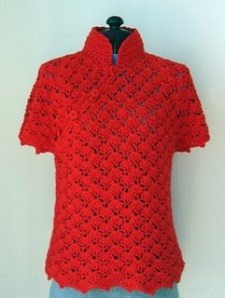
BLUE CURACAO from Amazing Crochet Lace

The iconic crocheted pineapple has played a recurring role in my designs. I was not always so enchanted with them.
Native to the Caribbean, the pineapple was offered by inhabitants as a gesture of welcome to early explorers of the 15th century. If the natives had foreseen how screwed they would be by letting those guys into the neighborhood, they would have taken back their luscious gifts, I’m sure. But it was too late. On his second voyage, Columbus brought the pineapple back to Europe, where it was prized as a culinary delight.
Reverence of the pineapple later reached all the way back across the ocean to colonial America, where the fruit became the ultimate symbol of hospitality, an important part of colonial life. So costly and rare was this fruit that to merely display one as a crowning touch on one’s table was proof of the household’s taste, wealth, power and resourcefulness.
The pineapple worked its way into fine and decorative arts, in paintings, carved into wood, cast into metal, glazed onto china. Needleworkers also took to the pineapple and stitched, wove, embroidered and needlepointed it into treasured heirlooms and decorative items of all sorts. During the classic era of the 30’s and 40’s, the crocheted pineapple was ubiquitous, and it’s shape, wide at the base, dwindling to nothing at the tip, became a familiar and much beloved motif.
The next explosion of pineapple popularity came in the 50’s after WWII. Although not native to Hawaii, pineapples were successfully commercially cultivated in the Hawaiian Islands, and quickly became widely available and inseparable from Hawaiian lore. I suspect that the attack on Pearl Harbor and the ensuing war in the Pacific theater served to focus the nation’s attention on those peoples, cultures and foods. Today we’ve forgotten how exotic the islands must have seemed, and how much interest there was when, the way the pineapple was a crowning touch to colonial tables, Hawaii became the crowning glory as our 50th state.
Whatever the reason, through the 50’s and 60’s there was a fascination with everything Hawaiian. Loud Hawaiian shirts became associated with rude American tourists, don’t ask me how. Shot on the island of Kauai, the 1958 film version of one of the greatest musicals of all time, Rodgers and Hammerstein’s “South Pacific”, had us all humming the tunes. (My most treasured music box as a girl had a ballerina who danced across a little mirror to “Some Enchanted Evening”). In 1961 we flocked to see Elvis Presley in “Blue Hawaii” (Mom’s favorite Elvis movie). Native son Don Ho became a minor pop star and TV personality after his 1966 hit recording “Tiny Bubbles” (I know all the words).
Suburban backyards were routinely transformed into Polynesian wonderlands, bristling with tiki torches, the setting for luau themed parties complete with grass skirts, flower leis and drinks with pineapple spears stuck in them. I am not sure when, how or why those tiny paper parasols came to join the fruit. Protection against UVA and UVB? “Aloha” and “Waikiki” became real words. Hula girl icons danced on the dashboards of our cars. Hula-hoops. Need I say more? Pineapple crochet covered everything in the house, including ours.
Neither my mother nor I had any idea of the historical significance of the pineapple motif. Columbus who? We liked eating pineapple, but mostly it was out of a can; little tidbits mixed in with the fruit cocktail, chunks in my dad’s sweet and sour pork, or rings on top of a holiday ham. Even so, it didn’t make sense that she would have labored hundreds of hours with miniscule thread and hooks to celebrate dumb old pineapples. To me they looked like fish doilies. Now, fish I could understand.
You see, my dad went fishing. Considering how little leisure time he had, fishing must have been very important to him, as important as the baseball and football games on TV. Dad would have gone fishing more often, but he never took vacations or did anything that meant closing the laundry. He said if you give customers a reason to go somewhere else, they might not come back. So the fishing was limited to occasional Sunday mornings in summer.
We kids were welcome to tag along on Dad’s fishing expeditions, but Mom never went and I didn’t know why, since she put crocheted fish all over the house. Dad always seemed so proud of the fish he and my brothers brought home. I wanted approval as well, so one morning I decided to find out for myself what this fishing was all about.
I was woken up well before the sun came up. Dad cooked us a big breakfast, but I couldn’t eat, it was way too early. In the dark we were hustled into the car. Normally on long trips I would read to pass the time, but it was still so dim I couldn’t even do that. In reality it took maybe half an hour, but putting up with my brothers crammed into the back of the station wagon made the trip to the reservoir seem an eternity.
By then it was dawn, so I could clearly see what a mistake I’d made. I had to stand at the edge of the water, tall reeds and scratchy grasses all around my legs, yucky, marshy ground under my feet. I could sit if I wanted… on a slimy rock. I had to stick nightcrawlers on my hook. Well, I HAD to do this myself because in front of my dad and brothers I could show no fear or loathing. I was cold and hungry, squirmy and chewed to bits by mosquitoes, terrified of getting ticks. And worst of all, my butt was damp from the rock and there was wormy gack all over my favorite shirt. If there is a Zen of fishing, I missed the point and the fish knew it because I caught nothing.
It occurs to me now that Dad didn’t enjoy the process of fishing as much as he loved fooling with free fresh fish in the kitchen. I could have saved myself one hell of a miserable morning had I known that and just showed up later for the marinated charcoal-grilled catfish and eel dinner.
From that day on I was more inclined to see pineapples in my mom’s doilies instead of fish.
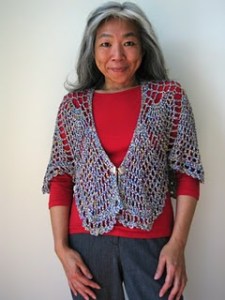
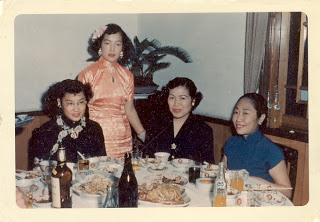
BACKSTORY: China Doll

Inspired by traditional Chinese costume (“cheongsam” for both women and men in the Cantonese dialect, or more accurately “qipao” for just the woman’s dress) this design has been a pet project of mine since childhood. In her trousseau my mother had several dresses that had been custom-made for her at the time of her engagement to my dad, when she was a mere 90 pounds. Here’s my favorite. That’s Mom, standing, with her bridesmaids at her engagement party, 1953. The dress is apricot silk shot with gold thread.


There were few Asian women to serve as role models for me, growing up Chinese American in the 60’s. When the film “Flower Drum Song”, based on the Rodgers and Hammerstein Broadway musical, came out, I immediately knew I didn’t want to be like HER (Myoshi Umeki as Mei Li, the good daughter):

I wanted to be like HER (Nancy Kwan as Linda Low, the showgirl):

Hey, not so awful as stereotypes go. Those dresses were part of the package.

It was a romantic and impractical idea to have such a dress tailored for me. The more I thought about it over the years, the less I wanted to actually wear one. Although the original 17th century qipao was loose fitting and concealing, the modern Shanghai style is form fitting, with a high, tight, stiff collar. Trust me, you can’t breathe, walk, sit or (gasp) eat in it. And I was never going to have the figure for it.

The only way it was ever going to happen was if I designed a baby-boomer stretchy crocheted one. A couple of years ago I decided I had enough skills and experience to tackle the project; this early prototype in worsted weight cotton/acrylic was the result:


When Kim Werker, editor of Interweave Crochet, and I were discussing a garment design to illustrate my take on crochet shaping, I think I squealed (I know I squealed) as I offered this one. I chose Filatura Di Crosa “Brillante”, an absolutely gorgeous sportweight blend of cotton/viscose with a subtle shimmer and crisp drape, a yarn that was WAY out of my league at the time of the above prototype. I was knocked off my butt thrilled when it made the cover:


This week I am crocheting my own China Doll to wear at TNNA in Columbus. With two weeks to go, there’s plenty of time to get it done. But, sigh, there will never be enough time to get myself to the point where it looks good on me. Aw hell, I’m wearing it anyway, belly fat be damned!

>Look, Ma… no seams!

>Welcome to my long over-due blogging debut. I agonized for days about what I should say in my first post. As usual I find myself blathering. See? I’m blathering right now.

The following is an essay, an introduction to me, that got kicked from my first book. WOWSERS, my editors were so strict.

My search for ways to avoid sewing is a recent development. Sewing was always a part of life. My parents kept a big old Singer treadle machine in the back of the laundry for replacing customers’ buttons that got mangled by the shirt presses and for making alterations. And while I observed my mother sewing for us at home, I didn’t pick up a needle and thread myself until 7th grade Home Ec. My teacher, Mrs. Johnson, made us sew a sampler as part of the course. I sewed a brilliant red blanket stitch edge around my square of school-bus yellow fabric (my favorite colors in 7th grade). Mrs. Johnson was kind, diplomatic and unstinting in her praise of my hand stitching, but I only got a B in her class due to an incident with scrambled eggs totally not my fault.

The next class project in sewing was making a simple garment with a set-in zipper. I made the first of many little skirts. I disliked wearing skirts and dresses and wouldn’t have but for the school dress code, which prohibited the wearing of pants by girls. Miraculously, one morning during homeroom it was announced over the PA system that the school board had lifted the ban. If you weren’t there you cannot imagine the din of a thousand girls raising up their voices to cheer as one. But that wouldn’t happen for another two years. Meanwhile, I was dutifully wearing skirts that my mother sewed.

My hope is that I was diplomatic in telling my mother that I no longer wanted to wear the knee-length, gathered, bouffant skirts she made for me. Pop-culture insisted that fashionable skirts be tight and scandalously short. I’d like to say that I convinced her how much more economical short skirts would be. A mini-skirt needed yards less fabric. But what probably happened was she got sick of hearing me complain and just gave up.

My favorite of all the skirts I made during that two-year period was cotton, navy with white pinstripes, the closest I could get to denim. It was majorly flawed, since I didn’t have enough fabric to properly match the stripes. In future I was to become an obsessive pattern matcher, but then, hey, it was close enough. That skirt was worn until it was rags, worn until the fateful PA announcement that obviated the wearing of it at all.

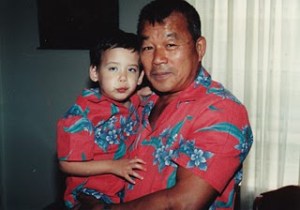
Sewing for me was never about the process. I did it at first in order to have clothes that fit. Then I sewed for my sons lots of adorable little overalls. I made matching Hawaiian print shirts. My dad wore his grudgingly; my sons had no choice. Hey, Magnum P.I. had nothing on MY guys!

My greatest accomplishment in those years was getting the flowers on the breast pocket of each shirt to align perfectly with ones on the shirt front. I was well on my way to pattern obsession by then. And I was the only one who thought matching shirts were cute. The guys merely put up with them as another eccentricity of mine. How twisted was that? My sons equated Hawaiian shirts with motherly love.

Sewing was never fun. Sewing became for me endless rounds of fussing. You press the tissue paper pattern, press the fabric, pin the pattern matching grain lines, cut the fabric leaving seam allowances, pin the seams, sew the seams, *rip the seams, re-sew the seams*, rep from * to * until your fingers bleed and the crooked seam starts to look not that crooked, clip the seams, press open the seams. If there has to be interfacing, lining, zipper or button holes, make that double and triple the fuss. And to top it all off there’s the finishing, hand sewing buttons, tacking down facings, hemming hems.

It’s no surprise that I abandoned sewing once I re-discovered first knitting and then crochet. Gone were the hours of fooling with pre-made cloth and precise, rigid seaming. Crocheted fabric is personal and organic. It can be grown any-which-way through the skill of your hands from balls of yarn, it’s alive. It molds, stretches, breathes and drapes. Eventually I stumbled upon the secrets of out how to coax the fabric to grow, seamlessly, into beautiful garments, the joy of which I share with you in my books and designs.